Just another WordPress.com weblog
Category: “Metamorphoses”
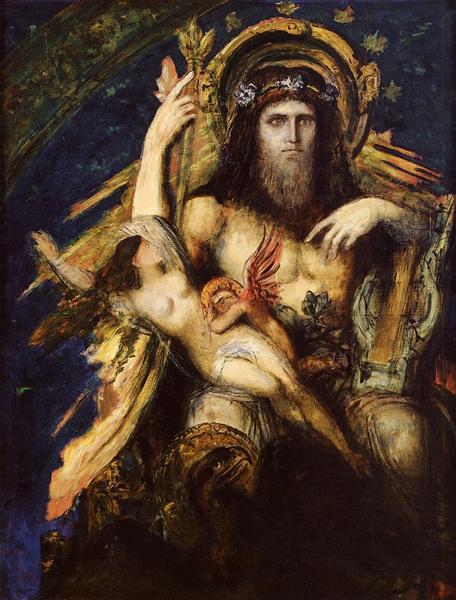
_________ Old Beroe’s decrepit shape she wears, Her wrinkled visage, and her hoary hairs; Old Beroe, faithful servant of Semele
hoary hairs, love it Whilst in her trembling gait she totters on, And learns to tattle in the nurse’s tone. Juno / Hera transforms herself into Old Beroe, tattl[ing], talking idly, in the nurse’s tone, impersonating herin order to seek revenge, if you’ll her husband’s progeny The Goddess, thus disguis’d in age, beguil’d With pleasing stories her false foster-child. foster-child, a child who is fostered,nurtured, by someone other than a parent, Semele , by Old Beroe, purportedly, in this instance false, Juno / Hera is not Old Beroe, but the nurse’s duplicitous, false, in both senses of the word here, double beguil’d, enchanted, amused Much did she talk of love, and when she came To mention to the nymph her lover’s name, Fetching a sigh, and holding down her head, “‘Tis well,” says she, “if all be true that’s said. I thought, meets Sleeping Beauty’s wicked stepmother, for a more contemporary coupling But trust me, child, I’m much inclin’d to fear Some counterfeit in this your Jupiter: Some counterfeit, your Jupiter is notyour [actual] Jupiter, Juno / Hera suggests Many an honest well-designing maid Has been by these pretended Gods betray’d, well-designing, without guile, withno ulterior motive pretended Gods, men who unjustifiablybeat their chest, tell tall tales, unequal to their proclaimed accomplishments But if he be indeed the thund’ring Jove, Bid him, when next he courts the rites of love, Descend triumphant from th’ etherial sky, In all the pomp of his divinity, Encompass’d round by those celestial charms, With which he fills th’ immortal Juno’s arms.”
to ask her lover, when next he courts the rites of love, to prove he is indeedappropriately Encompass’d round , accoutred,enveloped, in the pomp, incidentally, the splendour of his divinity, take on a couple of extra poetic lines, verses, indicative of that very splendour note also that Semele seems to have marital status, about bearing the child of another woman’s man, indeed that of a very, in this instance, goddess, Th’ unwary nymph, ensnar’d with what she said, ensnar’d, ensnarled, caught up in
Desir’d of Jove, when next he sought her bed, To grant a certain gift which she would chuse; Desir’d of, asked of, requested of chuse, choose “Fear not,” reply’d the God, “that I’ll refuse Whate’er you ask: may Styx confirm my voice, Chuse what you will, and you shall have your choice.” forms the boundary between Earth and Titans and been granted by him thatoaths should henceforth all be sworn upon her, and be punctiliously observed his own son Phaeton his wish upon very for both, of consequences “Then,” says the nymph, “when next you seek my arms, May you descend in those celestial charms, And fill with transport Heav’n’s immortal dame.” show me, Semele asks of her suitor, what she gets, what Juno / Hera gets, when next you seek my arms go, girl, I thought, if you’re going to be irreverent The God surpriz’d would fain have stopp’d her voice, But he had sworn, and she had made her choice. on very Styx , he’d sworn, ever so perilously stay tuned R ! chard
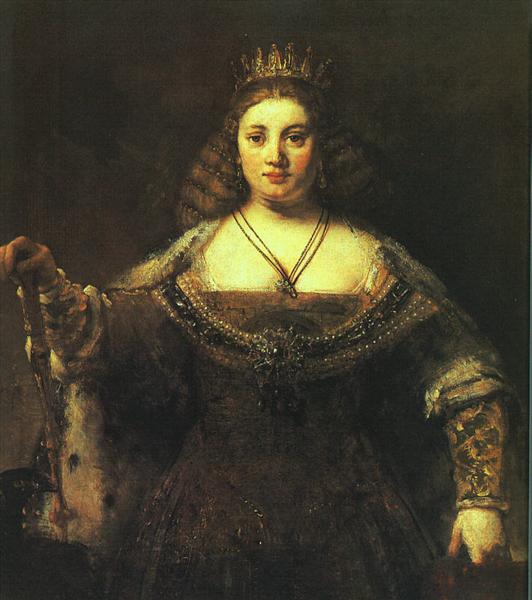
“ Juno ” (c.1662 – c.1665) ______ Actaeon’s suff’rings, and Diana’s rage, Did all the thoughts of men and Gods engage; Some call’d the evils which Diana wrought, Too great, and disproportion’d to the fault: Others again, esteem’d Actaeon’s woes Fit for a virgin Goddess to impose. The hearers into diff’rent parts divide, And reasons are produc’d on either side. remember , not all the gods were on side Juno alone, of all that heard the news, Nor would condemn the Goddess, nor excuse: queen , therefore, of the gods She heeded not the justice of the deed, But joy’d to see the race of Cadmus bleed; For still she kept Europa in her mind, And, for her sake, detested all her kind. Europa had been whisked awayhusband, and borne him several children, to the enduring enmity of the queen of the deities Besides, to aggravate her hate, she heard How Semele, to Jove’s embrace preferr’d, Was now grown big with an immortal load, And carry’d in her womb a future God. philanderer apparently, had now impregnated Semele , youngest daughter of Cadmus , to Juno’s utter disgust and dismay Thus terribly incens’d, the Goddess broke To sudden fury, and abruptly spoke. let me reiterate here that the original gods and goddesses of Olympus had migrated with the Greeks to other areas of the Mediterranean, but became known, in the lands that they’d settled, by other names according to the languages and customs that evolved in these new territories, thus the Greek goddess Hera was in Rome and its outlyingareas known as Juno , the Greek though their home remained for “Are my reproaches of so small a force? ‘Tis time I then pursue another course: about his inveterate philandering, her reproaches were not enough to stop the god from his determined activities she therefore ordains It is decreed the guilty wretch shall die, If I’m indeed the mistress of the sky, If rightly styl’d among the Pow’rs above The wife and sister of the thund’ring Jove (And none can sure a sister’s right deny); It is decreed the guilty wretch shall die. Juno / Hera is not only the wife ofsister, both children of Cronos / were themselves children of the earth goddess Gaia and the sky She boasts an honour I can hardly claim, Pregnant she rises to a mother’s name; While proud and vain she triumphs in her Jove, And shows the glorious tokens of his love: though Juno / Hera did indeed have she is probably no longer here bearing him any, I am supposing, while Semele , proud and vain, now show[ing] the glorious tokens of his love But if I’m still the mistress of the skies, By her own lover the fond beauty dies.” / Zeus the cause of Semele’sdemise This said, descending in a yellow cloud, Before the gates of Semele she stood. / Zeus , would’ve been officiating atthe Cadmeia , the equivalent of theAcropolis , at Thebes , thecity named after her father, its
sparks will surely fly stay tuned R ! chard
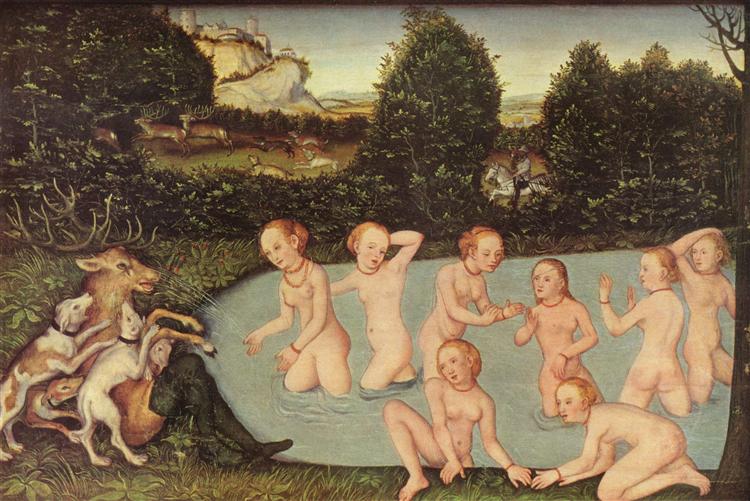
“ Diana and Actaeon “
Lucas Cranach the Elder
____________
Now all undrest the shining Goddess stood, wilder’d in the wood, wandered in the wild, in the forest To the cool grott by his hard fate betray’d, grott, grotto betray’d, treacherously confronted, his hard fate would not be on his side for this one The fountains fill’d with naked nymphs survey’d. survey’d, observed, espied, considered, contemplated The frighted virgins shriek’d at the surprize (The forest echo’d with their piercing cries). listen, you can hear it Then in a huddle round their Goddess prest:
ruddy welkin, red sky, as at sunset And tho’ the crowding nymphs her body hide, These, ’em, the circling waters not a warning here, but a curse, if thou can’st being the operative expression,for Actaeon , now in the process of transformation, will no longer be able to utter words This said, the man begun to disappear begun, began A rising horn on either brow he wears, the skittishness of a deer Transform’d at length, he flies away in haste, how did I do that, Actaeon wonders But as by chance, within a neighb’ring brook, his reflection, however by chance, however inadvertently, in the water, the neighb’ring brook, reveals to himhis transformation, his metamorphosis Wretched Actaeon! in a doleful tone the watry glass, the mirroring rivulet,rill, waterway, brook the association with Bambi here for me is inescapable, however grim might be later Actaeon’s own fate What should he do? Or seek his old abodes, something like the onset of puberty, I think, that frightful fundamental biological transformation, the fear, the shame, remember incidentally, the evidently unforgiving deity before anything but unsullied modesty, before uncompromised chastity, who’s presently, consider, As he thus ponders, he behind him spies op’ning, advancing A gen’rous pack, or to maintain the chace, Or snuff the vapour from the scented grass. or to … Or, either to … Or maintain the chace … snuff the vapour, dogs doing what dogs do He bounded off with fear, and swiftly ran brakes, bracken, brush a ring, a territory, a circumscribed area where once he did pursue, Actaeon had earlier been not the hunted, but the hunter In vain he oft endeavour’d to proclaim had warned, and now [n]or voice nor words the brutal tongue supplies, allows, Actaeon , to speak From shouting men, and horns, and dogs he flies, Deafen’d and stunn’d with their promiscuous cries. promiscuous, unleashed, unconstrained When now the fleetest of the pack, that prest the attack With dropping tears his bitter fate he moans, His servants, ignorant of what had chanc’d, what had chanc’d, the transformation,the metamorphosis, Actaeon become a stag With eager haste and joyful shouts advanc’d, Actaeon seemed to them not there, absent He shook his head in answer to the name; he couldn’t speak, could only [shake] his head He heard, but wish’d he had indeed been gone, gone, away, in another place, as [h]is servants thought him to be Or only to have stood a looker-on. a looker-on, observing rather thanhaving been the centre, the subject of the situation But to his grief he finds himself too near, too near, indeed present, central, in the very thick of the fray And feels his rav’nous dogs with fury tear Actaeon doesn’t survive this transformation, nor is he transmuted, like so many otherswho’d displeased the gods, into sets of stars, or constellations a recurring theme seems to be, as the poem advances, how arbitrary the fate of humans is in the hands of the, apparently capricious, gods to follow
R ! chard
_____ In a fair chace a shady mountain stood, chace, chase a fair chace, not far away Well stor’d with game, and mark’d with trails of blood; Here did the huntsmen, ’till the heat of day, Pursue the stag, and load themselves with rey: rey, probably prey, cause rey is nota word, and ray instead of rey would lead to inanities, improbabilities, lead to hunters, huntsmen, bearing branches, or stalks, of flowers at best, at worst, bolts of light When thus Actaeon calling to the rest:
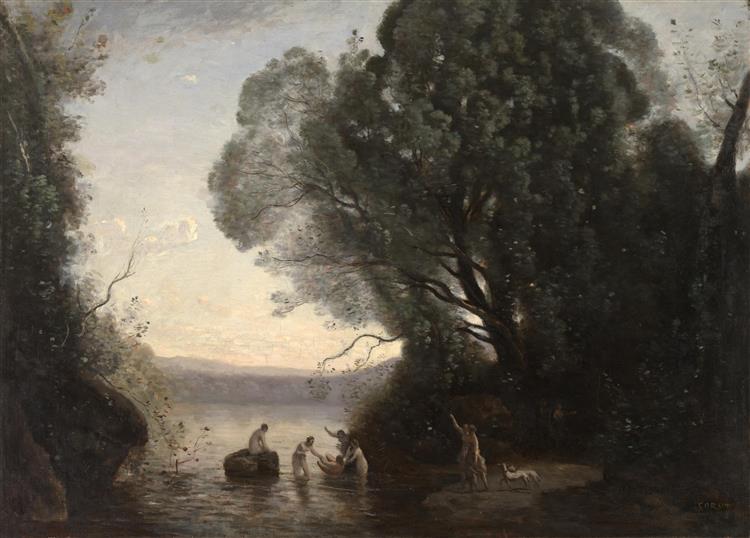
“My friends,” said he, “our sport is at the best, The sun is high advanc’d, and downward sheds His burning beams directly on our heads; let’s take a break, Actaeon says, it’s Call off the dogs, and gather up the toils, And ere to-morrow’s sun begins his race, Take the cool morning to renew the chace.” we’ve gathered sufficient quarry, he continues, let’s wait until to-morrow, for the cool[er] morning , in order to renew the chace They all consent, and in a chearful train The jolly huntsmen, loaden with the slain, Return in triumph from the sultry plain. loaden, laden the slain, the spoils from the hunt Down in a vale with pine and cypress clad, Refresh’d with gentle winds, and brown with shade, The chaste Diana’s private haunt, there stood Diana / Artemis , goddess of the Hunt, Full in the centre of the darksome wood A spacious grotto, all around o’er-grown With hoary moss, and arch’d with pumice-stone.
From out its rocky clefts the waters flow, And trickling swell into a lake below. Nature had ev’ry where so plaid her part, That ev’ry where she seem’d to vie with art. to vie, to contend, to curry forposition, favour Here the bright Goddess, toil’d and chaf’d with heat, Was wont to bathe her in the cool retreat. Here did she now with all her train resort, Panting with heat, and breathless from the sport; Her armour-bearer laid her bow aside, Some loos’d her sandals, some her veil unty’d; Each busy nymph her proper part undrest; While Crocale, more handy than the rest, Gather’d her flowing hair, and in a noose Bound it together, whilst her own hung loose. Five of the more ignoble sort by turns Fetch up the water, and unlade the urns. ignoble, not noble, lacking authority, pedigree, courtly experience unlade, empty an idyll about to unravel stay tuned R ! chard
______ an interesting thing has happened with the story of Cadmus , he is not only a mythical figure, but also a legendary one, which is to say that Cadmus has roots in actual history, he’s not just an imaginary construct like those that until now have peopled Ovid’s text Cadmus appears to have actually founded Thebes , whose origins, however, are lost in antiquity, going back to, it appears, the late Bronze Age , around 2000 BC, goodness stories evidently grew around Cadmus , that transformed him intoour first documented hero, indeed superhero counterparts exist in other traditions, consider David , for instance, whoslew his own dragon, Goliath , before becoming king of the Israelites, 10th Century BCE, at Jerusalem, where he consorted, incidentally, later, with Bathsheba , however illicitly, butthat’s another story King Arthur , late 5th to early 6th Centuries CE , stems from British lore, though his historical actuality has been contested, is also a hero with preternatural capabilities based on some historical accountability in our day, there’s James Bond , based on real, living and breathing, personalities or, dare I say, even Jesus the point here is that actual people are being included in the, however culturally specific, mythologies, which, in each, had earlier consisted of metaphorical constructs merely, the concept of History , in other words, was being born, memorable events were to be remembered, recorded, documented, if only, originally, orally, around, say, campfires, however aggrandized might have been their recollected heroes Cadmus , meanwhile, in our story, is about to establish his own historical, and archeologically confirmed, note, credentials The dire example ran through all the field, The dire example, the dragon’s teeth, grown into men, had begun, if you’ll remember , to slaughter one another
e xample, display The furrows swam in blood: and only five Echion, one of the five survivingbrothers Wisdom, also of War
And with the rest a peaceful treaty makes, the rest, the four other survivors So founds a city on the promis’d earth, promis’d earth, the premonition of the oracles whose counsel Cadmus Here Cadmus reign’d; and now one would have guess’d his exile, from Tyre , Cadmus’ original home, from which his father, Agenor , had sent him, not to return, he’d Long did he live within his new abodes, Ally’d by marriage , at the end of a period of penance for having killed the dragon, which had been sacred to Ares , god of War, the gods gave Concord, to be his wife Ares would eventually exact mightyvengeance, but that’s another story And, in a fruitful wife’s embraces old, even Cadmus , though he might enjoy a long life, and many, a long increase of, children, is not immune to any of the vicissitudes of life either until his own time has come, the poet advises, however ominously and here Ovid also introduces the subject of his next metamorphosis, Actaeon , however early, luring us thereby, deftly, literarily, towards his next instalment, Actaeon’s story, eponymously, there, given its title Actaeon was the first of all his race, Who griev’d his grandsire in his borrow’d face; Condemn’d by stern Diana to bemoan his grandsire, his grandfather, who was the mother of Actaeon
borrow’d face, Actaeon was transformed into a stag by the Hunt, of the Moon, of Chastity, for having seen her naked as she was bathing he now has the face, the visage, of someone, something, he hadn’t been before, borrow’d To shun his once lov’d dogs, to bound away, having been transformed into a stag, or metamorphized, Actaeon would end up hunted, and worse, by his own, once lov’d, dogs And yet consider why the change was wrought, to have been at the wrong place at the wrong time, yet to suffer, however unfairly, the consequences, that, Ovid asks, is the question, the conundrum stay tuned R ! chard
___________ Cadmus beheld him wallow in a flood swimming poison, the venom thedragon had spewed, intermix’d with blood , after Cadmus hadstruck the beast with his jav’lin, When suddenly a speech was heard from high the suggestion here is that the voice is disincarnate, ethereal, otherworldly, from high, not nigh “Why dost thou thus with secret pleasure see, secret pleasure, the self-satisfaction of the soul, unspoken what thou thy self shalt be, a prophecyas cryptic as oracular pronouncements ever tended to be,also ever ominous Astonish’d at the voice, he stood amaz’d, all around, the detritus, the waste, theravages that surrounded him, that Cadmus viewed, gaz’d at, amaz’d … with inward horror When Pallas swift descending from the skies, Pallas, the goddess Athena , of Wisdom,of War, bold and wise patroness, protectress of, among other Greek cities, incidentally, Athens , site of, on her temple Bids him plow up the field, and scatter round we’ve seen this happen before, if you’ll casting the stones, their mighty mother ‘s bones, to replenish, after the flood , theresurgent Earth with people Then tells the youth how to his wond’ring eyes
wond’ring, startled
He sows the teeth at Pallas’s command, And flings the future people from his hand. The clods grow warm, and crumble where he sows; Cadmus is sow[ing] people, future people, however, apparently, military,at the command of the goddess, but Pallas , remember, is goddess of War, these metamorphosizing, ahem, entities would be her progeny, her spawn And now the pointed spears advance in rows; an army – listen , this is how I think Shostakovich would’ve heard it, searing allegretto, a movement he’d initially entitled War before deciding against it you be, and I highly recommend it, into it, a much more convincing, to my mind, production, however significantly extended So through the parting stage a figure rears as each of the teeth develops, grow[s] warm, as each figure rears … and limb by limb appears, men arise, recognizableas such, each in his full proportion Cadmus surpriz’d, and startled at the sight forbear, hold on, desist, stop promiscuous, indiscriminate This said, he struck his brother to the ground, the new foes are slaughtering eachother, Cadmus doesn’t have to lift a finger what’s up stay tuned R ! chard
__________ And now the scorching sun was mounted high, In all its lustre, to the noon-day sky; When, anxious for his friends, and fill’d with cares, To search the woods th’ impatient chief prepares. th’ impatient chief, Cadmus , prince ofTyre , had sen[t] his servants to a neighb’ring grove / F or l iving streams, to thank that god for these new A lion’s hide around his loins he wore, The well poiz’d javelin to the field he bore, Inur’d to blood; the far-destroying dart; And, the best weapon, an undaunted heart. Cadmus here is a precursor of the mythologically later Heracles , orHerakles, or Hercules in Latin, a hero , which is to say descended from the gods, in that latter’s case, very deity who’d just abducted of all Europeans, divine or human Soon as the youth approach’d the fatal place, He saw his servants breathless on the grass; breathless, not breathing,deceased The scaly foe amid their corps he view’d, Basking at ease, and feasting in their blood. The scaly foe, the dragon corps, corpses “Such friends,” he cries, “deserv’d a longer date; a longer date, a longer life, a more extended period of existence But Cadmus will revenge or share their fate.” either [t]he scaly foe will die, the dragon, or Cadmus attempt to avenge his friends, his servants breathless on the grass, he promises Then heav’d a stone, and rising to the throw, He sent it in a whirlwind at the foe: in a whirlwind, taking advantage of a meteorological condition, as one would a kite A tow’r, assaulted by so rude a stroke, With all its lofty battlements had shook; a tower would’ve swayed at so powerful a strike, I rememberan earthquake once rocking my own high rise apartment building for an unnerving moment before settling, returning the ground, my ground, to its, otherwise imperturbable, placidity But nothing here th’ unwieldy rock avails, Rebounding harmless from the plaited scales, That, firmly join’d, preserv’d him from a wound, With native armour crusted all around. native, integral, a constituentpart of With more success, the dart unerring flew, the dart, the javelin Which at his back the raging warriour threw; the raging warriour, Cadmus Amid the plaited scales it took its course, And in the spinal marrow spent its force. The monster hiss’d aloud, and rag’d in vain, And writh’d his body to and fro with pain; He bit the dart, and wrench’d the wood away; The point still buried in the marrow lay. And now his rage, increasing with his pain, Reddens his eyes, and beats in ev’ry vein; Churn’d in his teeth the foamy venom rose, Whilst from his mouth a blast of vapours flows, Such as th’ infernal Stygian waters cast. forms the boundary between the river also, which encircled the entire world The plants around him wither in the blast. Now in a maze of rings he lies enrowl’d, enrowl’d, encircled, surrounded Now all unravel’d, and without a fold; without a fold, an intervening obstacle Now, like a torrent, with a mighty force Bears down the forest in his boist’rous course. Bears down the forest, like a torrent, against the wall oftrees Cadmus gave back, and on the lion’s spoil Sustain’d the shock, then forc’d him to recoil; gave back, drew back, backed away, forc’d … to recoil the lion’s spoil, the dragon’s venom and its gore The pointed jav’lin warded off his rage: the dragon readies for the onslaught, overcoming his, otherwise consuming rage, at the sight of [ t]he pointed jav’lin Mad with his pains, and furious to engage, The serpent champs the steel, and bites the spear, Till blood and venom all the point besmear. But still the hurt he yet receiv’d was slight; For, whilst the champion with redoubled might Strikes home the jav’lin, his retiring foe Shrinks from the wound, and disappoints the blow. the jav’lin is still no match for the, however wounded, dragon The dauntless heroe still pursues his stroke, And presses forward, ’till a knotty oak Retards his foe, and stops him in the rear; retards, stops, inhibits Full in his throat he plung’d the fatal spear, That in th’ extended neck a passage found, And pierc’d the solid timber through the wound. the fatal spear has pierc’d not only th’ extended neck, but alsothe knotty oak behind it, which had prevented the dragon from moving onward toward his escape Fix’d to the reeling trunk, with many a stroke Of his huge tail he lash’d the sturdy oak; ‘ Till spent with toil, and lab’ring hard for breath, He now lay twisting in the pangs of death. ding dong, the dragon is, if not dead, dying stay tuned R ! chard
_______ Cadmus salutes the soil, and gladly hails The new-found mountains, and the nameless vales, And thanks the Gods, and turns about his eye To see his new dominions round him lye; Europa , has , on the advice of thethe lonely cow, / Unworn with yokes, unbroken to the plow had stoop’d, and couch’d amid the rising grass,
vales, valleys Then sends his servants to a neighb’ring grove For living streams, a sacrifice to Jove. Cadmus , a prince, would’ve hada retinue, followers, Hamlet for instance, his Horatio , his Jove , note, is the god who abductedto our story, isn’t yet supposed to know this, never having found his sister, nor identified, consequently, her ravisher, namely Jove , the god to whom Cadmus is now about to give sacrifice, give thanks O’er the wide plain there rose a shady wood Of aged trees; in its dark bosom stood A bushy thicket, pathless and unworn, O’er-run with brambles, and perplex’d with thorn: perplex’d, a wonderful metaphor here for entangled, enmeshed Amidst the brake a hollow den was found, With rocks and shelving arches vaulted round. brake, bracken, brush Deep in the dreary den, conceal’d from day, Sacred to Mars, a mighty dragon lay, Mars , god of War a mighty dragon, dragons, it appears,go back to very prehistory, perhaps dinosaurs, and the like, that made its way into our poetic imagination Bloated with poison to a monstrous size; Fire broke in flashes when he glanc’d his eyes: glanc’d his eyes, threw glances at His tow’ring crest was glorious to behold, crest, as in roosters, or reptiles His shoulders and his sides were scal’d with gold; scal’d, having scales, plates,overlapping surfaces Three tongues he brandish’d when he charg’d his foes; His teeth stood jaggy in three dreadful rowes. rowes, rows, three dreadful ones,one behind the other The Tyrians in the den for water sought The Tyrians, Cadmus and his men,all originally from Tyre
And with their urns explor’d the hollow vault: urns, to collect from living streams within the vault a sacrifice to Jove From side to side their empty urns rebound, rebound, knock against a hardersurface repeatedly And rowse the sleeping serpent with the sound. rowse, rouse Strait he bestirs him, and is seen to rise; he bestirs him, he bestirs himself And now with dreadful hissings fills the skies, And darts his forky tongues, and rowles his glaring eyes. rowles, rolls The Tyrians drop their vessels in the fright, vessels, urns All pale and trembling at the hideous sight. Spire above spire uprear’d in air he stood, Spire above spire, scale upon scale uprear’d, reared up he, the serpent And gazing round him over-look’d the wood: overlook’d, looked over, surveyed Then floating on the ground in circles rowl’d; rowl’d, rolled Then leap’d upon them in a mighty fold. fold , embrace, encirclement Of such a bulk, and such a monstrous size The serpent in the polar circle lyes, That stretches over half the northern skies. The serpent in the polar circle, Serpens ,a constellation in the Northern Hemisphere in close proximity to the North Pole lyes, lies In vain the Tyrians on their arms rely, their arms, their weapons In vain attempt to fight, in vain to fly: All their endeavours and their hopes are vain; Some die entangled in the winding train; the winding train, the serpent’stail Some are devour’d, or feel a loathsom death, Swoln up with blasts of pestilential breath. stay tuned R ! chard
______
When now Agenor had his daughter lost, Europa , his daughter lost He sent his son to search on ev’ry coast; his son, Agenor’s son, Cadmus , Europa’s brother And sternly bid him to his arms restore pious to a crime, intent on, devoted to, having justice restored The restless youth search’d all the world around; amours, loves, trysts, entanglements When, tir’d at length with unsuccessful toil, his angry sire, Agenor , father, sire He goes a suppliant to the Delphick dome; suppliant, supplicant, petitioner, one in search of a favour proclaimed her cryptic prognostications, her famously ambiguous prophecies Delphi , incidentally, was one of several sacred sites in Greece, sanctuaries, open to any Greek, or person who could speak Greek, regardless of geographical provenance, any city-state , for instance then, or kingdom, akin to embassies today, or places where people can expect to find similar political haven Delphi was the destination then also ofpilgrimages, comparable to our own ancient path I dearly would’ve, but never have, unfortunately, undertaken though I did walk to Mission B.C. some several years ago, from my home in Vancouver, to a monastery there, a place of recuperation when I needed one, three days there, and a half, three days and an equal half back, my feet were blistered, I noticed at one point, but hadn’t at all registered any pain, a truth I gathered about the power of intention, one’s very aim can be a salve, a balm, a solace, against any adversity There asks the God what new appointed home where do I land, asks Cadmus , where is my appointed home, my final destination The Delphick oracles, subordinates to Pythia , the high priestess at Delphi
“Behold among the fields a lonely cow, Unworn with yokes, unbroken to the plow; Mark well the place where first she lays her down, There measure out thy walls, and build thy town, And from thy guide Boeotia call the land, In which the destin’d walls and town shall stand.”
Boeotia , a region still of Greece No sooner had he left the dark abode, the Delphick God, Apollo , god ofmusic, dance, truth, prophecy, healing, the sun, light, poetry, among many other things When in the fields the fatal cow he view’d, fatal, fateful gall’d, irritated, frustrated Her gently at a distance he pursu’d; the great Pow’r, Apollo , by way of hisDelphick oracles, the high priestesses, through their counsel, their divinations Her way thro’ flow’ry Panope she took, Panope , plural, were sea nymphs, not places, in Ancient Greece, therefore Cadmus must’ve been crossing water,however flow’ry, I’ll have to check my Latin text for, maybe, inaccuracies inthe translation And now, Cephisus, cross’d thy silver brook; a brook, a stream, anthropomorphized here, which is to say Cephissus , the flow, the waterway, is being addressed as a rational being, I have cross’d t hy silver brook, he says
meanwhile, to brook, to conquer, to overcome, a wonderful, a shimmering, literarily speaking, homonym , which is to say, a word with two faces When to the Heav’ns her spacious front she rais’d, she, the fatal cow, see above , has led Cadmus destination, destin’d place, destiny stay tuned R ! chard
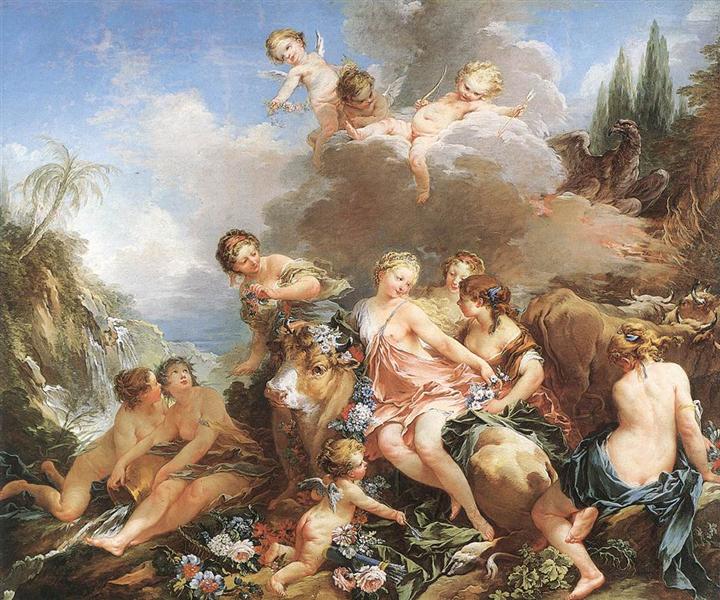
___________ Agenor’s royal daughter, as she plaid Among the fields, the milk-white bull survey’d, an area comprised then of ancient Lebanon , as well as a good part of the Eastern, and later, the Southern, which is to say the African, Mediterranean coasts, father of, notably, Europa , his royal, hisindeed mythic, daughter And view’d his spotless body with delight, And at a distance kept him in her sight. Europa is intrigued, delight[ed], by this milk-white … spotless … bull, but froma distance, discreetly, furtively At length she pluck’d the rising flow’rs, and fed The gentle beast, and fondly stroak’d his head. pluck’d, dared, mischievously, to confront He stood well-pleas’d to touch the charming fair, But hardly could confine his pleasure there. And now he wantons o’er the neighb’ring strand, Now rowls his body on the yellow sand; to wanton, to play, to frolic, often immodestly, like puppies, goats strand, shore rowls, rolls And, now perceiving all her fears decay’d, decay’d, dispelled, dissipated, evaporated Comes tossing forward to the royal maid; Gives her his breast to stroke, and downward turns His grizly brow, and gently stoops his horns. grizly, grizzly, grayish In flow’ry wreaths the royal virgin drest drest, adorned His bending horns, and kindly clapt his breast. ‘Till now grown wanton and devoid of fear, Not knowing that she prest the Thunderer, She plac’d her self upon his back, and rode O’er fields and meadows, seated on the God. however heedlessly, however immoderately, immodestly, however innocently He gently march’d along, and by degrees Left the dry meadow, and approach’d the seas; Where now he dips his hoofs and wets his thighs, Now plunges in, and carries off the prize. The frighted nymph looks backward on the shoar, shoar, shore And hears the tumbling billows round her roar; But still she holds him fast: one hand is born born, borne, held Upon his back; the other grasps a horn: Her train of ruffling garments flies behind, Swells in the air, and hovers in the wind. picture of Europa , more in keeping with the last few lines Through storms and tempests he the virgin bore, And lands her safe on the Dictean shore; Dictean, of Dicte, or Dikti , a mountain range in Eastern Crete , site of the was apparently born, if it wasn’t the Idaean Cave, which is to say a cave on Mount Ida , therefore Idaean, also in Crete , both hollows having claimed the right to be called the site of the exalted provenance Where now, in his divinest form array’d, In his true shape he captivates the maid; longer bull, but divinity, dripping still in bovine potency, however residual Who gazes on him, and with wond’ring eyes Beholds the new majestick figure rise, His glowing features, and celestial light, And all the God discover’d to her sight.
once, to a man who’d bewitched me,how could you touch me, I wrote, you must’ve known you would transfix me, leave me breathless, which he, however inadvertently, had, did I went on, of course, to not populate continents, nor to become queen of instance, before my own exalted entity
R ! chard

 Richibi's Weblog