Richibi’s Weblog

Just another WordPress.com weblog

Category: Johann Sebastian Bach

Piano Concerto no. 5, opus 73, “Emperor” – Beethoven

v1.bTsxMTIxMTMxNztqOzE3ODE0OzEyMDA7MTEyNTsxNTAw

     All About Eve (1950)

            _______

while I’m on the subject of concertos,
there’s one concerto that cannot be 
overlooked, the very epitome of 
concerti, their summit, apex, their 
very pinnacle, Olympus, compared 
to other less mighty compositions,
Beethoven’s Fifth Piano Concerto,
the piece I would take with me to a 
desert island, used to even walk 
along the seashore in the privacy of 
my headphones nights, after dinner, 
taking in its cadences, its wisdom,
under the moon, the stars, along 
the, however temperamental, 
ocean waters, transported 

indeed this very version of it, Glenn
Gould’s, Beethoven’s, in my mind,  
oracular equal

Beethoven made literature out of 
music, progressed to the point of
delivering a very philosophy, 
Gould took the prevailing 
Romantic aesthetic of the time,
Arthur Rubinstein being a prime
example, for instance, and gave 
us the music of the Information 
Age, the mathematical precision 
of computers, people could hear 
it, perhaps not even knowing how,
why

briefly, Gould eschews – Gesundheit
the hold pedal, the sustain pedal, on 
the piano, he’d grown up on Bach, 
made him his specialty, but Bach
had no sustain pedal on his 
harpsichord, Gould transferred this 
process to later, more rhythmically 
malleable, works, making obvious 
thereby their inner workings, 
something like reading blueprints, 
his interpretations give us the bare, 
and revelatory, bones of these later 
masterpieces, without the sometimes 
facile effects of Romanticism, think 
of rubato, for instance, the ability to 
stretch a note, not possible on the 
harpsichord, but often overused in 
Romantic renderings, a cheap trick, 
like paintings on velvet

Gould would have none of that, he
shows you the composer’s 
compositional brilliance, without 
fanfare, just the facts, no pedal, 
which at the time was completely 
revolutionary, much like computer 
science was thenand algorithms 

here’s something else about Gould,
more savourymaybe, he was called 
in at the last minute to perform this
piece when the planned pianist, of 
considerable renown, wasn’t able to 
make it, Gould hadn’t played it in a 
number of years, but showed up the 
next morning to deliver, the rest is,
as they say, history

that’s All About Eve up there, but 
for pianists, Glenn Gould is Eve 
Harrington, though without her
predatory instincts, nobody now 
remembers the other pianist
unless you were there, interested,  
listening, piano’s Margo Channing, 
even if I named himhowever 
consummately accomplished he 
might’ve been, a man I profoundly 
admire, remains, cruelly, essentially 
unremembered 

imagine


R ! chard
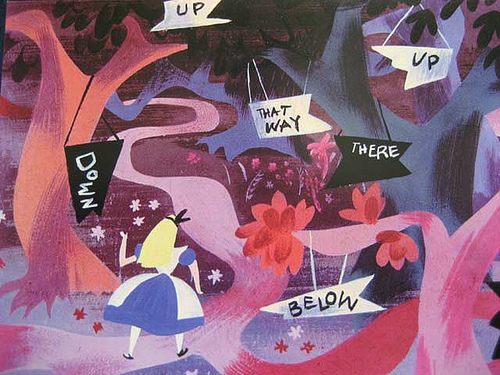
off my top – from Bach to Beethoven

6.jpg

    “Alice in Wonderland” 

             Mary Blair

               _______

when I listen to Bach, I feel like I’m 
on a train – from Leipzig to Dresden, 
say, his territory – the constancy of
his rhythms, modified only by 
accidentals along the way, the 
particular condition of the rails, that 
indeed decorate an otherwise 
monotonous clockwork progression, 
beat upon beat, there is neither an 
increase in volume, which hadn’t been 
formally invented yet as a principal 
musical implement – and I’m only 
partially joking here – the music is 
horizontal, not focused on reiteration, 
but on getting there, accomplishing 
mission, upon which the outcome is
even spiritual – it’s Dresden, I get off 
at the Neustadt Station, am not only 
refreshed but utterly inspired, 
reminded of my position in the world, 
and my place in this novel, but
ordered, and pious, environment 

listen to Bach, his Sonata for Violin
and Piano, B minor, BWV 10141717 
to 1723 approximately, for instance

with Mozart, I get on a merry-go-round,
at a carnival, the clockwork has become 
circular, you can sing the tune, and sing 
it again without a problem, the wooden
horses fly by, one after the other, entirely 
recognizable, though ever magical and
entertaining, but you get off at exactly 
the same untransformed station, 
however delightedly

Mozart’s Sonata for Violin and Piano,
no 18 in G major, K301, 1778, say

with Beethoven, though, it’s like going 
through the looking glass, if you’ve ever 
been through one, the direction is 
horizontal again, you might try singing 
along, but get only so far, until you’re 
utterly confounded, what happened, 
where am I, you wonder, when 
suddenly a Mad Hatter comes along, 
or a Queen of Heartsand speechless, 
you hold onto your seat, it’s 
Disneyland, but without the usual 
safeguards

later, after however many movements,
you’re returned to, if you’ll permit in 
its American transliteration, Kansas, 
from Oz, and Dorothy’s tornado, her 
equally transformational journey, 
safe and wondrously sound, but with 
extraordinary benefits, mystical, 
even transcendental 

but, o my goodness, you think, it’s 
late, I’ve got to get the supper on, 
and, did that really just happen, a 
blip in the order of consciousness, 
a very illumination, a transcendence, 
however secular, however 
non-denominational a take on the 
question of our shared fate, our 
shared humanity, our manifest 
and sublime glories, our profound 
and wrenching tragedies, as 
probing, and indeed as oracular 
as the words of any of the other 
propounding pastors, indeed 
philosophers, then, in a world 
coming to grips with the debate 
around God, and by extension,  
I might extrapolate, my own 
God/dess

for by this time, that had become
a concern, Science, which is to say, 
the Enlightenment, the Age of 
Reasonhad provided a convincing 
counterpoint to the various takes on 
an, even just Christian, Supreme 
Deity, Who’s very viability was up,
in the 18th Century, for grabs

Beethoven provides the first 
personal option, his version of the 
Ten Commandments, for the later
non-denominational ages, our 
souls, our individual agonies, he 
demonstrates, are enough of an 
argument for our unconditional 
salvation, our personal, and 
resplendent souls are not not to
be discounted, their poetry, their 
truth and beauty, are the heaven 
towards which we can existentially 
all aspire, for better, of course, or  
for worse

Beethoven, his Sonata for Violin 
and Piano in G major, no 10
Opus 96, 1812, listen 


R ! chard

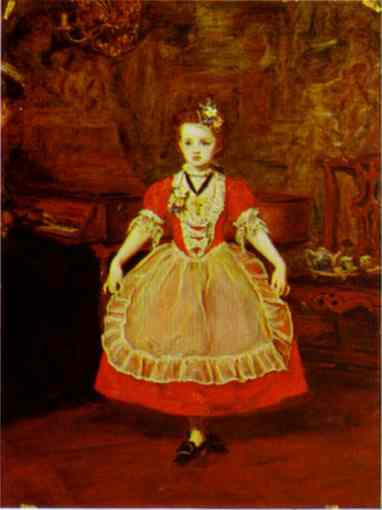
Minuets in G – Bach / Mozart / Beethoven

not_detected_236478.jpg

    The Minuet (1866) 

          John Everett Millais

                  _________

having pointed out that the minuet 
and the waltz were historically 
related, let me somewhat 
extrapolate

they are both in 3/4 time, which is 
to say, three quarter-notes to the 
bar, which means that when 
you’re dancing, your beat is one,
two, three, one two three, with 
the accent, usually, on the first 
note

so what happened, how could two
identical frameworks turn out so 
differently 

here’s Bach, 1725, his Minuet in G
the first thing you’ll think is, o, so
that’s what that is, it is an iconic 
number written on our collective
consciousness

the second thing you’ll notice is
that it is choppy, however delightful, 
that it is written for a harpsichord,
and that it’s probably not ready, 
despite it’s 3/4 time, to be a waltz,
too many curtsies

here’s Mozart, 1762, his Minuet in G
though you might not want to admit 
it, I suspect this number is much
more present in your subconscious
than you’d think, see if you don’t 
find yourself later on humming it

but it’s still way too polite to be a
waltz, you can easily imagine the 
partners, hands held high together
around their imaginary maypole,
courting, but there’s a touch more 
fluidity in the progression of the
notes, it is written for a fortepiano,
an instrument that has added the
hold, or the sustain, pedal to the 
harpsichord to increase a note’s
resonance, a loosening of the 
earlier constraints of that 
quintessentially Baroque 
instrument, a cannily apt 
metaphor, take into account, for 
the unfolding cultural r/evolution

here’s Beethoven, 1796, his Minuet 
in Gyou’ve heard this one too

the Revolution has taken place, 
but entrenched in the music of an
earlier era, the beat remains the 
same, this is not a waltz, despite 
it’s 3/4 progression

you’ll note, however, more spin 
to the cadences, more give, more
elasticity, much of this has to do 
with the development of the 
central instrument, which was 
about to become a pianoforte,
instead of a fortepiano, but 
‘nough said about that, I’ll let 
you feel it

here’s Chopin, 1833, his Grande 
valse brillante, Opus 18, written
for itself, the piano, it is indeed 
a waltz, the difference is in the 
piano’s ever evolving flexibility, 
again a metaphorical expression 
of, or an avatar for, the unleashing 
of personal freedom, an idea spun 
ineradicably from the lessons of
the French, and the, incidentally, 
nearly simultaneous, 1776, 1789, 
American Revolutions

for better or for worse 


R ! chard

“Caprices” for Solo Violin – Paganini

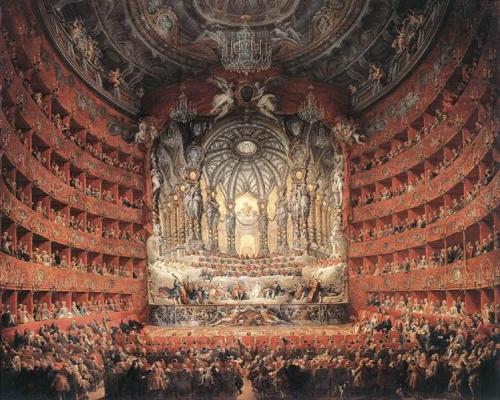
musical-f-te-1747.jpg!Large

    “Musical Fête (1747) 

           Giovanni Paolo Panini

                        ____________

though by now you must be assuming 
that Beethoven had been defining the
entire early Romantic Period all by 
himself, 1803, let’s say, to, say, 1810, 
when Schubert, 13 by then, started 
kicking in, however immaturely, with 
his D1 – D1, note, not D960, over a 
thousand compositions later, a work 
imbued, so early, not unexpectedly,  
with the irrepressible spirit of Mozart, 
and therefore, by thenincidentally, 
audibly outdated – but you would be, 
we would  be, overlooking the extraordinary  
influence of a maverick, a relic of the  
earlier Italian domination of the arts, 
from the Renaissance, at least, on – 
Paganini – the wizard of the 
violin, who’d sold his soul, like Faust,  
to the devil, it was susurrated, for his
extraordinary gift
 
Bach had not only changed the course 
of musical history, in the early 18th
Century, but shanghaied the very 
language of art as oracular expression,
and substituted music as the voice that 
spoke for the people, music will define 
henceforth, for a time, the period
 
there is the Italian Baroque, of course,
utterly masterful paintings, sublime
even, see abovebut it has been 
supplanted in our 21st-Century 
popular imagination by the Baroque 
of the German nations, their music, 
Bach’s, transcendental then, though 
ever so intricate, descriptions of his 
particular epoch 

this dominance will migrate to Paris, 
eventually, and back to art, painting, 
after over a hundred tumultuous, 
and impermeable, years, with the 
Impressionists, in the late 19th 
Century

meanwhile, Paganini will get in the 
way, 1780 – 1840, an exact, more or 
less, contemporary of Beethoven, 
1770 – 1827, and show off what 
Romantics can do, unleashed, 
before a newly enfranchised, and 
thrilled, as you will surely be, 
audience  

watch, be dazzled


R ! chard

psst: the Caprices are essentially
          cadenzas, the improvised solo
          sections in concertos, where 
          instrumentalists get to show 
          off their stuff, and riff, however
          exponentially, on their subject

          Paganini, makes an art form 
          of that, as do others, whom 
          I’ll bring up, trust me, later

          stay tuned


Cello Sonata no 2 in G minor, opus 5 – Beethoven

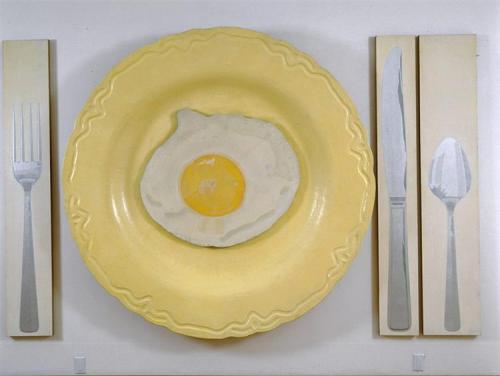
egg-on-plate-with-knife-fork-and-spoon-1964.jpg!Large

   Egg on Plate with Knife, Fork, and Spoon (1964) 

           Alex Hay

              ____

after my somewhat prolonged side trip 
into Bach country, though it is a land
of many more wonders, I’ll get back 
on track, more or less, here, with 
Beethoven’s Second Cello Sonata
the other half of his Opus 5

till then, the cello had served as 
accompaniment, essentially, for other 
more discursive, higher pitched, less 
sonorous, less stentorious  
instruments

but Beethoven puts the cello back 
into the hottest seat in the house, right 
next to the ubiquitous piano, a 
requirement in any instance following 
the neglect of the cello during the 
intervening Classical Period, despite 
Bach’s earlier luminous illustration of 
its incandescent potential

the Opus 5, no 2 starts, audaciously, 
with an adagio, not always a wise 
choice, as you’ve heard me repeat 
here before, it can be unentertaining

but Beethoven gives his adagio tension
by introducing breaks often, which,
rather than stultify, creates momentum,
therefore a narrative, a story to follow

the rhythm is no longer adjusted to 
dance essentially, such a spin as is
heard in the second and third 
movements, for instance, would 
surely sweep one off one’s feet

but the art is in the dance that 
Beethoven allows and creates between 
the piano and the cello, the first the 
filigree on the arm of the more grounded, 
more entrenched latter, the crystal, the 
silverware that adorn, symbolically, an 
however majestic oak table, the creamy
Hollandaise that makes an egg, however 
elemental, irresistible, the literary turns 
that might transform mere prose into, 
verily, poetry, icing on a cake, in a word,  
to complement, in stunning and equal 
cooperation, the inextricable 
counterpart

there is even a moral lesson transmitted
here

Beethoven can often be long-winded, 
I’ve found, but there’s always, always,
at the end of the road something 
entirely worth the extra minute, the 
even several extra minutes 

enjoy 


R ! chard

Cello Concerto no 2 in D major – Haydn

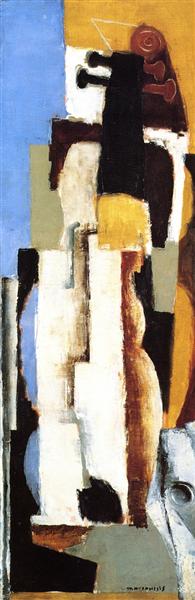
a-cello-1921.jpg!Large

         A Cello (1921)

        Louis Marcoussis

             ___________

between Bach’s transcendent Suites for
Cello and Beethoven’s reinvention of that 
instrument, two only cello works occupy
the last half of that century, both by
Haydn

his Second, however, Concerto, written 
several years later than his First, 1783, 
indeed nearly twenty years later, seems 
to me less accomplished, though ever, 
nevertheless, unimpeachably, and 
impressively, Haydn 

the first movement is long, long works 
only until you start thinking it’s long

the initial melody in the adagio, the 
second movement, struck me as artificial, 
saccharine, though Haydn weaves magic, 
not unexpectedly, still, and  
continuously, around it in its 
development, his elaboration of it

and the pace of the third movement, 
following the second, is disconcerting 
rather than surprising, rather than, 
were it effective, delightful

Mozart wrote a Cello Concerto too, 
apparently, but, if so, it is lost

otherwise we’re on to the next historical
epoch, Beethoven’s, after this inauspicious 
turn at this generation for the cello, lost 
for a while among the more assertive 
instruments of that prim, and proper,
Classical Era


R ! chard

Cello Concerto no 1 in C major – Joseph Haydn

st-george-and-the-dragon.jpg!Large

     “St. George and the Dragon (c.1470) 

                Paolo Uccello

                    ________

it isn’t easy for me to leave Bach behind
whenever I start listening to him, I could 
ride his musical train forever

but the middle of the 18th Century did, put 
him aside, for about a hundred years, until 
Mendelssohn rediscovered him

Bach’s Cello Suites were themselves only 
reinstated in the 1930s by Pablo Casals,
the Classical 18th Century had considered 
Bach too fussy, his pieces, they thought, 
were technical exercises rather than 
actual entertainments, form was  
overtaking, for them, function 

there’s a wonderful book about all this,
The Cello Suites“, written by Eric Siblin, 
a Canadian journalist, which is not only 
amazingly informed and probing, but also 
beautifully written, it holds a place of 
honour on my bookshelf, along with other 
inspired, and inspiring, texts

not only was Bach set asunder, dismissed,
during the Classical Era, but all of the 
formative music also he had written, for 
cello, violin, keyboard, in other words,
the entire curriculum

which, since Bach’s reinstatement, has 
become, paradoxically, the very  
foundation for learning these instruments

imagine playing a tune with the right 
hand, then a few notes later, picking 
it up in the left hand while the right 
hand keeps on going, imagine what
that does to your fingers, never mind  
to your mind, that’s what his Two-Part
Inventions are all about, fifteen of 
them, eight in major keys, seven in
minor, consider the technical 
difficulties, intricacies, imposed 
both compositionally and upon 
the harried performer 

then Bach follows through with his 
Three-Part Inventions to top it all 
off, for the keyboard at least, and 
only for the moment – there’ll still 
be his transcendental Goldberg 
Variations” among other 
incandescent masterpieces – 
wherein one juggles three tunes at 
time, and all of them in the same 
assortment of fifteen contrasting, 
foundational, keys, the “Inventions
 – if you can do that, you’re on your 
way, one would think, to knowing 
entirely what you’re doing

but time marches on, the Classical
Era hits, Haydn takes over, not
unimpressively

the same thing happened in my 
generation to Frank Sinatra via 
the Beatles, not to mention, a little 
later, to either, with Pink Floyd

listen to Haydn’s First Cello Concerto,
note the bravura inherent in the 
composition, this is not Bach’s 
meditative music, the very Romantic 
Period is, through Classical reserve, 
expressing already its imminence, 
individual prowess is taking over 
from community, which is to say 
religious, affiliation, the same way 
the Renaissance artists, Duccio
GiottoFra AngelicoFilippo Lippi
Uccello had stood out, incidentally, 
from their brethren in the standard 
communal art schools dedicated to 
decorating the ever burgeoning 
churches sprouting out in the still
fervent European environment 

musical, though unaristocratic, 
talents, this time, were beginning, 
within German context, to flex 
their decidedly not unimpressive 
muscles, and gaining some 
significant purchase

and who wouldn’t when a Cello 
Concerto would’ve sounded like 
this, listen


R ! chard

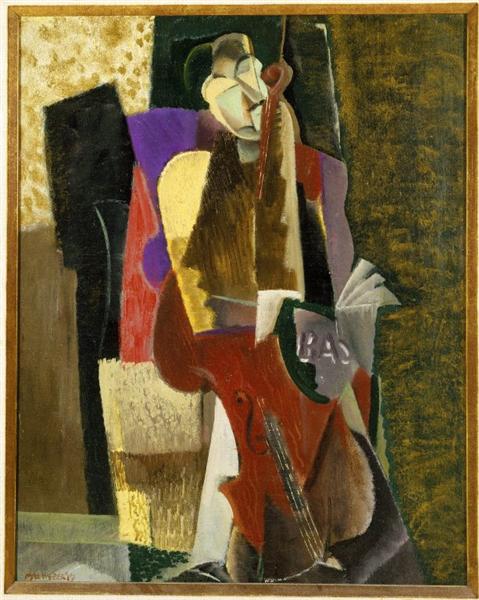
Cello Suite no 5 in C minor – J.S. Bach

the-cellist.jpg!Large

        The Cellist (c.1917) 

              Max Weber

                 ______

what struck me immediately upon hearing
the bow’s very first strokes on the violin in 
this Fifth Cello Suite of Bach was that the 
mood was not only brashly Romantic, but 
quite specifically Russian Romantic, right 
up there with Dostoyevskyand Fiddler 
on the Roof, dark brooding colours at 
first, followed by long plaintive musical 
phrases, you can even hear the sound of 
the steppes, I thought, stretching out into 
the endless distance, this performance,  
surmised, is not, other than 
compositionally, Baroque, not to mention 
not even German 

yet as played by Mischa Maisky, it’s one 
of the best versions of the Fifth I’ve ever 
heard, and if it works, who’s to complain

but more context – Bach never gave not 
only textural indications, but not even 
tempos to his pieces, apart from the 
very dance terms that identify the 
movements, so what, therefore, is the 
specific pace, you’ll ask, of a courante, 
for instance, you tell me, I’ll reply

in other words, the modular terms were 
significantly looser in the early 18th 
Century than later, when metronome 
markings would begin to demand more
accurate replication of the artist’s 
explicit specifications – Beethoven 
especially made sure of that, by 
requiring accurate renderings of his   
mood or pace indications, largo,  
allegro, andante, for instance, still less  
strict than the stipulation later for exact 
musical beats per minute – trying to 
keep pace with a prerecorded tape, for 
example, as in again the industrially 
driven, which is to say emotionally 
indifferent, context of the seismic 
Different Trains“, masterpiece of a 
more technically conditioned era

I don’t think that Bach would at all have
been disappointed that the heirs of his 
fervent, though more genteelcreations 
might’ve morphed into something 
profound for other groups, be they 
national, or of a class, or of even a 
generation, of people, which is to say 
that these works have superseded 
their merely regional intent, and have 
reached beyond space and time, the 
very purview of music, to speak a 
common and cooperative, indeed a
binding, language

I said to my mom the other day that if
we all sang together, we could save
the world


R ! chard

psst: Maisky’s encore,, incidentally, is from  
          the Bourrée” of Bach’s Third Cello  
          Suitenote this contrastingmore  
          courtly – more refinement, more 
      reserve – rendition, you can even 
          hear, not to mention see, in this
          particular instance, not Russian 
          steppes, but European trees on 
          their baronial estates, if you lend  
          an attentive ear

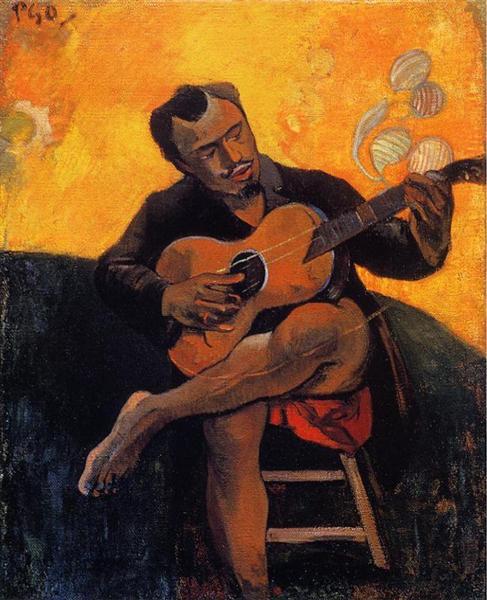
Cello Suite no 4, in E flat (trans. to C for guitar) – Bach

the-guitar-player-1894.jpg!Large

       The guitar player (1894) 

                Paul Gauguin

                    ________

                                               for Daniel, despite his 
                                                               occasional jabs


transcribed for guitar, Bach’s Cello Suite no 4 
becomes an entirely other experience, listen

less transformationally, the original key, E flat,
is transcribed, altered, to the key of C, you 
won’t even notice 

from an introspective, however lively often,
utterance, I hear here, rather, a serenade, 
before a balcony, before the balustrade of 
blushing señorita, demure beneath her 
modest mantilla, quivering behind a  
fluttering matching fan, at the sincerity,  
and artistry of her courter, his 
unadulterated, and utterly vulnerable 
pursuit, an unmistakable expression of 
his devotion, ability, agility, and eventually, 
his worth, which is, incidentally, what art 
is, when achieved, always irresistible, even 
miraculous

plus who wouldn’t surrender everything 
to this guitarist, apart even from his art


R ! chard

Cello Suite no 3, in C major – Bach

narcissus(1)-1.jpg!Large.jpg

        “Narcissus (c.1599)

                Caravaggio

                     ______

what struck me about this most extraordinary
performance of Bach’s Third Cello Suite was 
nothing to do with the Suite itself, but with 
the work of the camera, right out of 
Caravaggio, I thought, a bona fide Baroque
artist also, what could the cameraman have 
known

stark contrasts, an absolute focus on the 
subject without much set decoration, no
consideration for extraneous, though 
perhaps effective, decorative elements 
to cloud the pictorial issue 

this is not at all Bach, incidentally, who 
relies on accompaniment, feeder notes, 
to shed light on the essential melody, 
often even nearly indistinguishable 
from the main statement 

both are considered Baroque, Bach,
Caravaggio, but I won’t be getting into 
it right nowit’s a long, and tortuous 
story

otherwise note, indeed, in Bach, the 
reiteration of clusters of music, forward 
propulsions, with incremental tonal 
variations, moving the melody forward, 
something lost during the later, more 
frivolous, Classical Period, but recovered 
eventually, two generations down, by 
Beethoven, kind of like children resemble 
their grandparents much more than they 
do their actual folks

eventually that becomes Minimalism, see,
for instance, Steve, Different Trains“, 
Reich


R ! chard