Richibi’s Weblog

Just another WordPress.com weblog

Category: concerts to ponder

Divertimento no 17, K334 – Mozart
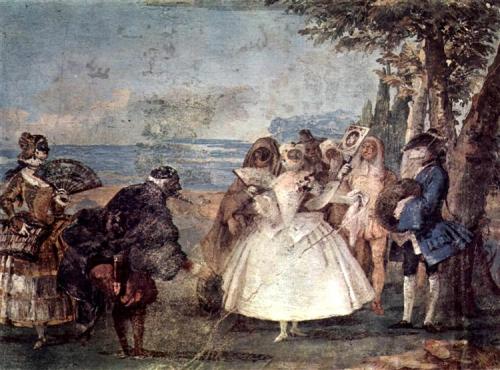
minuet-with-pantaloon-and-colombine-from-the-room-of-carnival-scenes-in-the-foresteria-1757.jpg!Large.jpg

Minuet with Pantaloon and Colombine, from the Room of Carnival Scenes
                                                                                                       in the Foresteria (1757)

     Giovanni Domenico Tiepolo

             ________________

already I can hear you asking, why is
The Seven Last Words“, with its nine
already movements, not a divertimento,
you’ll cry 

a divertimento is an entertainment, it 
doesn’t have the gravitas of Haydn’s 
composition, a sacred work, a 
divertimento is meant to delight

The Seven Last Words“, therefore,
by definition is not a divertimento,
it’s a completely different idea of a
piece with several movements, it 
has profoundly ulterior intentions,
following, rather, in the tradition of
Bach’s oratorios, though it had 
originally been conceived without 
words, the prelate in this work 
would be doing the talking

the piece gives itself a theme, a 
focus, a project, creating something 
like chapters in a book 

or think of the Stations of the Cross 
a metaphorically more apt, perhaps, 
unifying principle, instead of just a 
series of disparate airs, like singles 
were on albums until Pink Floyd 
similarly revolutionized music with 
a topic during my generation, The
Wall, with a little preparatory help
albeit, from the Beatles, earlier,
our friends

here’s Mozart, nevertheless, in order 
to compare, his Divertimento no 17,  
K334giving the aristocracy what 
they still, in 1780, wanted, something 
courtly

you’ll notice there are not just one 
but two minuets in the program, both 
with recapitulations, sure sign that 
we’re still in the Classical Era, though 
the minuet will die off as quickly as 
the divertimento will in the following 
decades, relics, both, of an earlier era

and indeed this is Mozart’s last for 
small orchestra, divertimenti would be 
composed from here on as merely 
tributes to an earlier period and its 
musical formulas

masses and oratorios would go the same 
way, incidentally, with some resurgence 
in the following centuries from a couple 
of Catholic organists who left profound 
influences individually on later centuries

but more about them later

meanwhile, here’s Mozart, feel the 
gentility, his genuflexion to propriety 
rather than to faith


R ! chard
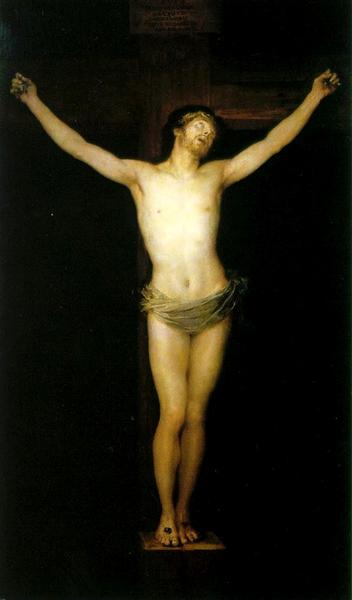
“The Seven Last Words of Our Saviour on the Cross”, opus 51 – Joseph Haydn

crucified-christ-1780.jpg!Large.jpg

                  “Crucified Christ (1780) 

                          Francisco Goya

                                 _______

Haydn’s Opus 51 was commissioned 
for the Oratorio de la Santa Cueva, the 
Holy Cave Oratoryin Cádiz, Spain,
church, as the name suggests, built 
partially underground, it would be
performed, the Opus 51, for the Good 
Friday service of 1787, Haydn therefore 
put his Opus 50 on hold, six string 
quartets, to finish this ecclesiastical 
work on time

what had been required was a work for 
small orchestra to inform the Seven 
Last Words of our Saviour on the 
Cross, it would therefore have at least
segments, movements, and would be 
divided by the elaboration of the 
bishop upon the significance of these 
individual “Words”, or, in fact,
statements, see this example 

Haydn added an introduction, and a 
finale in the form of an earthquake,
quite, I think, wittily and ever so 
appropriately

nearly simultaneously, Haydn 
composed the orchestral 
arrangement for string quartet, and 
later for orchestra and voice, for, in
other words, an oratorio

to my mind “The Seven Last Words 
of Our Saviour on the Cross” is 
Haydn’s crowning achievement, in 
all of its iterations

you’ll note that there is even first of 
all a title, and the title asks for 
something quite specific, indeed 
words, which the composer would
have to render musically, somehow, 
he’d need drama, something of a 
musical narrative, no minuets

all of the movements, apart from 
the end ones, are variations on 
slow – adagio, lento, largo, even 
grave – and how do you keep an 
audience, or in this case a 
congregation, happy, or even 
interested, with seven potentially 
lugubrious adagios in a row, all 
profoundly melancholy

only Shostakovich has managed 
to do that since, which I’ll talk 
about at some point later

Haydn also undoubtedly inspired 
Beethoven here with the 
consequences of so many 
movements, the possibility of 
extending a musical intention
into something resembling,
indeed, a book, a story, the 
introduction of narrative, 
essentially, into our musical 
history, which is to say, music
as literature 

the orchestral version of “The 
Seven Last Words” is performed 
here at the very Oratorio de la
Santa Cueva, the string quartet
version, played not only better 
than I’ve ever heard it played
before, but better even than any 
other quartet I’ve ever heard, 
period, includes the commentaries 
in German by an attendant prelate,
as intended in the original 
composition 

the movements’ “Seven Words” are 
indicated in Latin, not, incidentally, 
the  language of “Our Saviour”, and 
move from “Lord, why have you 
forsaken me” to “If it is Your will, 
then let it be done”

the last version presented here is 
the oratorio, for orchestra and
voice  

all of them, utterly inspiring

listen


R ! chard 

        (to be, incontrovertibly, continued,
         this piece is too loaded with 
         substance, it is transformational)

String Quartet no 22 in G major, opus 17, no 5 – Joseph Haydn

rhythm-1956(2).jpg!Large.jpg

       Rhythm (1956) 

            Bice Lazzari

               ________

before I return to string quartetsand 
Haydn, here’s a divertimento, Mozart’s
First, I couldn’t let it pass, it sparkles 
from the very first instant

Mozart himself confounded his musical
definitions, he called his early string 
quartets divertimenti, before they were 
compiled by his own bibliographer, 
Köchel

notably, however, divertimentos were 
meant to be joyful, light, fluffy, no, in 
other words, adagios

this might create the problem of 
confusing movements, however, that 
have similar tempos, blending one 
indistinguishably into the others, so
that no particular theme stands out,
you leave the show not singing

dance rhythms help that, it’s not too 
hard to tell a jive when it follows a 
tango, or a polka, it’s something in 
our blood

but the more abstract tempos – 
andante, allegro, adagio – as musical 
prompts are cerebral concepts, and 
their airs more suited to singing, not
dancing

from the Baroque suites – sets of
musical dances, gavottes, minuets,
and so on, which were the model
for the string quartets, and indeed
divertimentos of the later 18th
Century – chamber music was 
evolving towards a more abstract 
level of musical conversation

Haydn and Mozart were setting up
the grammar for that, the Classical 
structure, and letting others take 
care of the nomenclature

note that though the performance 
here is electric, the piece, one you’d 
even pay for, you’ll wonder if Mozart 
even changed the music, or was it 
only the rhythms he altered, his 
middle andante wasn’t slow enough 
to make a dent in the general flow, 
the tenor, the mode, the mood of  
the composition

here’s Haydn’s String Quartet no 22,
opus 17, no 5, in G major to compare

though not as crackling as Mozart’s 
Divertimento in this, at least, particular
productionjust listen to what a little 
adagio can do for you, to anchor the 
entire experience in your heart

note also that the second movement 
is still a minuet, a dance step

this will change


R ! chard

Divertimento in G major, Hob.II:1 – Joseph Haydn

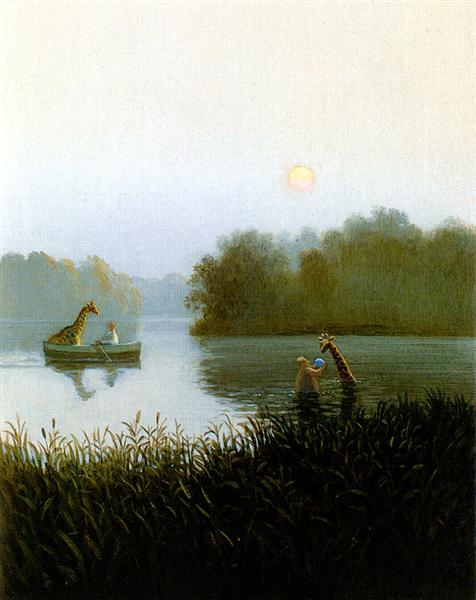
giraffe.jpg!Large

        “Giraffe” 

               Michael Sowa

                        ________

after looking everywhere on the Internet 
for how many divertimenti Haydn had 
written – since I’d given up counting them 
individually from the only list I could find
there, confounding one – I asked Siri
the 21st Century’s Delphic Oracle, whom 
I’d never yet consulted, apart from once 
during a friendly demonstration of her 
prowess

her reply about “divinity minty”, however, 
didn’t lead me anywhere, though 
“divertimento” eventually got me, 
however unsatisfactory, somewhat more 
pertinent answers

regardless, here is Haydn’s very first  
divertimento

a divertimento is quite simply an 
entertainment, an after dinner mint for
the aristocratic set, a place to digest 
one’s fine culinary offerings in the 
same, usually stratified, company
 

nowadays we have supper clubs

when Haydn called his early string 
quartets “divertimenti a quatro”, he
wasn’t kidding, a divertimento could 
be comprised of indeed even a small 
orchestra, or, quite simply, one only
performer, the string quartet as a 
form hadn’t yet been established as 
such, Haydn pulled it, as it were, out 
from under his hat, and gave it status

here’s the short, terse, Divertimento 
in G major, for instance, for, originally, 
harpsichord only, which is to say, just 
one person, but this homemade piano
version will point out already Haydn’s 
musical brilliance – you’ll love the 
giraffe, I loved the coffee cup at the 
bottom of the keyboard

incidentally, Haydn could’ve called 
his Divertimento a piano sonata, 
like Hoboken did, his bibliographer, 
eventually, for the list he compiled 
of the works of Haydn, we know it 
now, therefore, as well, as Haydn’s
First Piano Sonata in G major, 
Hob. XVl:8, same number as for  
the corresponding Divertimento

new terms were popping up, and 
being tested, then just as now, 
like our app, interface, Siriand 
who says compact disc anymore, 
or record

tempus, as we say in Latin, fugit,
time ever is on the wing


R ! chard

String Quartet no 1 in G major, K80 – Mozart

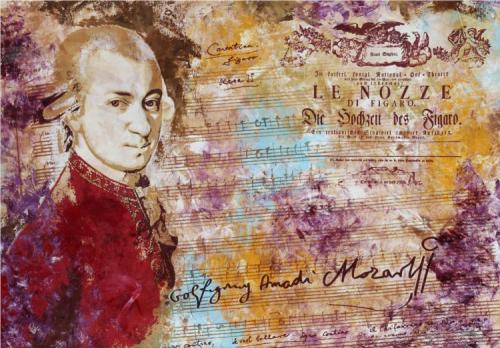
mozart-2015.jpg!Large

        “Mozart (2015) 

             Bernd Luz

                ______

Mozart’s First String Quartet, in G major, K80,
is not at all equal to Haydn’s First, then again
Mozart was only 14 in 1770 when he wrote
it, Haydn in his early thirties when he 
composed his, in the late 1750s

the difficulties are flagrant, first of all, starting 
with an adagio is something to avoid, like
falling into your agonies before even saying
hello, it can be entirely dispiriting for your,
however forgiving, audience

unless, of course, the lament is poignant,
unlike here, I thought

the later movements are emotionally 
nearly indistinguishable from each  
other, despite astute changes in 
tempo, that sufficiently differentiate 
the several parts, but one leaves the 
recital, nevertheless, remembering 
nothing, essentially, though not not  
entertaining, the quartet is not 
memorable

but listen to his first piano concerto, in
D major, K175, called his Piano Concerto
no. 5 for esoteric reasons I won’t get into, 
he was only 17, and already he entirely 
seduces you, leaves you enchanted

he needs the piano, I think, for the lovely 
musical runs up the octaves he invents,
like birds lifting gently, light as air, from 
their branches, soaring, coasting, 
dipping, dropping, finding a nearby 
branch or eave upon which to rest for a 
moment, and cede to the strains of the 
restless orchestral windsand then fly 
off again, irrepressibly, towards another 
part of its musical wonderland

a string instrument can’t do that for the 
sake of the bow, which doesn’t have the 
extension

Mozart never outdoes Haydn at string 
quartets, though he learnt a lot from 
him about them, Haydn never bested 
Mozart at piano concertos  


R ! chard

Symphony no. 15 in a major, opus 141 – Dmitri Shostakovich

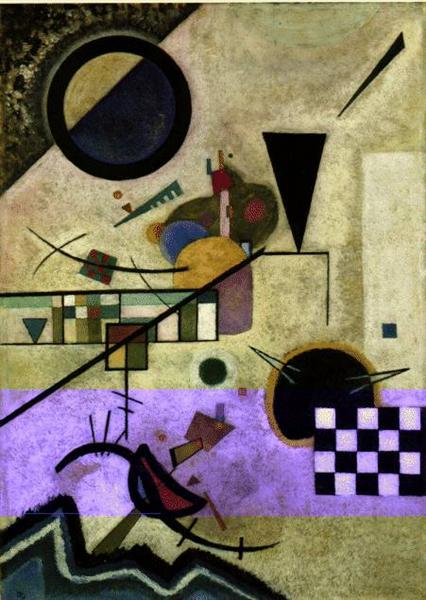
contrasting-sounds-1924.jpg!Large.jpg

        “Contrasting Sounds (1924) 

                Wassily Kandinsky

                       __________

Shostakovich can be difficult, he speaks a
foreign language, discordant notes leave 
you wondering where you’re going

the disruption of the three conditions of
Classical music, tonality, tempo and 
repetition, has given us here, the 
equivalent of derivatives of Latin, you 
don’t understand Italian if you speak 
only French, despite the profound
interconnections, roots

or think of trying even to read 
Shakespeare

also Shostakovich is more literal than 
other composers, his works are intimately
connected with the history and trials 
of his homeland, wrapped in folkloric 
references later cultures and generations 
would not be aware of

one can detect a composer of great 
consequence, like reading Homer in
translation, but never be able to feel 
their local, tribal, force

only a French Canadian could truly 
understand French Canadian, say,  
in hir very atoms, and that, everywhere


there are many references to personal
influences in Shostakovich’s 15th
Symphony, which he viewed, apparently,
as a kind of autobiography – the initial
revolutionary ardour, his profound 
disillusion, the day to day struggles to 
endure the murderous tribulations of his 
political masters, the moral ambiguities  
that would have gone with them, the  
existential crosses to bear – with   
appropriately pertinent quotations from   
other foundational composers

you’ll surely not miss Rossini’s Overture” 
to his opera, William Tell“, which Russians 
would’ve been entirely familiar with, though 
we’re more likely to have known it in North 
America as the theme from the TV show, 
The Lone Ranger

much as we got our Shostakovich, however 
circuitously, from Walt DisneyHanna-Barbera,
if you’ll remember them

and if you think you’ve heard in this symphony 
something you might’ve heard already
Shostakovich quotes himself from his earlier 
symphonies 

and if you’re good, you might even catch 
some WagnerMahler, some, however 
esoteric, Glinka, even

much of it, I’m afraid, now lost to us, in 
this new century, unless we’re total 
nerds

which is where, of course, I take a bow


the first movement was conceived as a 
toy box, it’s disorganized in the manner
of a child discovering

I heard, as well, a drunken degenerate
dancing, or trying to, a bull in a china 
shop 

but in the next movement, a dirge, an
“adagio – largo – adagio – largo”, if 
you’ve ever heard one, the drunken 
lout, in my mind, the next morning 
wakes up, broken but nevertheless
patient, and resilient

with one shoulder to the pillow, he 
props himself up, having understood 
that he must face the day, if only to do
his morning business, with a hand on 
the night table, he braces himself for 
the effort of heaving himself up from
the side of the bed, hears every bone
crack, every muscle stir as he lifts
himself up to a stable posture, tests 
his balance, then turns to move 
forward, crouched under the weight 
of all of his days, towards the basin 
and the mirror, where the picture 
could be better, but could also be 
worse

a blemish there takes up less than
a minute, a residual sense of duty, 
much more than of pride

his business done, the coffee, the 
grinder, the beans, the warmed cup
and then the hour or two to read 
poetry and find the inspiration, to 
undertake the day that’s been 
thrust upon him

he writes his Symphony no 15


the following movements are 
excessive to me, we drown in a sea 
of adagios and allegrettos, a not
unpleasant fate, but more confusing
than entertaining

though I’ll return

I think I might even get to really like
this symphonyit took me years to 
adjust to Kandinsky’s paintings


R ! chard

psst: thanks for listening

Symphony no 14, opus 135 – Dmitri Shostakovich

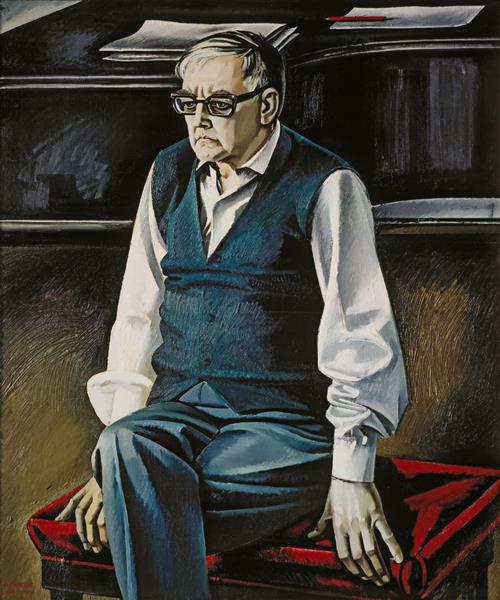
portrait-of-shostakovich-1976-2.jpg!Large

      “Portrait of Shostakovich (1976)

            Tahir Salahov

                   _______

though I’d feared undertaking Shostakovich’s
14th Symphony – it would be a set of eleven
movements, each setting its own poem to
music, poems by Federico García Lorca,
Guillaume Apollinaire, Rainer Maria Rilke,
and one Wilhelm Küchelbecher, translated 
from their respective languages into Russian,
compounded by once again the fact that this
wasn’t either a symphony, but strictly speaking
a song cycle – I found the 14th Symphony to be,
counterintuitively, a triumph, all the issues I’d
earlier listed as compositional misadventures 
– the play of voice and instruments, the dangers 
of using a single singer, one pitch, to anchor an 
orchestral work – had been dealt with expertly, 
all the obbligatos, even, were back, I couldn’t 
wait to hear it again

Schubert had done several song cycles, 
Die Schöne Müllerin“, “Schwanengesang“,
Winterreise“, for instance, sad stories, 
steeped in Romantic torment, not unlike, 
still in 1969, Shostakovich the 14th  

Schubert, though, accompanies with just a 
piano


but a music cycle, without voice this one, 
no poems, just musical ones, of Liszt, his 
Années de pèlerinage“, his Years as a 
Pilgrim, three years, one, two, three,  
1835 through to 1838, travelling through 
Switzerland and Italy, is consummate, 
ethereal, exquisite, and goes on for a  
few utterly enchanting hours 

one New Year’s Eve, I sat before a cozy fire,  
comfortable on my fluffy sofa, cuddled up 
in the several picturesque melodies along 
the musical way, like station stops on a 
train

did the entire trip with him, nearly three 
hours, the music like a sonic looking glass
a hearing glass, a hearing film, not only 
transparent, but transcendental, into  
very wonderland, beyond even its mere 
incidental geography

that’s what art does, and music, when 
you look, listen

enjoy


R ! chard

Symphony no 13 in B-flat minor, opus 113, “Babi Yar” – Dmitri Shostakovich

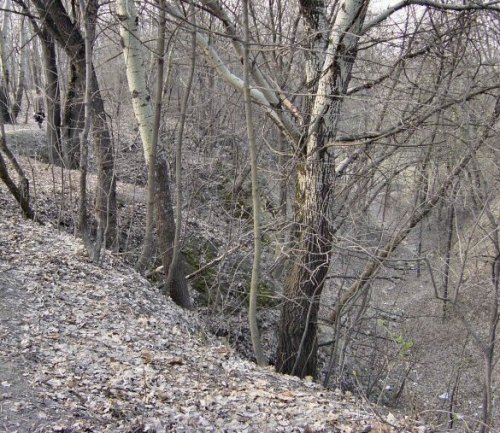
Babi_Jar_ravijn

             the ravine at Baby Yar 

                     ___________

Shostakovich’s Symphony no 13
“Babi Yar”, to me is not a symphony, 
it’s a cantata, a text with accompanying 
orchestra, which is what we have here

does it matter, perhaps not that much, 
but it’s like going to a restaurant where 
you’re looking to enjoy what they’ve 
posted on their website but when you 
get there they tell you they’re out, you 
can only have what they’re serving 

unless it’s sensational, you’re put out 

Shostakovich’s Symphony no 13
“Babi Yar”, is not sensational, not only 
too mired in local history, no matter
how horrid, how very horrid, but too, 
musically, not inspired 

note that with voice to concentrate the
composition, the orchestra becomes
just backdrop, no more of 
Shostakovich’s signature obbligatos, 
that gave distinction and significance 
to individual orchestral players’ lone,
often poignant, complaints

the choice of a bass to anchor the 
enterprise is especially, I think,
unfortunate, like putting all your eggs 
in one basket, that basket lugubrious
and forbidding – I thought of Taras 
Bulba, or Alberich, the gnome in
Wagner’s “Ring”, singing – the jokes in 
the second movement, “Humour”,  
go flat, people wouldn’t laugh, but 
tremble rather before the domineering 
patriarch, oligarch, the composition
needs the grace, the lightness, the 
breath, of a female figure, voice


Bach is famous for cantatas, but what
came up for me was Carl Orff‘s 
incomparable Carmina Burana“,
written in, coincidentally, 1937, from 
medieval texts the composer had 
found, in Latin, describing, in lurid 
lyrics, the spirit of cloistered monks
during the Medieval Era 

you’ll enjoy the translation of the 
Latin into English here, something I 
hadn’t experienced before, giving 
a whole new meaning to the word
“monastery”


R ! chard

Symphony no 12 in D minor, opus 112 (The Year of 1917) – Dmitri Shostakovich

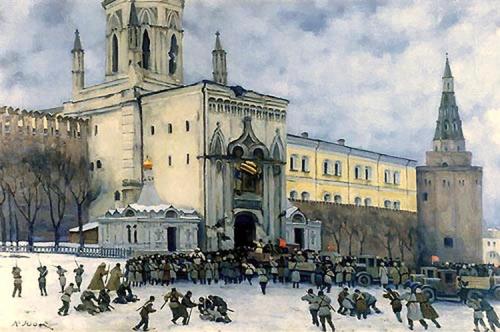
assault-on-the-kremlin-in-1917-1951.jpg!Large

 Assault on the Kremlin in 1917 (1951)

               Konstantin Yuon

                    __________

the Twelfth Symphony of Shostakovich, 
“The Year of 1917”, is a lot more of the 
Eleventh, “The Year 1905”, both 
commissioned, both celebrating 
significant events of the Russian 
Revolution, both therefore steeped in 
references that now elude many who 
aren’t Russian, and certainly those who
generations elsewhere later never lived 
through these particularly local events 

but the Twelfth is shorter by nearly 
half, thankfully, I also found it to be 
unconvincing, plastic, formulaic, 
neither original, nor enthusiastic, 
tedious and uninspired, musically 
speaking, of course

or maybe I’m just getting cranky

also a music honouring a system that 
is now defunct, debunked, discredited, 
couldn’t long survive but historically
among the works of an otherwise 
extraordinary composer, think of 
Confederate monuments still standing 
in the Southern United States, or of 
those of oppressors of First Nations, 
for instance, in our very own Canada, 
though these might’ve been  
sculpted by even Michelangelos,   
an irresolvable cultural confusion,
predicament


the works are programmatic, both 
have titles to indicate a particular
referent, and should be evocative 
of, therefore, those situations, 
music, in other words, for the 
movies, but in these instances, 
without the movie, I’ve talked 
about that before 

all the movements also have titles,
apart from the time signatures, 
adagio, presto, allegro, the like,
the Eleventh, “The Palace Square”, 
“The 9th of January”, “Eternal
Memory”, and “Tocsin”, a warning 
bell

the Twelfth, “Revolutionary Petrograd”,
“Razliv”, “Aurora”, and “The Dawn of 
Humanity”

I couldn’t help but refer to Beethoven’s
Sixth Symphony, the “Pastoral”, to
compare identical musical intentions,
his five movements are “Awakening of 
cheerful feelings upon arrival in the 
countryside“, “Scene by the brook“, 
Merry gathering of country folk“,
Thunder, Storm“, and “Shepherd’s 
song; cheerful and thankful feelings 
after the storm

compare the use of the flute, the 
oboe, the bassoon, Beethoven isn’t 
using any obbligatos yet, solos for 
particular instruments, but you still 
get the feeling of country folk 
dancing, spring taking hold


let me point out that you’ll have to be
patient with the link to the Sixth
Symphony, it’s Japanese, I think, and
will require you to push the arrow in 
the middle of the screen, then wait 
out a few movie ads, which’ll nearly
confound you, but then you’ll get the
best ever Sixth Symphony I’ve ever 
heard, Herbert von Karajan at the 
helm of the Berliner Philharmoniker,
proving why he is still Zeus among
conductors

and his thumbs, goodness, anyone 
with thumbs like that is bound to 
change history


R ! chard

psst: incidentally, Yevgeny Mravinsky 
          was the conductor, equally 
          illustrious, who premiered 
          Shostakovich’s Twelfth in 1961, 
          the same conductor as in the 
          presentation here

Symphony no 11 in G minor, opus 103 (The Year 1905) – Dmitri Shostakovich

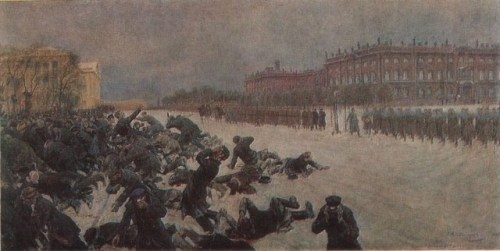
bloody-sunday-shooting-workers-near-the-winter-palace-january-9-1905-1  Bloody Sunday. Shooting workers near the Winter Palace January 9, 1905” 

       Ivan Vladimirov

            ________

if you don’t find a lot to hang on to in
Shostakovich’s 11th Symphony, as I
didn’t, apart from his everywhere
ravishing instrumentation, it’s that 
the piece is a commemoration of a 
particular event in Russian history, 
Bloody Sunday, when the Tsar’s 
Imperial Guard opened fire on a 
crowd of unarmed protestors who 
had come to petition Nicolas ll for 
better work conditions, akinindeed, 
to slavery then, there, January 22, 
1905, the first stirrings, thus, of the 
1917 Russian Revolution, which 
installed the Bolsheviks, Leninism, 
then Stalinism, and so forth

Bloody Sunday can be compared to 
China’s Tiananmen Square, June 4, 
1989it seems totalitarian states will 
blithely resort to such dire measures

Shostakovich had been commissioned 
to write a symphony for the 50th 
anniversary of the event, January 22, 
1955

he’d been reinstated by Khrushchev  
after the death of Stalin, who’d 
excused the tyrant’s condemnation 
of Shostakovich by saying the despot 
had been too subjective, and rescinded 
the law which that earlier ruler had 
imposed requiring all artists to  
conform to party ideology, see Hitler 
again on that one, his proscribed
entartete Kunsthis interdicted
degenerate art

but for personal reasons, Shostakovich 
was unable to compose this new work 
until 1957, the year after the Soviets had 
quashed the Hungarian uprising of 1956
with tanks and ammunition, an event 
too reminiscent of, to the composer, the
earlier tsarist massacre, and horrifying

furthermore, his father had been there,
and spoke of children having been shot 
out of the trees as they merely watched
the proceedings, felled too suddenly, 
apparently, to wipe the smiles off their 
innocent still faces 

the Symphony is called The Year 1905“,
it is mighty, but is too local to effect any
universal understanding, I think, the 
program is too specifically Russian to 
evoke more than historical attention to
an unacquainted observer, listener

I’d visited a church in Rome, Sant’Agnese
fuori le mura, St Agnes Outside the Walls,
once, a place I would not miss were I ever
to return to that illustrious city, before even 
the Vatican, the Coliseum, et cetera, the 
church was built in the 4th Century and 
has weathered the ages, the vicissitudes 
of time, with all their impositions 

the mass was in Italian, however, not the 
Latin that had once united all Catholics
in a common set of sounds that had been
internalized to represent the message of 
the service

but now I could only recognize the form,
no longer the content, something like the 
response a person without the history
of Russia would have here, I would 
contend

this is the dilemma of this, however 
significant, composition, I find

you might also imagine that a tribute to
Canadian soldiers who’d died at, say,
Vimy Ridge, or Passchendaele, might 
not be as moving to someone who    
wasn’t Canadian 


Shostakovich received the Lenin Prize
for his achievement, one of the Soviet 
Union’s most prestigious accolades


R ! chard