allegros – Mozart / Schubert quintets

But now they only block the sun
They rain and snow on everyone
So many things I would have done
But clouds got in my way
I’ve looked at clouds from both sides now
From up and down, and still somehow
It’s cloud illusions I recall
I really don’t know clouds at all
Moons and Junes and Ferris wheels
The dizzy dancing way you feel
As every fairy tale comes real
I’ve looked at love that way
But now it’s just another show
You leave ’em laughing when you go
And if you care, don’t let them know
Don’t give yourself away
I’ve looked at love from both sides now
From give and take, and still somehow
It’s love’s illusions I recall
I really don’t know love at all
Tears and fears and feeling proud
To say “I love you” right out loud
Dreams and schemes and circus crowds
I’ve looked at life that way
But now old friends are acting strange
They shake their heads, they say I’ve changed
Well something’s lost, but something’s gained
In living every day
I’ve looked at life from both sides now
From win and lose and still somehow
It’s life’s illusions I recall
I really don’t know life at all
I’ve looked at life from both sides now
From up and down and still somehow
It’s life’s illusions I recall
I really don’t know life at all”
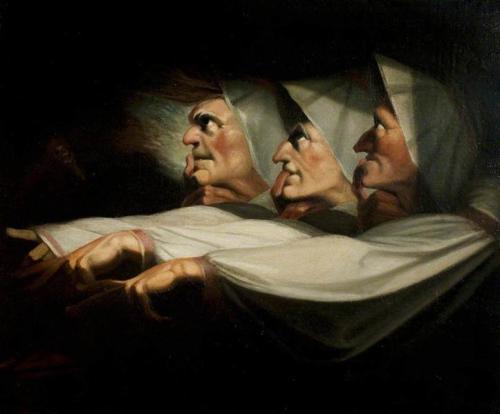
“‘Macbeth’, Act I, Scene 3, the Weird Sisters“ (1783)
_______
if you thought “The Kingdom of Denmark
vs Hamlet“ was fun, you’ll love “The
Kingdom of Scotland vs the Weird
Sisters“, U.S. Supreme Court Justice
Ruth Bader Ginsburg presides, with
the assistance of four other eminent
American judges, over the case in
which the defendants, the witches
who encounter Macbeth, are accused
of concocting the murder of Duncan,
King of Scotland, by that unsuspecting
Thane of Glamis, soon to be Thane of
Cawdor, not only predicting it, but
verily perpetrating it
double, double, toil, indeed, and
trouble, topical allusions fly, pithy,
witty, pungent, delightful late night
comedy fare, but of a more esoteric,
effete order
R ! chard
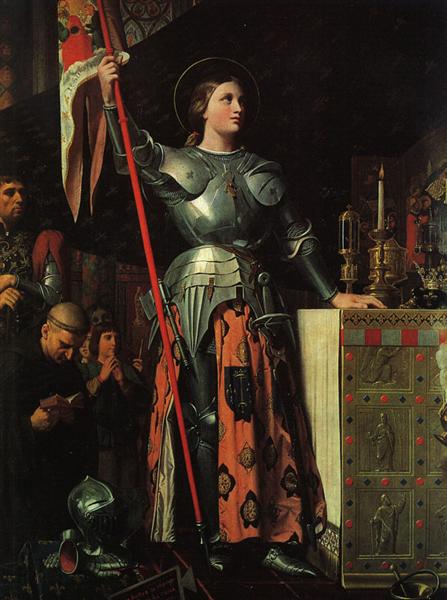
“Joan of Arc upon Coronation of Charles VII in the Cathedral of Reims“ (1854)
____________________
many years ago, while I was volunteering
at our hospital’s palliative care unit, nearby,
recently installed as a response to, among
other pressing preoccupations, but most
urgently then, the AIDS crisis, I was asked
to sit by a lady in profound distress, her
family, Western Buddhists, would go to
lunch while I would sit by her to comfort
her as much as I could
she was dishevelled, of course, completely
disconcerted, all ajitter, lost, and evidently
confused, in her profound isolation, not to
mention in the crumpled state of her
harried bed, unable to communicate, or
reason
I found a chair, sat by her with earnest
concentration, my partner had died
there, only recently, on that very unit,
and I was expressing, to all of those
concerned in his unparalleled care,
my unlimited appreciation
I lay a hand gently upon her arm, to let
her feel, at least, the safety that my
touch could allow, to let it settle on
her, however removed might be her
remaining consciousness, began to
sing quietly a chant I’d been intoning
from a creed I’d turned to for comfort
in my own personal anguish, at the
loss of my own friend, a call, an
invocation, the continuous iteration
of a line that brought solace, Om Nama
Shivaya, I prayed, over and over again,
with the greatest intention, whatever
that phrase might’ve, I’ve forgotten,
meant
she relented, found her space, little by
little she became, as though grace had
descended upon her, calm, by however
infinitesimal degrees, while I continued,
now, my hopeful, helpful, it appeared,
manifestly mystical, intervention
she had become restful, I’d
accomplished essentially, I gathered,
my primary mission, though I
continued, with some sense, perhaps
even a glow, of personal pride, my
soulful incantation
then in a voice not much louder than a
whisper, but much less distraught than
a moan, she began to join in with row,
row, row your boat, tunefully, over and
over again, accommodating herself,
though, naturally, exceedingly weakly,
to my rhythm, I felt I was experiencing,
right there, and then, through the
power of cadence, a miracle
when I looked back, upon hearing
behind me a rustle, standing at the
door was her family, wrapped in
equal consternation
here’s something with someone singing
in several inscrutable languages for
most of us, mostly, words from historical
texts, in Greek, Latin, Olde English,
Japanese, and French, “I Was Born For
This“
that title, of one of the segments of a
longer work, “Journey“, by a contemporary
composer, Austin Wintory, is indeed a
translation of Joan of Arc‘s words on the
cross, “Ne me plaignez pas. C’est pour cela
que je suis née.”, do not pity me, she says,
I was born for this, Joan of Arc, my own
personal Jesus
Shostakovich has an entire symphony,
his 14th, composed of music to
accompany classic poems, all in a
variety of foreign, to him, tongues, but
translated back into Russian for his
purpose in this particular, and not
uncommon, instance, a nevertheless
pointed reference to music as a superior,
more direct, communication – note, here,
the word, communication – it, the 14th,
is profound, extraordinary, read here
first, then listen
R ! chard
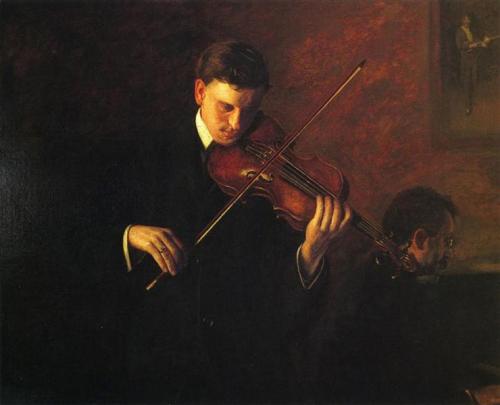
“Music“ (1904)
_______
music cannot lie, when it caresses
you, your very senses on the alert
for what, or what does not, inspire,
from one note to the next, and, of
course, from one sensation to the
other
words are subject to all kinds of
interpretations, visual arts can be
manipulated, tell varying versions
of an, even imagined, event, see,
for instance, Surrealism, with its
distortions as multifarious as the
imagination
but music cannot not tell the truth,
one hears music with one’s senses,
and responds to it with the same
primitive instinct as, nearly, smell,
another powerful truth teller, ask
dogs, or ask “a young man’s fancy“
when it “turns to thoughts of love”,
in spring, there is no surer compass
here’s more Bach, “Capriccio on the
departure of his beloved brother“,
from their family home, a marvel I’ve
recently discovered
do you love it
thanks, sincerely, for dropping by
R ! chard
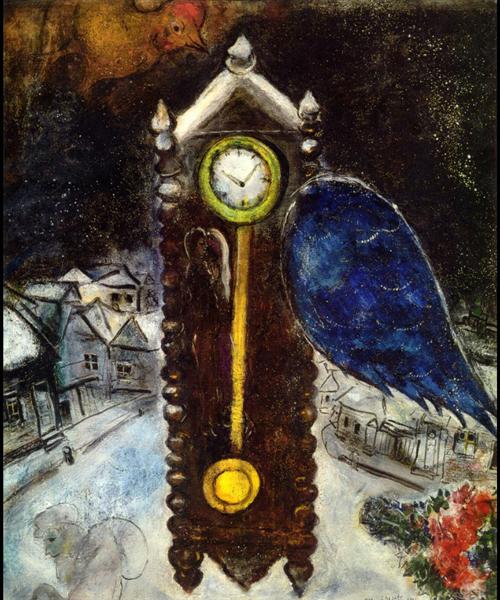
“Clock with Blue Wing“ (1949)
________
with the unruly sleeping patterns of the aged,
mostly, disquieting midnight hours awake,
fretting ever about not enough proper rest,
even though the next day might be fraught,
in retirement, with plenty of time to recover,
I wondered, as such a person, at the
relevance of this semiannual time change,
especially among seniors, those dripping in
time to squander, one day following the next,
often nearly indistinguishably
all it means to me, I said to my mom, is that
I’ll be falling asleep, instead of at two, at three,
in the morning
she hasn’t answered yet
R ! chard
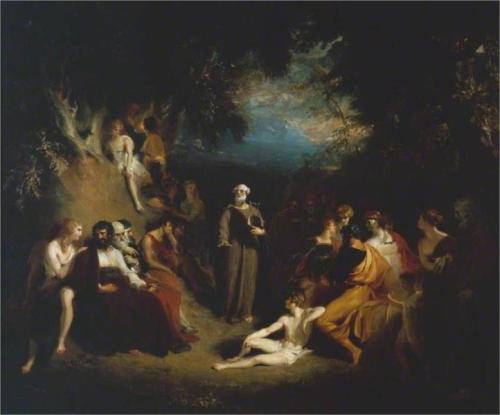
“Homer Reciting his Poems“ (1790)
_________
thanks Collin
hot on the heels of my paean to
Billy Collins, his my favourite
poem of the year, a friend sent
me “Aristotle“, saying, hey, you
might like this, like this, Aristotle
has been my rebuke to Plato for
a while now, latent even in my
least metaphysical speculations
in his poem, Collins goes back
to the earliest definitions of the
structure of literary works as
anticipated, or defined even, by
arbiters who were trying to
understand their place and
function, the poems’, in the
culture, Aristotle’s “Poetics“ is
the very source, 350 BCE, the
diagram, for our understanding,
even in the present age, of what
we mean, in the West, by art,
we’ve been answering him ever
since, it’s genetic
Billy Collins‘ description is not
chronological, it’s poetic,
appropriate to its topic
its structure nevertheless
follows specifically Aristotelian
logic, shedding glory,
coincidentally, on both prophets
for a special treat, listen to the
poet’s audio recording at the
poem’s site – which delivers
even more compelling
information – by clicking the
red arrow pointing right
beside “Aristotle“, the title
R ! chard
___________
This is the beginning.
Almost anything can happen.
This is where you find
the creation of light, a fish wriggling onto land,
the first word of Paradise Lost on an empty page.
Think of an egg, the letter A,
a woman ironing on a bare stage
as the heavy curtain rises.
This is the very beginning.
The first-person narrator introduces himself,
tells us about his lineage.
The mezzo-soprano stands in the wings.
Here the climbers are studying a map
or pulling on their long woolen socks.
This is early on, years before the Ark, dawn.
The profile of an animal is being smeared
on the wall of a cave,
and you have not yet learned to crawl.
This is the opening, the gambit,
a pawn moving forward an inch.
This is your first night with her,
your first night without her.
This is the first part
where the wheels begin to turn,
where the elevator begins its ascent,
before the doors lurch apart.
 Richibi's Weblog