Richibi’s Weblog

Just another WordPress.com weblog

Category: a poem to ponder

“Metamorphoses” (The Golden Age) – Ovid

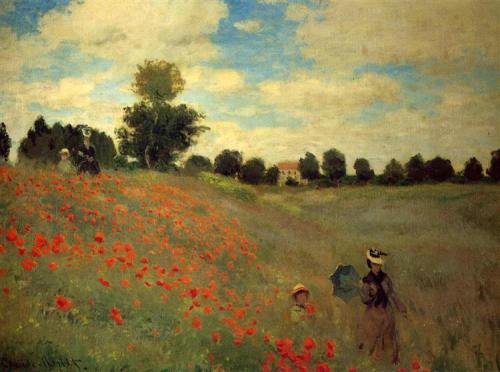
field-of-poppies.jpg!Large

    “Field of Poppies (1873) 


           Claude Monet


               _______


once the Creation is complete, Time 

becomes one of its components, ages, 

or eras, or epochs ensue giving credence 

to the fact of an evolutionary process,

instead of stasis a continuation of the 

inner workings of primordial Chaos still 

roils, bristles, but among more orderly 

elements now 


so that the first age, The Golden Age,

is positively blissful 


             The golden age was first; when Man yet new,
             No rule but uncorrupted reason knew: 


Evil was not yet even a concept 


             And, with a native bent, did good pursue. 


a native bent, naturally, by instinct, inately


             Unforc’d by punishment, un-aw’d by fear,
             His words were simple, and his soul sincere; 


therefore


             Needless was written law, where none opprest: 


where no one offended, laws were 

unnecessary


             The law of Man was written in his breast: 


a function of his emotions


             No suppliant crowds before the judge appear’d,
             No court erected yet, nor cause was heard: 


suppliant crowds, petitioners for justice


             But all was safe, for conscience was their guard. 


remember conscience, something that too

often now has fallen, it seems, by the 

wayside


though we’re a long way off at present, 

admittedly, from the Golden Age


             The mountain-trees in distant prospect please, 


please is a verb here, as in the mountain-trees 

bring pleasure


but


             E’re yet the pine descended to the seas: 


E’re, or before, the pine trees descended, 

grew closer to, gravitated toward, the water


compare here, ” About her coasts, unruly 

waters roar; / And rising, on a ridge, 

insult the shore.”, from earlierwhere 

“water vies with earth for its place upon 

the strand”


instead of water, Earth encroaches here, 

an equally formidable opponent 


             E’re sails were spread, new oceans to explore: 


E’re, or before, ships set out to conquer,

see Columbus for the archetypal example


             And happy mortals, unconcern’d for more,
             Confin’d their wishes to their native shore. 


a world without an economy


             No walls were yet; nor fence, nor mote, nor mound,
             Nor drum was heard, nor trumpet’s angry sound: 


drums and trumpets at any distance 

would’ve been cause for alarm, or at

the very least caution


             Nor swords were forg’d; but void of care and crime, 


note the negative no, nor, nor hammered out

through the last three verses, describing by 

omission the state of the original age, 

what there was not


             The soft creation slept away their time. 


soft creation, not inclined to struggle


             The teeming Earth, yet guiltless of the plough,
             And unprovok’d, did fruitful stores allow: 

             Content with food, which Nature freely bred,
             On wildings and on strawberries they fed; 


the subject here throughout is the “teeming 

Earth”, the Earth, metonymized, becomes 

earthlings – therefore “they” replaces 

“teeming Earth” as subject in the last two 

lines – who’d feed on wildings, uncultivated 

plants, crab apples, for instance, strawberries


             Cornels and bramble-berries gave the rest,
             And falling acorns furnish’d out a feast. 


Cornels, shrubs 


             The flow’rs unsown, in fields and meadows reign’d: 


flowers bloomed unbidden, covering fields


see above 


I watch the cherry blossoms grace our 

streets with their opulence as I speak,

decking our April days with springtime, 

still, even thousands of years later“,

a remnant, a bequest, of that golden 

past 


             And Western winds immortal spring maintain’d. 


like very Paradise, stretching into even 

immortality


             In following years, the bearded corn ensu’d
             From Earth unask’d, nor was that Earth renew’d. 


renew’d, tilled, harvested


             From veins of vallies, milk and nectar broke; 


valleys engender streams that create 

the conditions for milk and nectar


             And honey sweating through the pores of oak.


or our own indigenous syrup of maple


R ! chard


“Metamorphoses” – Ovid, 105

fullsizeoutput_5aa

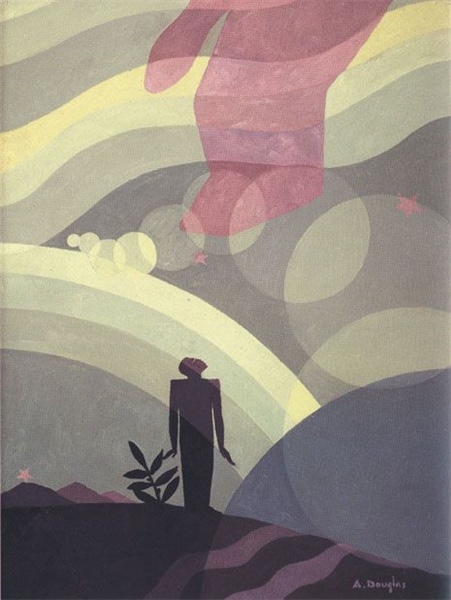
    The Creation(1935) 


           Aaron Douglas


               ________


it should be noted that this exemplary 

translation of Metamorphoses was 

done by a clutch of eminent poets, 

John Dryden principally, England’s 

first Poet Laureate, 1688, but with 

the help of, notably, Joseph Addison,  

Alexander Pope, and William 

Congreve, among a number of 

celebrated others, under the 

direction of the poet and physician,

Samuel Garth, in no later than 1717, 

over 300 hundred years ago


this will explain the sometimes 

disorienting spelling of some 

otherwise common words, you’ve

read alreadyfor instance, extreams” 

for “extremes”“watry” for “watery”, 

“blustring” for “blustering” 


it might also be that my own reading

of the text could be influenced by 

idiosyncratic interpretations given 

by the above poets, who would’ve 

written according to the perspectives 

of their own time, the 18th Century, 

somewhat altering, most likely, the 

pristine intentions of Ovid’s original


as I myself, however philologically 

scrupulously – mea culpa, mea 

culpa, mea maxima culpaI must 

contritely confess – can, can 


be forewarned


but onwards to the completion of 

the Creation


            High o’er the clouds, and empty realms of wind,
           The God a clearer space for Heav’n design’d;
           Where fields of light, and liquid aether flow; 


a description of Heaven, “fields of light and 

liquid aether”


            Purg’d from the pondrous dregs of Earth below. 


“the pondrous dregs of Earth”, our dwelling


             Scarce had the Pow’r distinguish’d these, when streight
            The stars, no longer overlaid with weight,
            Exert their heads, from underneath the mass;
           And upward shoot, and kindle as they pass, 


“the Pow’r”, or “the God, whatever God was he”, 

earlier noted


while gravitation again allows the “fields of light”, 

newly “distinguished”, or separated, from the 

pondrous dregs of Earth“, to “streight…upward 

shoot, and kindle”, or sparkle, like firewood, or 

nebulae, aurorae, very constellations 


             And with diffusive light adorn their heav’nly place.


diffusive, evanescent, aetherial, nearly 

transcendental


             Then, every void of Nature to supply,
           With forms of Gods he fills the vacant sky:
           New herds of beasts he sends, the plains to share:
           New colonies of birds, to people air:
           And to their oozy beds, the finny fish repair. 


note that all life forms are “forms of Gods”,

and “birds”, anthropomorphically, no less

than “people air”

             A creature of a more exalted kind
           Was wanting yet, and then was Man design’d: 


the design follows


             Conscious of thought, of more capacious breast,
           For empire form’d, and fit to rule the rest: 


though the specific initial progenitor will remain 

ever the secret of that Creator


           Whether with particles of heav’nly fire
           The God of Nature did his soul inspire,
           Or Earth, but new divided from the sky


was it “heav’nly fire” or Earth”, which malleable


             And, pliant, still retain’d th’ aetherial energy: 


we are, in other words, quintessentially, 

however muddied, starlight


             Which wise Prometheus temper’d into paste,
           And, mixt with living streams, the godlike image cast. 


Prometheus is the Titan who fashioned 

us of clay, and gifted us with fire despite 

the opposition of the Gods, for which he 

was cruelly punished, but that’s another

story


             Thus, while the mute creation downward bend
            Their sight, and to their earthly mother tend, 


mute creation, species who have no 

language, animals, lizards, insects


             Man looks aloft; and with erected eyes
            Beholds his own hereditary skies. 


hereditary, received from the Creator,

the primordial ancestor, generator


             From such rude principles our form began;
           And earth was metamorphos’d into Man.


R ! chard


“Metamorphoses” – Ovid, 104

the-west-wind.jpg!Large

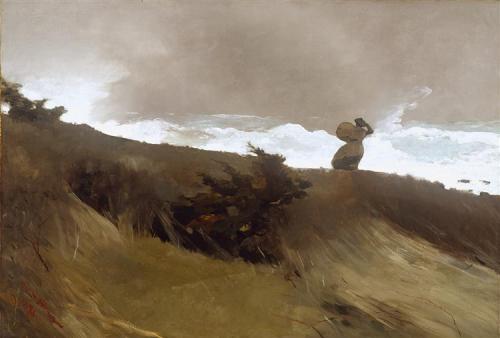
      The West Wind (1891)


            Winslow Homer


               __________


next, the creation of climate 


          And as five zones th’ aetherial regions bind,

          Five, correspondent, are to Earth assign’d: 


the five zones are the equatorial zone, the two 

temperate zones, and the polar zones


          The sun with rays, directly darting down,

           Fires all beneath, and fries the middle zone: 


the equator gets the brunt of it


          The two beneath the distant poles, complain

          Of endless winter, and perpetual rain. 


the poles get the other brunt of it


          Betwixt th’ extreams, two happier climates hold

          The temper that partakes of hot, and cold. 


temper”, as in “temperate”, as in zones


          The fields of liquid air, inclosing all, 

          Surround the compass of this earthly ball:


fields of liquid air, cloud covers


          The lighter parts lye next the fires above; 


fires above, the sun and the stars 


         The grosser near the watry surface move:


“grosser” air, less pure, less aetherial


          Thick clouds are spread, and storms engender there, 

          And thunder’s voice, which wretched mortals fear, 

          And winds that on their wings cold winter bear. 


they gravitate towards the denser earth, creating

conditions “there” for storms, strife, thunder


ever so ominously


          Nor were those blustring brethren left at large,

          On seas, and shores, their fury to discharge: 


blustring brethren, the winds, are not, we learn,  

not apportioned, not not allocated


          Bound as they are, and circumscrib’d in place,

          They rend the world, resistless, where they pass;

          And mighty marks of mischief leave behind;

          Such is the rage of their tempestuous kind. 


tempests, tsunamis, hurricanes


they call the winds 


          First Eurus to the rising morn is sent

          (The regions of the balmy continent);

          And Eastern realms, where early Persians run,

          To greet the blest appearance of the sun. 

          Westward, the wanton Zephyr wings his flight;

          Pleas’d with the remnants of departing light: 

          Fierce Boreas, with his off-spring, issues forth

          T’ invade the frozen waggon of the North.  


where we encounter, incidentally, aurorae borealis


          While frowning Auster seeks the Southern sphere;

          And rots, with endless rain, th’ unwholsom year.


it is to be noted that in 8 AD, when Metamorphoses 

was purportedly first published, one gathers from 

the text that the world was understood to be 

spherical, with two poles, the boreal and the 

austral, from which we later get the eponymously 

named Australia 


the world went flat, note, only later in the 

Middle Ages


R ! chard 


“Metamorphoses” – Ovid, 102

to-be-titled.jpg!Large

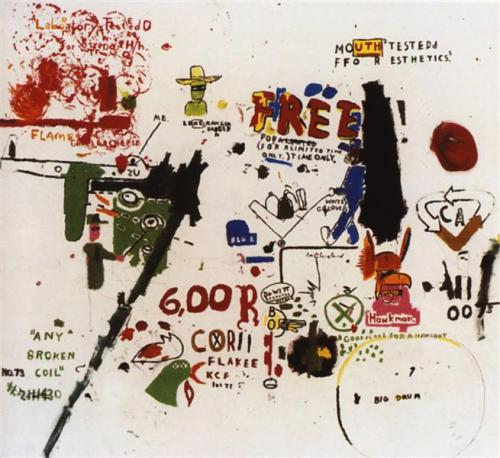
   To Be Titled (1987) –


          Jean-Michel Basquiat


                     __________


next, according to Ovid, inspired, presumably,  

by the Gods, is what happens before the world 

is created


        Before the seas, and this terrestrial ball, 


which is to say, the earth


        And Heav’n’s high canopy, that covers all,

        One was the face of Nature; if a face:


the “face of Nature” was “One”, an 

indistinguishable, perhaps not even, “face”


        Rather a rude and indigested mass:

        A lifeless lump, unfashion’d, and unfram’d,

        Of jarring seeds; and justly Chaos nam’d.


this undifferentiated agglomeration, this “lifeless 

lump” was called Chaos


note the “seeds”, however, potential, though 

“jarring”, or conflicting, the genesis for what 

is to follow   


           No sun was lighted up, the world to view;

           No moon did yet her blunted horns renew:


the horns of the moon are visible when the 

crescent moon lies flat on the horizon, in 

the shape of a smile, presenting “horns”, 

the twin elevated extensions


           Nor yet was Earth suspended in the sky,

           Nor pois’d, did on her own foundations lye:


or lie


           Nor seas about the shores their arms had thrown;

           But earth, and air, and water, were in one.


see again Chaos here


           Thus air was void of light, and earth unstable,

           And water’s dark abyss unnavigable.

           No certain form on any was imprest;

           All were confus’d, and each disturb’d the rest.

           For hot and cold were in one body fixt;

           And soft with hard, and light with heavy mixt.


next, the first metamorphosis


stay tuned


R ! chard


on love – “Nature Boy”

99_9

    unidentified


       _______


                               for Danielle and Joe


a few nights ago, friends came over, a 

young couple, in the bloom of youth,

relatively speaking, half, approximately, 

my age, I’m seventy, for a glass of wine


during a conversation about the many

knickknacks scattered about my 

apartment, pictures, paintings, 

assorted paraphernalia, memorabilia,

they asked, was there one piece of 

information I could give them, 

something not just physical, but 

metaphysical, that could lead to a  

good and meaningful life


after cautioning that any answer would

be way too complex, the question way 

too broad, I nevertheless trotted out, 

convivially, a few words of ready 

wisdom, a couple of trusted and true 

maxims I hold in store for such 

occasions, personal precepts, 

however seemingly flippant, I 

faithfully and diligently live by


pray for grace, for instance, make sure 

your tie’s on right, the only two 

practicable positions in any 

predicament, I’ve found


later, after privately thinking more 

about it, I realized there is indeed a 

specific answer, I’d been singing it 

already for a while, to help me deal 

with recent, and even accumulated, 

loss, it is the punchline to this 

wonderfully enchanted 

composition, called Nature Boy


      the greatest thing you’ll ever learn,


it knowingly advises 


      is just to love, and be loved in return 


words eminently worth retaining


listen


R ! chard


“Death is nothing at all…” – Henry Scott Holland

St_Paul's_by_Thomas_Hosmer_Shepherd_(early_19th_century)

     “St Paul’s Cathedral 


           Thomas Hosmer Shepherd


                          _____________


upon learning of the recent demise 

of my younger sister, my only sibling,

a friend sent me the following passage


    “Death is nothing at all. It does not count. I have only slipped away 

     into the next room. Nothing has happened. Everything remains 

     exactly as it was. I am I, and you are you, and the old life that we 

     lived so fondly together is untouched, unchanged. Whatever we 

     were to each other, that we are still. Call me by the old familiar 

     name. Speak of me in the easy way which you always used. Put 

     no difference into your tone. Wear no forced air of solemnity or 

     sorrow. Laugh as we always laughed at the little jokes that we 

     enjoyed together. Play, smile, think of me, pray for me. Let my 

     name be ever the household word that it always was. Let it be 

     spoken without an effort, without the ghost of a shadow upon it. 

     Life means all that it ever meant. It is the same as it ever was. 

     There is absolute and unbroken continuity. What is this death 

     but a negligible accident? Why should I be out of mind because 

     I am out of sight? I am but waiting for you, for an interval, 

     somewhere very near, just round the corner. All is well. Nothing 

     is hurt; nothing is lost. One brief moment and all will be as it was 

     before. How we shall laugh at the trouble of parting when we 

     meet again!”


it is usually presented as a poem, but 

was part of a sermon, rather, given by 

Henry Scott Holland, the very pastor 

who composed it, at St Paul’s 

Cathedral, in London, after the death 

of Edward Vll


listen


it expresses well the experience I’ve

had with others of my beloved 

departed


intimations of my sister are already 

popping up in my reality, soon, I told 

another friend, I’ll be talking to her 

more often than when she was not 

gone


much as is the case with my father, 

for instance, away some 30 years 

now, but an abiding presence, 

however mystical, still, and, 

it appears, forever


I consider myself profoundly 

blessed


R ! chard


on ego, in particular, mine

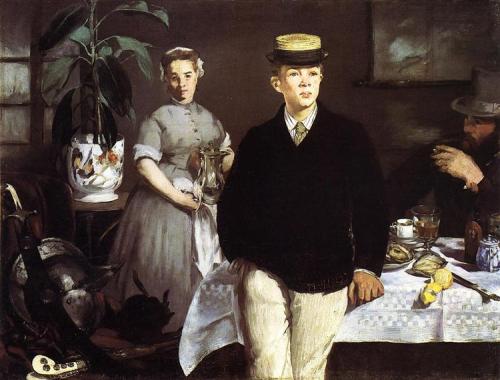
luncheon-in-the-studio-1868.jpg!Large

       “Luncheon in the Studio (1868)


                 Édouard Manet


                      _________


you think I’ve got a big ego, I asked
friend who’d just told me I had one,
not confrontationally 
but as a matter
of fact, I wasn’t offended, just curious,
I think I’m so humble, I answered,
usually, so deferential

she wouldn’t cede to my, to her,

manifestly improbable, argument 


what do you call ego, I asked


what the definition is in the dictionary,

she answered, and pulled out her cell

phone to prove it


sure, I said, I know what the dictionary 

says, but how does that apply to me


well, just what it says, she said


my mother reads in the paper that it’s

going to rain today, I said, then it 

doesn’t, and I retort that only the 

weather essentially knows about the 

weather, but she still keeps to the

prognostications


one night I said, look, mom, the moon 

is full, no, she answered, it’s a quarter 

moon, it said so on the calendar, look, 

I said again, it’s full, it’s a full moon, 

but she wouldn’t believe me, it turned 

out she’d been reading the previous 

year’s almanac 


print gives us Platonic ideals, standards

that we think definitive, I asserted, but 

everything is in the eye of the beholder, 

words are just approximations, nothing 

but meeting places where we toss around

disparate ideas no firmer, nor distinct,  

nor assured than conversations among

different languagesmiscommunication 

can be that wide 


my friend tells me just talking like that

is proof of my big ego, but I still don’t 

get it, I think I’m so courteous, 

fundamentally, so congenial and, you

know, nice, otherwise 


R ! chard


the conditional

if-once-you-have-slept-on-an-island-1996.jpg!Large

    “If Once You Have Slept on an Island (1996) 


           Jamie Wyeth


               ________


the conditional mood is easy, it always

follows if 


     if I had a hammer, for instance


or


     if I were a rich man


it is not a real event, as Classical 

representation would be in art, were I

to make that synesthetic juxtaposition,

which is to say, were I to replace the 

visual sense with that of letters, but

rather like Surrealismfor instance, 

in that other context, a superimposed

idealization


here’s a poem you’ve probably 

already heard, or heard of, through 

its final, and epochal, verse, Kipling’s

If“, a towering instance of moral 

suasion on our culture


       If you can keep your head when all about you

           Are losing theirs and blaming it on you,   

       If you can trust yourself when all men doubt you,   

            But make allowance for their doubting too;  

       If you can wait and not be tired by waiting,

          Or being lied about, don’t deal in lies,

       Or being hated, don’t give way to hating,

           And yet don’t look too good, nor talk too wise:


        If you can dream—and not make dreams your master;   

            If you can think—and not make thoughts your aim;   

        If you can meet with Triumph and Disaster

           And treat those two impostors just the same;   

        If you can bear to hear the truth you’ve spoken

          Twisted by knaves to make a trap for fools,

        Or watch the things you gave your life to, broken,

           And stoop and build ’em up with worn-out tools:


      If you can make one heap of all your winnings

            And risk it on one turn of pitch-and-toss,

      And lose, and start again at your beginnings

           And never breathe a word about your loss;

        If you can force your heart and nerve and sinew

          To serve your turn long after they are gone,   

       And so hold on when there is nothing in you

          Except the Will which says to them: ‘Hold on!’


        If you can talk with crowds and keep your virtue,   

           Or walk with Kings—nor lose the common touch, 

        If neither foes nor loving friends can hurt you,

            If all men count with you, but none too much;

        If you can fill the unforgiving minute

           With sixty seconds’ worth of distance run,   

        Yours is the Earth and everything that’s in it,   

           And—which is more—you’ll be a Man, my son!


in the spirit of juxtaposition, compare 

that to Polonius’ admonition to his son,

Laertes, upon that young colt’s imminent 

return to France, where he had earlier

been, reputedly, carousing


       Yet here, Laertes! aboard, aboard, for shame!

       The wind sits in the shoulder of your sail,

       And you are stay’d for. There; my blessing with thee!

       And these few precepts in thy memory

       See thou character. Give thy thoughts no tongue,

       Nor any unproportioned thought his act.

       Be thou familiar, but by no means vulgar.

       Those friends thou hast, and their adoption tried,

       Grapple them to thy soul with hoops of steel;

        But do not dull thy palm with entertainment

        Of each new-hatch’d, unfledged comrade. Beware

        Of entrance to a quarrel, but being in,

        Bear’t that the opposed may beware of thee.

        Give every man thy ear, but few thy voice;

         Take each man’s censure, but reserve thy judgment.

         Costly thy habit as thy purse can buy,

         But not express’d in fancy; rich, not gaudy;

         For the apparel oft proclaims the man,

         And they in France of the best rank and station

         Are of a most select and generous chief in that.

         Neither a borrower nor a lender be;

         For loan oft loses both itself and friend,

         And borrowing dulls the edge of husbandry.

         This above all: to thine ownself be true,

         And it must follow, as the night the day,

         Thou canst not then be false to any man.


from Shakespeare’s “Hamlet”act 1, scene 3,

all, incidentally, in the imperative, the mood

of command, authority, however consequential

there, or not


 a film called “If…” is also worth visiting 

in this context, from the 1970s, with an 

iconic soundtrack that gripped the

generation then that heard it, listen,

watch, the Missa Luba, be gripped


R ! chard


a juxtaposition of verb moods


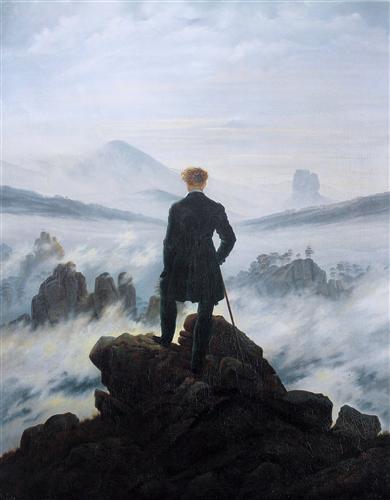
       the-wanderer-above-the-sea-of-fog.jpg!Blog.jpg

           The Wanderer above a Sea of Fog (1818) 


                   Caspar David Friedrich


                         _______________


a cardinal rule, the juxtaposition of two 

things of the same sort will exponentially

increase the information gleaned of either


therefore the following


The Impossible Dream“, listen 


       To dream the impossible dream

       To fight the unbeatable foe

       To bear with unbearable sorrow

       To run where the brave dare not go


       To right the unrightable wrong

       To love pure and chaste from afar

       To try when your arms are too weary

       To reach the unreachable star


       This is my quest, to follow that star

       No matter how hopeless, no matter how far

       To fight for the right

       Without question or pause

       To be willing to march

       Into hell for a heavenly cause


        And I know if I’ll only be true

       To this glorious quest

        That my heart will lay peaceful and calm

        When I’m laid to my rest


        And the world will be better for this

        That one man scorned and covered with scars

         Still strove  with his last ounce of courage

         To fight the unbeatable foe

         To reach the unreachable star


and Climb Every Mountain, listen again


        Climb every mountain

        Search high and low

        Follow every byway

        Every path you know


        Climb every mountain

        Ford every stream

        Follow every rainbow

        ‘Till you find your dream


        A dream that will need  

        All the love you can give

        Every day of your life

        For as long as you live


        Climb every mountain

        Ford every stream

        Follow every rainbow

        ‘Till you find your dream


        Climb every mountain

        Ford every stream

        Follow every rainbow

        ‘Till you find your dream


an initial similarity, they are both

inspirational


an initial divergence, the former is 

in the infinitive mood, which is to 

say that the lesson is for all time

in all places and for all people, 

while the second is an imperative,

in other words, an exhortation,

something only pertaining to the 

future, though the other conditions,

of place, and of person, can still 

apply  


note that the verse, in either, is in 

the indicative, in keeping with, in

each, the altered air, the second,

and contrasting melody, which in

both, note, personalizes, makes

the recommendation actual, no

longer merely idealized, the

indicative is the only mood which

deals in facts, the other moods

are all imagined, dreamed


let me point out that in comparison

with songs in the indicative, love

songs and the like, the show tunes

above find their source in medieval

religious music, hymns, liturgical

stuff, and more recently,

comparatively, specifically in

England after the Protestant

Reformation with Handel’s both

church and ceremonial music


in which England went on to

specialize, incidentally, while other

forms of music there, the racier,

secular European stuff, had been

demonized, deemed sinful, and

thus proscribed


England would only get its mojo back

in the 1960s with the Beatles


R ! chard


the infinitive in Shakespeare’s “To be, or not to be”

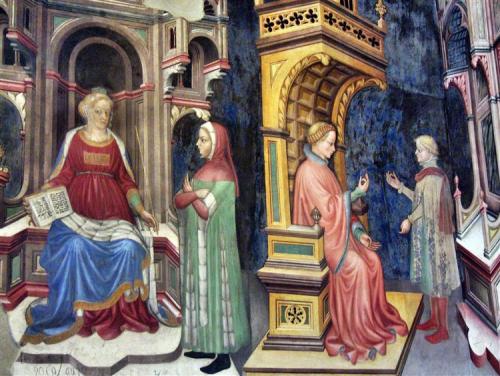
philosophy-and-grammar.jpg!Large

     Philosophy and Grammar 


           Gentile da Fabriano


                  __________


when I referred to Shakespeare’s 

perhaps most famous monologue,

To be, or not to be, in my most 

recent transmission, in order to 

shed light on the idea of tempi, 

that it would parallel Beethoven’s

Opus 111 in its philosophical 

significance, however might’ve I 

done so unintentionally, I was

nevertheless quite spot on, it is

perhaps his most potent

disquisition, as is Beethoven’s

own masterpiece, on existence


but let me extrapolate


to be, or not to be, both infinitives,

which is to say that their form, their 

moodrelate to infinity, the infinite, 

etymological correlatives, which 

means that the actions, thus, are 

not localized, not specific, but 

belong to all places at all times and

for all people, the very stuff, let me

point out, of philosophy 


whether ’tis nobler in the mind to 

suffer, infinitive, the slings and 

arrows of outrageous fortune, or 

to take, infinitive again, arms 

against a sea of troubles, and by 

opposing end, bare infinitive,

which is to say, without the

preposition to, them  


as in  


to die, to sleep, infinitives, no more, 

and by a sleep to say, infinitive, we 

end the heartache and the thousand 

natural shocks that flesh is heir to, 

’tis a consummation devoutly to be 

wished, passive infinitive      


you’ll find that the rest of the 

soliloquy abounds in infinitives,       

the grammatical home, the 

territory, of philosophy


with this speech, incidentally, 

Shakespeare kicks off, in

literature, the Renaissance, much

as Beethoven with his Opus 111

firmly establishes, in music, the

Romantic Period


compare, meanwhile, thou shalt 

not kill, an imperative, the mood

the tenor, the register, is of 

commandments, it differs from 

the infinitive in that, though 

seemingly universal at first, there 

is an exception to its authoritative 

span, and that exception is the 

speaker, all others are called upon 

to abide, this is not philosophy, 

this is power 


much as in music, see in that context

my earlier text, one can read an awful 

lot between the lines


R ! chard