Richibi’s Weblog

Just another WordPress.com weblog

Month: January, 2018

String Quartet no 8 in E Major, op 2, no 2 – Joseph Haydn
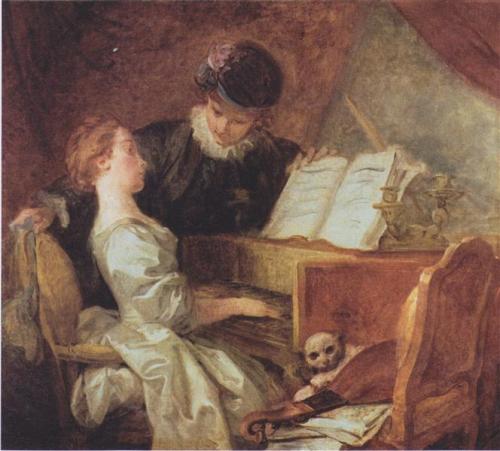
the-music-lesson.jpg!Large.jpg

      “The Music Lesson (c.1769) 

           Jean-Honoré Fragonard

                ________________

Haydn’s String Quartet no 8 in E Major, 
op 2, no 2 is not an iconic work, but 
representative of what the period had 
on offer, which wasn’t at all shabby, 
however more entertaining than in 
any way inspirational, seismic, that’ll 
come later, Haydn was nevertheless 
not only composing delightful pieces, 
but setting the stage for an era, the 
Classical Period, along, of course, 
with Mozart 

the form is not quite settled yet for
the string quartet, with again five 
movements here mirroring each 
other across again a central adagio,
twice the length, incidentally, of the 
other sections, againthough not at 
all unpleasantly, which ought to tell 
you something

the call and response aspect of the 
music, like a verse and refrain, are 
manifest, and grounding, everywhere,
you know where you stand, or sit, be
it the allegros, the minuets, or the 
adagios, the tunes return and 
reassure like clockwork 

dance forms, you’ll note, still remain
in the titles, a vestige of the earlier
period’s suites, this will alter, with
headings turning to tempo markings
exclusively, a move towards the 
transcendental rather than the 
frivolities of gavottes, or minuets


transposition, meanwhile, of the
Opus 2, no 2 has beguiled me, the 
first violin has been replaced here 
with a guitar, same string quartet, 
but with an exquisite alteration

the guitar can only pluck, not glide
across a note, something akin to the 
harpsichord before the fortepiano, 
it makes for a completely different, 
though profoundly remembered, 
original

and delivered a particular zing to  
the strings of my heart

listen


R ! chard

String Quartet no 1 in G major, K80 – Mozart

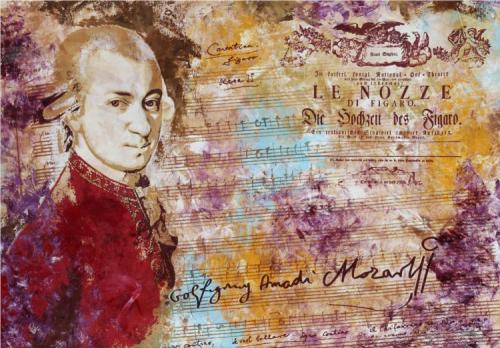
mozart-2015.jpg!Large

        “Mozart (2015) 

             Bernd Luz

                ______

Mozart’s First String Quartet, in G major, K80,
is not at all equal to Haydn’s First, then again
Mozart was only 14 in 1770 when he wrote
it, Haydn in his early thirties when he 
composed his, in the late 1750s

the difficulties are flagrant, first of all, starting 
with an adagio is something to avoid, like
falling into your agonies before even saying
hello, it can be entirely dispiriting for your,
however forgiving, audience

unless, of course, the lament is poignant,
unlike here, I thought

the later movements are emotionally 
nearly indistinguishable from each  
other, despite astute changes in 
tempo, that sufficiently differentiate 
the several parts, but one leaves the 
recital, nevertheless, remembering 
nothing, essentially, though not not  
entertaining, the quartet is not 
memorable

but listen to his first piano concerto, in
D major, K175, called his Piano Concerto
no. 5 for esoteric reasons I won’t get into, 
he was only 17, and already he entirely 
seduces you, leaves you enchanted

he needs the piano, I think, for the lovely 
musical runs up the octaves he invents,
like birds lifting gently, light as air, from 
their branches, soaring, coasting, 
dipping, dropping, finding a nearby 
branch or eave upon which to rest for a 
moment, and cede to the strains of the 
restless orchestral windsand then fly 
off again, irrepressibly, towards another 
part of its musical wonderland

a string instrument can’t do that for the 
sake of the bow, which doesn’t have the 
extension

Mozart never outdoes Haydn at string 
quartets, though he learnt a lot from 
him about them, Haydn never bested 
Mozart at piano concertos  


R ! chard

Quartet 1 in B major (“La chasse”), op. 1 no. 1 – Haydn

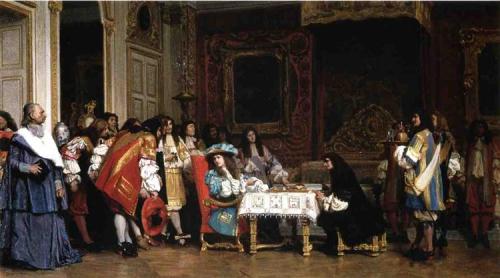
louis-xiv-and-moliere.jpg!Large

        “Louis XIV and Molière (1862) 

              Jean-Léon Gérôme

                     ________

the string quartet didn’t come out of nowhere,
as nothing does – I think – but probably, I 
suspect, from the earlier period’s suites, the
Baroque’s, Bach’sfor instance

suites are a series of dance pieces, stylized 
for the purpose of the musical poet, a popular 
appropriation, an even natural one for 
composers

the aristocracy, by the middle of the 18th
Century, demanded erudite entertainment,
something that Louis XlV, the Sun King,  
had instilled, a little earlier, during his 
Radiant Reign – see Racine, Corneille
Molière, see above, as well, incidentally –
1643 to 1715, up at Versaillesas 
prerequisite for excellence in being a
monarch, a sovereign, sponsorship of 
culture, painting, poetry, music

dukes and counts and barons and 
princesses got onto the bandwagon 
and the arts consequently flourished

witness Haydn and Mozart then, still, 
now, giants 

here’s Haydn’s first, his Quartet no 1
in B major, (“La chasse”), op. 1 no. 1,
the first significant string quartet in 
our Western culture

you’ll note five movements, following 
the suite model described above, with 
mirrored minuets sandwiched between 
opposing mirrored prestos, and an 
adagio in the very middle, as though  
their crowning moment 

an adagio, to my mind, always gives 
away a composer’s worth, listen to 
this one, it’s melting

and he’s got 67 more to go through, I    
marvel, a veritable, and utter,
however improbable, musical
cornucopia 


R ! chard

Quintet for Clarinet and String Quartet in B♭ Major, Op. 34 – Carl Maria von Weber

Carl-Maria-Von-Weber

              Carl Maria von Weber

                        ________

though I’d considered heading into 
later string quartets, later clarinet
quintets actually, an intriguing, I 
thought, divergence, it seemed a 
better idea to return to the 
Classical and early Romantic 
Periods to find an anchor for our  
formative musical idiom, again
rhythm, tonality, and recurrence

Carl Maria von Weber does an 
intermediate Clarinet Quintet
between Mozart’s and Brahms’,
which is noteworthy for especially
its Classical roots than its 
Romantic pretensions, I think, 
Weber sounds nothing like 
Beethoven, but is a nearly spitting
image of Mozart, which isn’t a bad
position at all to be in

listen for his courtliness, the staid,
though lively, musical interactions

you’ll note that the clarinet, though 
to one side, takes preeminence in
this composition – it’s nearly even 
a clarinet concerto – Weber called 
it a Quintet for Clarinet and Strings,
a perhaps more apt appellation

appellations, incidentally, remain 
the means by which we sharpen 
our understanding, however 
presumptuous might the term 
sound, appellations, in other 
words, count

though I could’ve used, I suppose, 
nomenclature, or something 


R ! chard

Clarinet Quintet in B minor, Op. 115 – Johannes Brahms

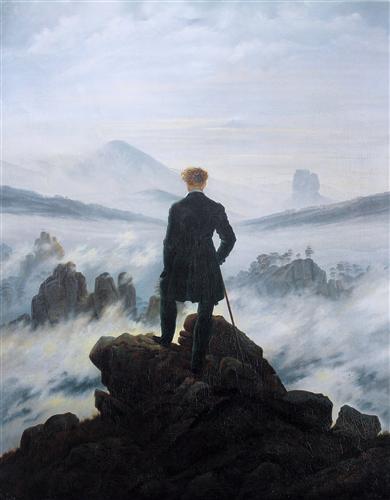
the-wanderer-above-the-sea-of-fog.jpg!Blog

    “The Wanderer above a Sea of Fog / 

            “Der Wanderer über dem Nebelmeer (1818)   

          Caspar David Friedrich

                     ___________

                              for Collin, who’ll appreciate
                                        especially, I’m sure, the 
                                             Chopin


while I’m on the subject of clarinet quintets,
since there are so few significant ones, let 
me pull Brahms’ out of my hat and celebrate 
it, a worthy challenge to Mozart’s own utter
masterpiece

but over a century has gone by, it’s 1891, 
Beethoven, the French Revolution, the 
Romantic Era is reaching its end, ceding 
to Impressionism, after the disruptions of 
rampant industrialization, and its 
consequent effects on the social contract

Marx has proposed a theoretical master 
plan to equitably protect the rest of us 
from the 1%, however too politically 
fraught, eventually, such a system – see
Communism

furthermore, Darwin had suggested that 
we weren’t all descended from Adam and 
Eve, but from larvae, which is to say, 
millennially morphed, modified, through
time, genetically, leading to festering still 
ideological  objections

Elizabeth Barrett Browning had written 
her unadulterated love poems to her 
husband, RobertCaspar David 
Friedrich had shown us his wanderer’s 
back while facing the mountainous 
challenges of the upcoming world, 
godless now after NietzscheAnna 
Karenina had thrown herself in front 
of a train, Madame Bovary had taken 
poison, and Ibsen‘s Nora had left her 
husband for a fraught, if not even 
dangerous, life on her own, to escape 
his safe but insufferable dominance, 
while Jane Eyre was finding ghosts
in her cobwebbed, and insufferable, 
to my mind, though admittedly  
aristocratic, attic 


you’ll note the clarinet is not sitting
centre stage, but has nevertheless 
a place at the table, by this time, 
though not not honoured, familiar,
and is more integrated to the 
conversation, the idea of democracy 
has taken hold, with everyone having
an equal, and even a vociferous, say

Brahms modelled his Clarinet Quintet,
on Mozart’s, the Classical structure is 
still the same, movements, tonality, 
musical recurrence, all to wonderful 
effect

that he would do that is not a given, 
but a tribute to the power of that form, 
take the waltz for instance, alive from 
even before Strauss, not to mention 
Chopin, to approximately the middle 
of the Twentieth Century

think about it, who waltzes anymore,
though they might’ve enchanted still, 
residually, the  50’s – see Patti Page
for instance – its lustre having 
dissipated, with the wind, as it were, 
the gust, before us, of the unending 
ages 


R ! chard

Clarinet Quintet in A major, K581 – Mozart

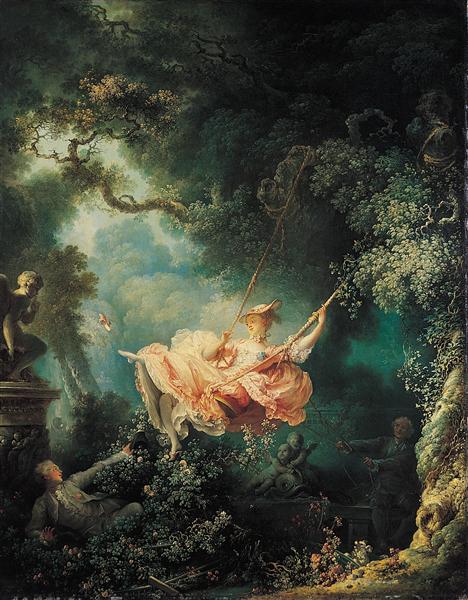
the-swing-1767.jpg!Large

The Swing / Les Hasards heureux de L’Escarpolette (1767) 

       Jean-Honoré Fragonard

                __________

it wouldn’t be fair to overlook Mozart 
when it comes to string quartets, after
all, he wrote 23 of them, but they’re 
not what he’s famous for, you have to 
go to his piano concertos for that, 
sublime things, and, in my estimation, 
to one of his chamber pieces, his 
utterly enchanting Clarinet Quintet,
in A major, K581, which, since I prefer
chamber pieces, I turn to most often

but to go to a quintet so quickly in a
discussion about quartets could be 
disconcerting, after all, you’ve got
somebody else at the table, you’ll
need another chair, another place 
setting, more food, for four still of the
standard courses, some of those even
elaborate, all this makes a difference

plus the new guest is to be accommodated, 
should typically be given the place of honour, 
as well as a distinct voice, command, like a 
soloist in a concerto, though, of course, be
less peremptory, more, indeed, courtly,
courteous, where, incidentally, the word
“courtesy” comes from

the sound of the clarinet in this quintet
mimics the sound of birds, midst the 
strings’ foliage, the guest, as it were, at 
the party, the piece delivers a wonderfully 
pastoral setting, a mainstay of that period 
see even above – an allegorical return to  
Mother Nature as a guiding principle over
the irascibility and the imperviousness of 
the Christian God, not to mention the 
search for a, nearly obliterated, feminine 
principle, deity

the second movement, the larghetto, 
which means a slow largo, which 
means it’s really, really slow, is 
accordingly melting

also, where would that movement be 
without the clarinet, I ponder, the guest 
that evening of especial honour, I get  
momentary glimpse at genius then 
and marvel, Mozart had written this for 
a clarinetist frienda friend he must’ve 
really admired

all the other movements are equally
consummate, unforgettable, perfect

I promise


R ! chard

psst: here’s Mozart’s 17th String Quartet
          no 17 in B flat major, “The Hunt”,  
          nevertheless, a quartetone of his    
          several, however perfunctorily

String Quartet no 1, Opus 18, no 1 – Beethoven

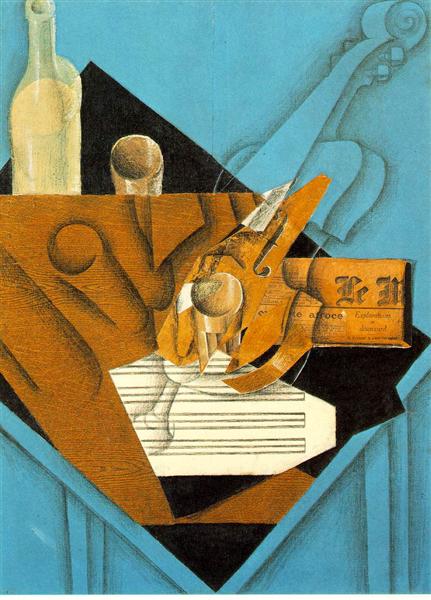
musician-s-table-1914.jpg!Large.jpg

      “Musician’s table (1914) 

            Juan Gris

                _____

Beethoven’s First String Quartet came 
out much around the same time as 
Haydn’s Opus 76, no 1among six of 
them in his set, Beethoven also had 
six in his, however junior still, first
collection, his Opus 18, Beethoven 
would’ve been going on thirty, Haydn
nearly seventy, though his spirit hadn’t
in any manner flagged, listen

but their differences are evident if you
lend a thoughtful ear 

the format is the same, four movements,
inarguably contrasting, with formal 
adherence to Classical norms, tonality,
tempo, and return, but the style is, in 
Beethoven, being overtaken by the 
substance, again inarguably

at dinner together, if I may continue my
earlier allegorical conceit, by the second
movement, Beethoven has already 
entered politics, essentially, religion, 
these four, the players, have a bone to 
pick, and their conversation gets heated, 
there’s a pause, a reconciliation, before 
the third movement, dessert, as it were, 
which is merrier initially, but later 
remains contentious, liqueurs later, in 
the final movement, are still not enough 
to allow for a comfortable exit, however 
might’ve been the serenity of the 
intoxicating sherries, cognacs

Haydn would never have done that, 
having grown up in the proprieties
of the Esterházys, his aristocratic
sponsors, courtesy would’ve been 
of their essence

Beethoven’s is a call to arms, a 
consequence of the French 
Revolution, the birth of the 
Romantic Period

you can hear it in the music


R ! chard