Richibi’s Weblog

Just another WordPress.com weblog

Tag: Zeus

what’s up in Frankfurt – Piano Sonata in F minor, “Appassionata” – Beethoven

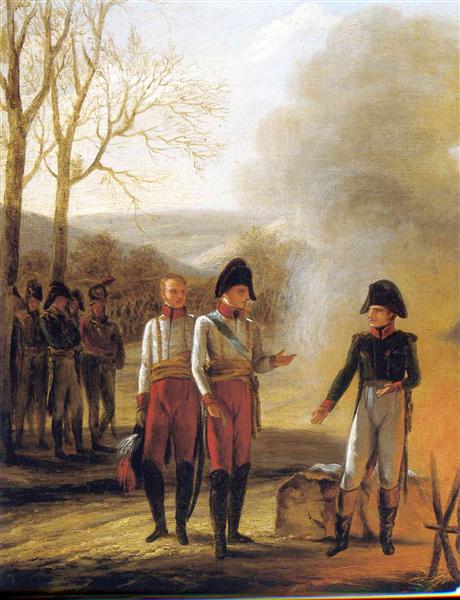
the-conversation-of-napoleon-and-francois-ii-1808.jpg!Large

  “The conversation of Napoleon and Francois II (1808) 

        Pierre-Paul Prud’hon

________

it’s 1804, Beethoven has entered his
Middle Period, left the more formal 
constraints of the Classical Period, 
Mozart and Haydn, behind, though
perhaps not essentially, the 
structure remains, hardwiredbut 
its spirit is entirely different, 
revolutionarily different, thanks to
Napoleon

and Beethoven is as opinionated 
as the revolutionaries, boisterous,
adamant, peremptory even, he is 
Zeus, and not undeservedly, at 
the top of Olympus’ musical 
mountain, where, incidentally, 
he still prevails, harmony’s very 
Homer

by his Opus 57, the Appassionata” 
– a name not of his own invention, 
but, however discriminately, ascribed 
later – he isn’t as metaphysical as 
Schubert is in that later poet’s D960
Beethoven is still writing descriptive 
texts, torrid novels, however 
masterfully illustrated, more than 
the philosophical stuff he’ll later 
undertake, even topping, when that
takes place, Schubert’s, ever, 
nevertheless, transcendental D960
if you can believe it

but Schubert remained a stripling, 
Beethoven, his elder, was given the 
grace to probe longer his humanity,
however might it have been equally 
cruelly benighted, and to stretch his 
speculative reach into previously 
unimagined dimensions, beyond 
the limited temporal scope of the 
surely shriven since Schubert 

all of whose wonders have defied 
the harsh indignities of time, and 
continue still to profoundly and
indelibly reverberate

listen, marvel


R ! chard

Symphony no 12 in D minor, opus 112 (The Year of 1917) – Dmitri Shostakovich

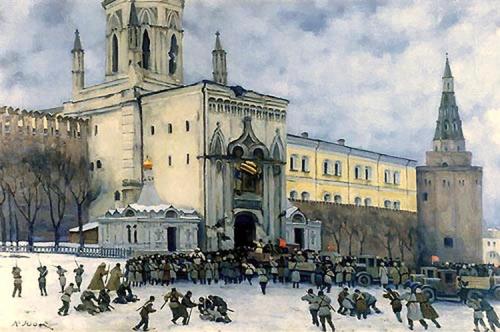
assault-on-the-kremlin-in-1917-1951.jpg!Large

 Assault on the Kremlin in 1917 (1951)

               Konstantin Yuon

                    __________

the Twelfth Symphony of Shostakovich, 
“The Year of 1917”, is a lot more of the 
Eleventh, “The Year 1905”, both 
commissioned, both celebrating 
significant events of the Russian 
Revolution, both therefore steeped in 
references that now elude many who 
aren’t Russian, and certainly those who
generations elsewhere later never lived 
through these particularly local events 

but the Twelfth is shorter by nearly 
half, thankfully, I also found it to be 
unconvincing, plastic, formulaic, 
neither original, nor enthusiastic, 
tedious and uninspired, musically 
speaking, of course

or maybe I’m just getting cranky

also a music honouring a system that 
is now defunct, debunked, discredited, 
couldn’t long survive but historically
among the works of an otherwise 
extraordinary composer, think of 
Confederate monuments still standing 
in the Southern United States, or of 
those of oppressors of First Nations, 
for instance, in our very own Canada, 
though these might’ve been  
sculpted by even Michelangelos,   
an irresolvable cultural confusion,
predicament


the works are programmatic, both 
have titles to indicate a particular
referent, and should be evocative 
of, therefore, those situations, 
music, in other words, for the 
movies, but in these instances, 
without the movie, I’ve talked 
about that before 

all the movements also have titles,
apart from the time signatures, 
adagio, presto, allegro, the like,
the Eleventh, “The Palace Square”, 
“The 9th of January”, “Eternal
Memory”, and “Tocsin”, a warning 
bell

the Twelfth, “Revolutionary Petrograd”,
“Razliv”, “Aurora”, and “The Dawn of 
Humanity”

I couldn’t help but refer to Beethoven’s
Sixth Symphony, the “Pastoral”, to
compare identical musical intentions,
his five movements are “Awakening of 
cheerful feelings upon arrival in the 
countryside“, “Scene by the brook“, 
Merry gathering of country folk“,
Thunder, Storm“, and “Shepherd’s 
song; cheerful and thankful feelings 
after the storm

compare the use of the flute, the 
oboe, the bassoon, Beethoven isn’t 
using any obbligatos yet, solos for 
particular instruments, but you still 
get the feeling of country folk 
dancing, spring taking hold


let me point out that you’ll have to be
patient with the link to the Sixth
Symphony, it’s Japanese, I think, and
will require you to push the arrow in 
the middle of the screen, then wait 
out a few movie ads, which’ll nearly
confound you, but then you’ll get the
best ever Sixth Symphony I’ve ever 
heard, Herbert von Karajan at the 
helm of the Berliner Philharmoniker,
proving why he is still Zeus among
conductors

and his thumbs, goodness, anyone 
with thumbs like that is bound to 
change history


R ! chard

psst: incidentally, Yevgeny Mravinsky 
          was the conductor, equally 
          illustrious, who premiered 
          Shostakovich’s Twelfth in 1961, 
          the same conductor as in the 
          presentation here

Hesiod on poets, and, for that matter, kings

1280px-1807_Thorvaldsen_Tanz_der_Musen_auf_dem_Helikon_anagoria.JPG

The Dance of the Muses at Mount Helicon (1807)  

Bertel Thorvaldsen

________

though Zeus may preside over kings,
none other than Apollo and the Muses
preside over poets, according to
Hesiod

Kalliope, foremost of the nine Muses
who tends specifically to kings, and 
to those being born of kings, in the
company of her sisters, Kleo and 
Euterpe, Thaleia and Melpomene, 
Terpsichore and Erato and Polymnia 
and Ourania, will pour a dew sweeter 
than honey upon such a one’s tongue, 
and his words become soothing, 
palliative, placating

“far shooting Apollo, however, 
presides at the inspiration of poets,
lending the lyrical notes from his 
representative lyre, not to mention 
his lyrics, derivative both terms of 
that etymological “lyre”, incidentally,  
so far has Apollo “shot”, dare I say,  
his spirit into our collective 
unconscious
 
“From the Muses and far-shooting Apollo
are singers and guitar-players across the earth, 
but kings are from Zeus. Blessed is he whom the Muses
love. From his mouth the streams flow sweeter than honey.
If anyone holds sorrow in his spirit from fresh grief and
is dried out in his heart from grieving, the singer,
servant of the Muses, hymns the deeds of men of the past  

and the blessed gods who hold Olympus, and
right away he forgets his troubles and does not remember
a single care. Quickly do the gifts of the goddess divert him.” 
 
                                                    Theogony (lines 94 – 103)
                                                                     Hesiod

therefore poets 

Richard 

psst: a friend has just passed on,
 it is a time for poets

the judgment of richibi

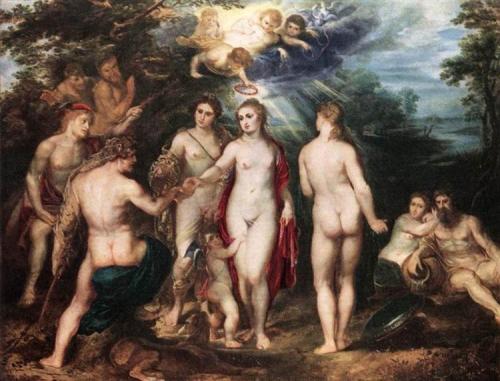
the-judgment-of-paris-1.jpg!Large.jpg

        “The Judgment Of Paris (1625) 

                         Peter Paul Rubens

                                       ___________

at the end of a long overdue visit to 
friend’s home the other night, she 
asked me, did you notice their facial
skin, which of us do you think had 
the best complexion, you can be 
honest, she insisted

we had intended to watch the finals
of a voice competition we’d both 
been following, over a glass of 
wine, or two, each, when a friend 
called, from, essentially, the door,
with a second friend in tow on their
way to a concert in the city

the friend of the friend, a lovely,
effervescent woman, from Poland
originally, with a story to tell of
growing up behind the Iron 
Curtain, was also a beautician in 
spa she runs in a nearby resort
city

the first friend, equally effervescent, 
had been telling my own friend of the 
intervening events since last they’d  
met, while I lapped up, more or less  
by default, this other alternate Soviet 
reality, perfumed as it was irresistibly 
throughout with the friend’s  
friend’s mellifluous Polish accent

I hadn’t paid any attention whatsoever
to skin quality apart from accepting  
a spa courtesy card for my mother, who 
would, naturally, be interested 

my dearest dear, I answered, I am  
not going anywhere near that one
look what happened to Paris when
he fell into that trap

what happened, she asked

the Trojan War, I answered  

the Trojan War, she asked

Paris was the son of Priam and Hecuba
king and queen of Troy, explained, he, 
one of its princes, he’d been awarded 
Helenwife of Menelausking of Sparta, 
by Aphroditegoddess of lovehe’d 
chosen Aphrodite to be the most 
beautiful among the goddesses, that 
was her prize

but let me step back a little, I  
interrupted, you need more context

Eris, goddess of discord, had not been 
invited to the marriage of Peleus and 
Thetis, I recounted, he a Greek hero, 
she a sea nymph, parents both later to 
Achilleshero at Troy, slain, incidentally, 
by that very Paris, you can read all about 
it in the Iliad“, I highly recommended

during the festivities, Eris tosses a 
golden apple among the assembled 
divinities, which reads

            “to the fairest” 
 
you can hear the stirrings of the much 
later Sleeping Beautyincidentally, in 
this earliest of tellings, reconfigured 
from the original myth

AthenaAphrodite and Hera, all assume
they are meant to receive the apple, and 
ask Zeus, father and husband, to decide

you’ll have to get someone else to touch 
that one, he replies, much as I did

and delegates the task, with the help 
of Hermes, the messenger god, to the
the guileless Paris, son of Priam and 
Hecuba, Trojan king and queen, as I 
said, he, Parisprince

Paris was tending sheep on Mount Ida
when, fatefully, by a spring, the nubile 
goddesses appeared vaunting their 
unadorned splendours, stark, flagrant, 
manifest, to the musical accompaniment 
of the Graces, Faith, Hope and Charity, 
also the Horae, the Hoursgoddesses 
of the seasons, maidens all in complicit  
attendance

Paris, mere mortal, would never have 
stood a chance 

but to sweeten, nevertheless, the 
deal, were it not yet sufficiently sweet, 
Hera promises Paris Europe and Asia 
should he choose her, Athena
conquest in war, Aphroditegoddess 
of love, was set to give him the most
beautiful woman in the world

Paris opts for Aphrodite, and is 
awarded Helenthe face that
launched the thousand proverbial 
ships, the wife, not incidentally,  
and completely inconveniently, of 
the King of Sparta, Menelauswho 
attacks thereupon Troy with his 
brother, Agamemnon, and their 
allied legions, to reclaim 
Menelaus’, whether abducted, or 
indeed unfaithful, wife, no one 
has ever conclusively determined
Paris having been Paris

no one won 

no one survived but Odysseus
but that’s another story

I walked home shortly afterwards, 
crossed my own Aegean, ten or
eleven blocks back, red lights, 
nighttime traffic, watched the voice 
competition I’d taped in any case at 
homewhooped it up along with my
favourite contestants, drank to my
narrow miss, had gotten away, I
considered, with the equivalent of 
Europe and Asia, if only in my 
mind

beauty might be in the eye of the 
beholder, I surmised, but it can 
have its thorny indeed 
consequences

Richard
Brahms Piano Concerto no 2 in B flat major, opus 83‏

though I’d no intention of presenting a piano concerto
quite yet I’d been trolling Celibidaches on the Internet,
after marvelling at his wondrous Boléro”, and couldn’t
hold back this gem I found of his, Brahms’ Piano 
 
same venue, same Münchner Philharmoniker, same
starched ceremonial ruffles, I thought, same even age
of the conductor, to the very minute, it appeared, in 
his unchanged eye and perspective, wise, serene,
omnipotent, perhaps the very same concert as in the
illustrious Ravel, I said to myself, though later couldn’t
especially recognize individual instrumentalists
 
Daniel Barenboim, who conducted earlier the speedy
“Boléro”, wears another hat here, he’s the pianist, but
in this incarnation he is transcendental, carried aloft,
I think, notably, by the Olympian Celibidache, who
cedes his fire and glory to the younger Barenboim
throughout, who supremely is up for the challenge,
a ready and rearing Apollo, taking on the treacherous
musical task, defying obstreperous planets, perilous
astrological constellations in nefarious conjunctions, 
stray or fleeting stars, to foster safely home to its
final hearth his solar chariot, in a towering sunset,
finale of apocalyptic proportions, each purveyor
casting unutterable light, god and mere immortal, 
from his own particular perch, upon our beholden
world
  
Celibidache, as would Zeus, cedes serenely to his 
younger avatar his bow, his deserved adulation,
safe in his own unquestionable omnipotence
 
 
this concerto has four movements incidentally, greater
length always suggests more gravitas, more substance 
 
is it warranted
 
you be the judge 
 
 
Richard
 
psst: in another mythological context, note the hand of
         Celibidache resting on air, intermittently fluttering,
         at the beginning of the slowest movement, the
         andante, the third, the hand of God ministering, 
         according to Michelangelo, in the “Creation of 
         Adam”, should you not yet be convinced of the 
         maestro’s august and unequivocal stature