Richibi’s Weblog

Just another WordPress.com weblog

Tag: Wolfgang Amadeus Mozart

how to listen to music if you don’t know your Beethoven from your Bach, cont.
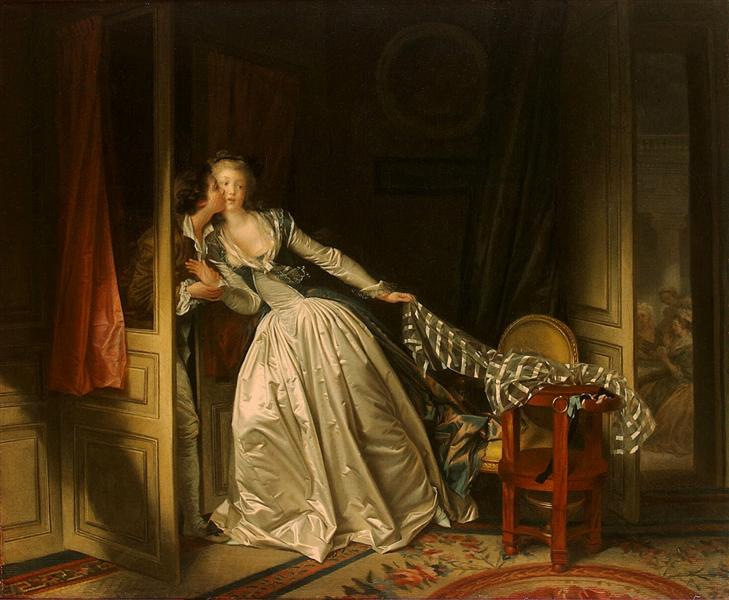
The Stolen Kiss, 1788 - Jean-Honore Fragonard


        The Stolen Kiss (1788)


       Jean-Honoré Fragonard


               _____________


if you listened to the couple of pieces I

recommended in my last commentary,

you would’ve indeed recognized, if

even only subconsciously, that the

first work wasn’t composed by the

composer of the other, that different

spirits infused either


a visual representation of the same

thing might be to juxtapose a

contemporary painting of the one

epoch with a corresponding painting

of the other


over a hundred years had passed

between Mozart and Prokofiev,

Mozart’s Piano Sonata no 18, K576

– his last piano sonata, incidentally,

he died a short two years later –

was written in 1789, the year of the

French Revolution, a still safe

distance from Vienna, where

Mozart could still cater to an,

however endangered, species
 

Jean-Honoré Fragonard, a contemporary

painter, 1732 – 1806, had been doing the

same thing, The Stolen Kiss, 1788, for

instance, a mere year earlier, see above


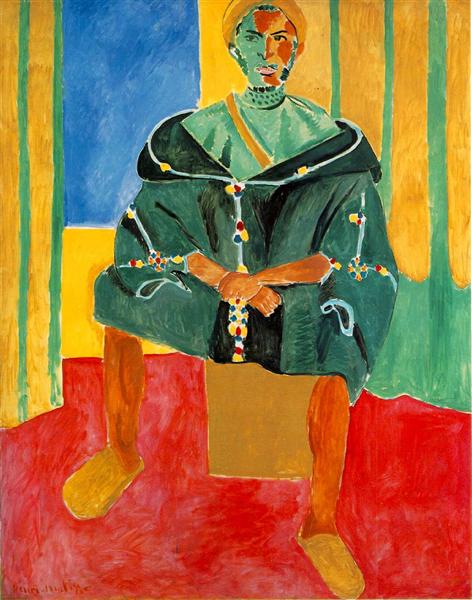
meanwhile, over a hundred years later,

inches only away from the First World

War, Matisse is doing in art what

Prokofiev is doing in music, taking the

temperature of his own time, Seated

Riffian (1911 –1912) – a Riffian, a Berber,

a North African tribesman – see below,

to corroborate Prokofiev’s equally

emblematic vision of their shared era


you can hear this in the music


mostly through the difference in the use

of volume, languorous softs, thunderous

louds, but also in the more expansive use

of pace, fast, slow, the rapidity of some

notes, the embrace, the extended caress,

of others, in the later composition


which, in a word, follows the development

of the piano from harpsichord to the

instrument we’re used to today


Mozart still had the harpsichord in his ear,

he was writing for the fortepiano, which

evolved, through the pianoforte, to the

piano we know of today, no flexibility of

pace, no flexibility of volume then, listen,

hearyou can hear it in the juxtaposition


we hear a lot more than we think we

hear


R ! chard


                  __________


Seated Riffian, 1912 - 1913 - Henri Matisse


        Seated Riffian (1911 – 1912)


                Henri Matisse


                  __________

Mozart Concerto for Two Pianos and Orchestra, K365‏

  Blind Man's Bluff - Jean-Honore Fragonard

                               Blind Man’s Bluff(1769-70)

                                               Jean-Honoré Fragonard
 
                                                      _______________
 
 
the spirituality that is everywhere in Bach, the
sense of musical exploration and ultimate solace,
will not be found again in the history of music
for another hundred years, in Anton Bruckner
then, 1824 – 1896, a profoundly devout Catholic
organist – Bach, 1685 – 1750, was Lutheran –
then for another hundred years again, in Olivier
Messiaen, 1908 – 1992, again a profoundly
devout Catholic organist, perhaps a
reincarnation, like a Dalai Lama 
 
already in his day Bach was being considered
old-fashioned, gasp, the new age was revelling
in courtly extravagance, see also for instance
François Boucher, and Fragonard, featured for
your convenience above
   
Mozart would fit right in, for a good time call
Wolfgang Amadeus  
 
 
Mozart takes the tools that Bach created, the
newly installed well-tempered clavier and does
what kids do with their parents heritage, play
with it, Mozart doesn’t explore, he entertains,
notes are the toys in his sandbox, and he makes
the very most of it, never leaving his kindergarten
sanctum, nor would anybody be as effervescent
again for, this time, another 150 years, with
Prokofiev, 1891 – 1953, even more outrageous,
though ultimately not for that more famous,  
being perhaps for many too out there, fun like
jack-in-the-box, too unnervingly unpredictable, 
still 
 
Mozart, though eminently delightful, is
appropriately predictable for his epoch
 
 
of all of his works my favourite, is what I put
on for instant exhilaration
 
it never fails me
 
 
enjoy
 
Richard