who’s afraid of the subjunctive
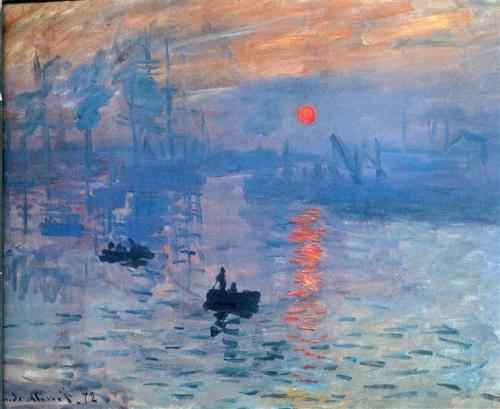
“Impression, Sunrise” (1873)
________
who’s afraid of the subjunctive
much like Elizabeth Taylor as Martha
in “Who’s Afraid of Virginia Woolf?”,
my answer is, I am, George, I am
the subjunctive is an esoteric mood,
even more abstruse in English than
in other languages, where the verb’s
conjugation highlights its presence,
in English, it’s nearly identical to the
indicative, the mood everybody
instinctively speaks in, facts
the subjunctive is about aspiration,
like the conditional, abstract, not
real, but its intention, rather than
the conditional’s inherent
impediment, a condition, shoots
for the stars, isn’t introspective,
but adamant, imperative
it is necessary that one be, it is
urgent that one have, it is
important that one effect, a
particular thing or event, all
subjunctives after the
doorkeeper word, “that”
one finds the subjunctive in
Shakespeare, master of grammar,
perhaps unparalleled in English,
a lot – O, that this too solid flesh
would melt, / Thaw and resolve
itself into a dew! – and follows
with Elizabeth Barrett Browning –
Pardon, o pardon that my soul
should make, / Of all that strong
divineness which I know / For
thine and thee …, for instance,
who is so profoundly indebted to
Shakespeare for her aesthetics
one wondrous day, I realized that
Proust’s entire “À la recherche du
temps perdu“, his “In Search of
Lost Time“, my Bible, was set in
the, French however, subjunctive,
the mood, there as well, of
possibility, therefore rather than
the definitive recreation of an
earlier time, Proust was
describing a sensibility, a personal
interpretation of a previous reality,
however bolstered by intimate and
apparently precise recollection of
shimmeringly imprecise, though
personally accurate, impressions
note here the similar preoccupations
of Proust’s contemporaries, the, aptly
named, Impressionists
everything, Proust was saying, as
were also the Impressionists, is in
the eye of the beholder
the subjunctive is the mood that
sets this instinct in motion
R ! chard
psst: Somerset Maugham I remember
being noteworthy as well for his
immaculate use, in his South
Pacific tales, of the subjunctive,
extremely elegant in its refined
construction, even with its
English austerities, like making
lace out of mere cloth, impressive
despite its impracticality, or
perhaps even because of it
 Richibi's Weblog