Richibi’s Weblog

Just another WordPress.com weblog

Tag: Walt Disney

“The Transformation of Io into a Heyfer” (III) – Ovid
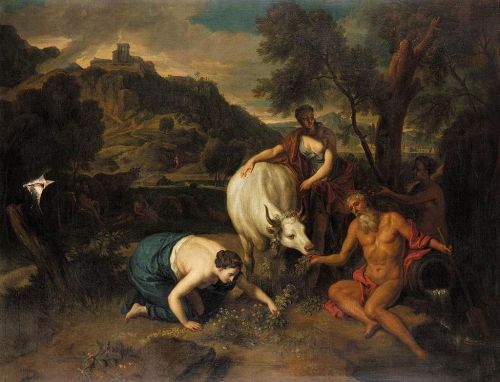
1024px-Victor-Janssens_Io-recognized-by-her-father

     Io Recognised by Her Father 


          Victor Honoré Janssens


              ______________


               The head of Argus (as with stars the skies)
               Was compass’d round, and wore an hundred eyes. 


not only did [t]he head of Argus have

an hundred eyes, but they circled,

compass’d, round his head, as with

stars the skies, as with stars the

geocentric firmament 


note the passive form of the verb to 

compass in the two lines above 

standing in for the inverted sentences

I earlier made mention of as literary 

devices Ovid, or Dryden, uses 

throughout the poem


the standard sentence, the active

sentence,  should read, an hundred

eyes compass’d [t]he head of Argus


compass’d, encircled


               But two by turns their lids in slumber steep;
               The rest on duty still their station keep;
               Nor cou’d the total constellation sleep. 


never could all the eyes, the total

constellation, sleep, or in slumber 

steep, since only two of them would 

turn[ ] their lids, close, at a time, 

while the others continued diligently

to keep watch


steep, incidentally, is a verb here, 

as in to put the kettle on, not an 

adjective, as in dauntingly

pitched, threateningly angled 


               Thus, ever present, to his eyes, and mind,
               His charge was still before him, tho’ behind. 


even when she was standing behind

him, Argus could still see Io, [h]is

charge, with the eyes he had in the

back of his head


               In fields he suffer’d her to feed by Day,
               But when the setting sun to night gave way,
               The captive cow he summon’d with a call;
               And drove her back, and ty’d her to the stall.
               On leaves of trees, and bitter herbs she fed,
               Heav’n was her canopy, bare earth her bed:
               So hardly lodg’d, and to digest her food,
               She drank from troubled streams, defil’d with mud. 


hardly lodg’d, given difficult living 

conditions


               Her woeful story fain she wou’d have told,
               With hands upheld, but had no hands to hold. 


fain, gladly


               Her head to her ungentle keeper bow’d,
               She strove to speak, she spoke not, but she low’d: 


to low is to make the sound that 

cows do, to moo


               Affrighted with the noise, she look’d around,
               And seem’d t’ inquire the author of the sound. 


the sound that she herself was making 

not only [a]ffrighted her, frightened her, 

but had her wondering where could 

it possibly be coming from 


               Once on the banks where often she had play’d
               (Her father’s banks), she came, 


Her father, Inachus, god of rivers


                                                    and there survey’d
               Her alter’d visage, and her branching head;
               And starting, from her self she wou’d have fled. 


much as the sound of her altered

voice had [a]ffrighted Io, now her 

reflection in the water chastened 

her as well, enough to make her

start, be startled, and want to run 

away from her self


               Her fellow nymphs, familiar to her eyes,
               Beheld, but knew her not in this disguise.
               Ev’n Inachus himself was ignorant;
               And in his daughter, did his daughter want. 


no one recognized Io, not even 

her father, who, in his daughter, 

the one who stood before him, 

the altered Io, could not make 

her out 


did his daughter want, as in to 

be found wanting, in the cow, 

to not even be suggested in

the, however conspicuous, 

heifer, not at all part of the 

picture 


Io is there but, simultaneously, 

disconcertingly, not there


               She follow’d where her fellows went, as she
               Were still a partner of the company: 


it should be remembered that 

Io was a beautiful heifer, even 

Juno had been impressed, so

that her fellows, her companions,

only other maidens, I’ll point out, 

fellows taking on its sexually 

indiscriminate meaning here, 

not at all restricted to males, 

would have easily let her follow


note the symmetry, incidentally, 

between follow’d and fellows, 

the nearly hidden alliteration, 

a delightful literary effect, 

though if you blinked you’d 

miss it


               They stroak her neck; the gentle heyfer stands,
               And her neck offers to their stroaking hands.
               Her father gave her grass; the grass she took;
               And lick’d his palms, and cast a piteous look;
               And in the language of her eyes, she spoke. 


her lowing would’ve had no effect,

would’ve let no one in on the fact

that beneath the animal exterior 

there might be an Io


               She wou’d have told her name, and ask’d relief,
               But wanting words, in tears she tells her grief.
               Which,


and here we get the punchline,

the plot twist, which turns this

story into, relatively speaking,

a total enchantment, as though 

Ovid were giving us, prefiguring

in fact, Walt Disney, our own 

20th Century mythologist


                            with her foot she makes him understand;
               And prints the name of Io in the sand. 


see above


R ! chard


“A Delicate Balance” – Edward Albee

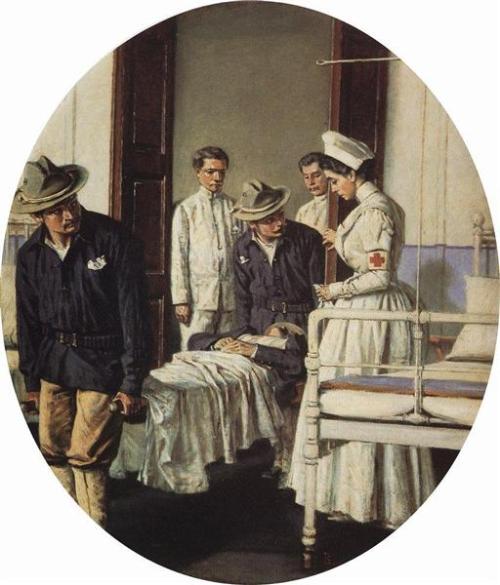
in-the-hospital-1901.jpg!Large

      “Theatre Drama 


             Kuzma Petrov-Vodkin

 
                           ___________


there are only a very few 20th-Century

American playwrights who’ve weathered

the rigours of time, two with several 

successes, Eugene O’Neill, and 

Tennessee Williams, but only one to 

tower above those two with only one 

work to outmatch them, Edward Albee,

his Who’s Afraid of Virginia Woolf? 

is every inch a king


this is not an impossible feat, Margaret

Mitchell wrote her only book, Gone 

with the Wind“, a contemporary Iliad“,

which will find its rightful place again 

in world literature, note, when our own 

too reverberant still times cede to the 

concerns of another, less pertinently 

fraught era, like reading “War and

Peace“, for instance, now that 

Napoleon is long gone


Gone with the Wind, quick, name 

another 20th-Century novel to top it, 

seconds are too long, Gone with 

the Windis in our bloodstream, 

like Walt Disney or Marilyn Monroe

even if you’ve never read it, which 

you should


but Edward Albee wrote another play

which deserves some attention, and 

with redoubtable performances from 

both the consummate ever Katharine 

Hepburn, and from our own Canadian 

tower of unutterable talent, Kate Reid

abetted by masterful presentations 

from no less than the revered Paul 

Scofield and the iconic Joseph Cotten 

when their supporting numbers come 

up, here is a show to watch for, if 

nothing else, those individual stellar

contributions


but A Delicate Balance“, also an 

incontestable masterpiece, is about 

friendship, and tells a lesson you’ll

not soon forget, friendship is more 

than, for better or for worse, just 

knowing each other, it says, an 

idiosyncratic, indeed recurrent,

Albee theme


cinematography, note, is, here

dreadful, though actually in that 

manner conceived, however 

improbably, by an otherwise 

noteworthy director, you’ll even 

think they’ve shrunk his frame


but visual style shouldn’t let you 

forego the play’s profound substance, 

nor the triumphant work of its illustrious 

cast, at the very top, mostly, of their 

considerable, even defining, powers


watch


R ! chard

Symphony no. 15 in a major, opus 141 – Dmitri Shostakovich

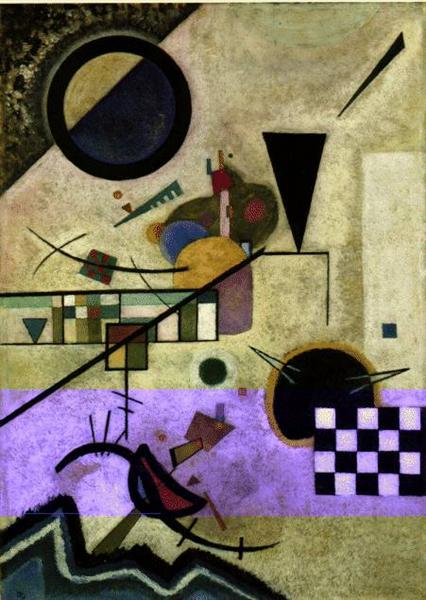
contrasting-sounds-1924.jpg!Large.jpg

        “Contrasting Sounds (1924) 

                Wassily Kandinsky

                       __________

Shostakovich can be difficult, he speaks a
foreign language, discordant notes leave 
you wondering where you’re going

the disruption of the three conditions of
Classical music, tonality, tempo and 
repetition, has given us here, the 
equivalent of derivatives of Latin, you 
don’t understand Italian if you speak 
only French, despite the profound
interconnections, roots

or think of trying even to read 
Shakespeare

also Shostakovich is more literal than 
other composers, his works are intimately
connected with the history and trials 
of his homeland, wrapped in folkloric 
references later cultures and generations 
would not be aware of

one can detect a composer of great 
consequence, like reading Homer in
translation, but never be able to feel 
their local, tribal, force

only a French Canadian could truly 
understand French Canadian, say,  
in hir very atoms, and that, everywhere


there are many references to personal
influences in Shostakovich’s 15th
Symphony, which he viewed, apparently,
as a kind of autobiography – the initial
revolutionary ardour, his profound 
disillusion, the day to day struggles to 
endure the murderous tribulations of his 
political masters, the moral ambiguities  
that would have gone with them, the  
existential crosses to bear – with   
appropriately pertinent quotations from   
other foundational composers

you’ll surely not miss Rossini’s Overture” 
to his opera, William Tell“, which Russians 
would’ve been entirely familiar with, though 
we’re more likely to have known it in North 
America as the theme from the TV show, 
The Lone Ranger

much as we got our Shostakovich, however 
circuitously, from Walt DisneyHanna-Barbera,
if you’ll remember them

and if you think you’ve heard in this symphony 
something you might’ve heard already
Shostakovich quotes himself from his earlier 
symphonies 

and if you’re good, you might even catch 
some WagnerMahler, some, however 
esoteric, Glinka, even

much of it, I’m afraid, now lost to us, in 
this new century, unless we’re total 
nerds

which is where, of course, I take a bow


the first movement was conceived as a 
toy box, it’s disorganized in the manner
of a child discovering

I heard, as well, a drunken degenerate
dancing, or trying to, a bull in a china 
shop 

but in the next movement, a dirge, an
“adagio – largo – adagio – largo”, if 
you’ve ever heard one, the drunken 
lout, in my mind, the next morning 
wakes up, broken but nevertheless
patient, and resilient

with one shoulder to the pillow, he 
props himself up, having understood 
that he must face the day, if only to do
his morning business, with a hand on 
the night table, he braces himself for 
the effort of heaving himself up from
the side of the bed, hears every bone
crack, every muscle stir as he lifts
himself up to a stable posture, tests 
his balance, then turns to move 
forward, crouched under the weight 
of all of his days, towards the basin 
and the mirror, where the picture 
could be better, but could also be 
worse

a blemish there takes up less than
a minute, a residual sense of duty, 
much more than of pride

his business done, the coffee, the 
grinder, the beans, the warmed cup
and then the hour or two to read 
poetry and find the inspiration, to 
undertake the day that’s been 
thrust upon him

he writes his Symphony no 15


the following movements are 
excessive to me, we drown in a sea 
of adagios and allegrettos, a not
unpleasant fate, but more confusing
than entertaining

though I’ll return

I think I might even get to really like
this symphonyit took me years to 
adjust to Kandinsky’s paintings


R ! chard

psst: thanks for listening

“Dumbo”‏

Pinned Image
 
                                                           View of Murnau
        
                                                           Wassily Kandinsky
 
                                                      ______________________
 
 
once again a movie for children of all ages – 
including for Zoë, incidentally, whose birth
date is coming up in May – Dumbo is another
Walt Disney masterpiece, and once again
fraught with the tropes, the creative novelties
and devices, of the most modern arts
 
it’s not difficult to intuit the influence of
Saint-Saëns‘ – an awful lot of sibilants
in the possessive case of only those two
capitalized syllables, by the way – his, I say,

especially, of the elephantsfor Disney‘s
famous sequence here of elephants on
parade, wherein psychedelia makes an
appearance in 1941 no less, years ahead
of its historical, and revolutionary, great
fruition, surely informing Warhol,
generally the entire Pop Art coterie 
 
he was transferring however what he’d
been learning from the German especially 
Expressionists, their attraction to bold,
dissonant colours, flat uninflected
surfaces, arbitrary and malleable
dimensions    
 
what Disney brought significantly to the
mix was essentially the spirit of fun, which
is what transformed all art after the First
World War, that generation’s response to
the utter failure of all that had come before,
politics, economics, ideologies, even the
very concept of the existence of God, none
of these had prevented the horror that had
been that signal event, the best defence, as
we said in the Seventies, was living well,
therefore the Roaring Twenties, therefore,
for that matter, the Seventies 
 
we haven’t retreated from that imperative
yet, be it for better or for worse remains
still to be seen, for faith or fun, the opposite
poles of personal responsibility, both fell 
and heal 
 
 
animals, incidentally, courtesy of the spirit
 
 
Richard


“Snow White And The Seven Dwarfs”‏

enchanted movie for children of all ages, that
means especially you, Manolito, that means
especially you, Aidan
 
you might however notice, in a more analytical
vein, the introduction of German Expressionism
already in more popular culture, Nolde, Kirchner,
even some Edvard Munch, the Norwegian, in the
bold, garish colours that expressed horror and
perversion for them following the First World War,
and did the same for Walt Disney later if you’ll
consider the evil queen’s mirror and mask, or
van Gogh branches in the threatening forest, flat
surfaces, notably on faces for instance, touched
with only daubs of colour for only perfunctory
shading and character, prefiguring incidentally,
Andy Warhol‘s Pop Art
 
artists talk to each other
 
  
musical atonalities, also, show up, to attest to
modernity, in the music tooted out by the pipe
organ, delivering ornery pipes and a climactic
cuckoo who can only emit a shrill, discordant 
screech, we can thank especially Prokofiev,
the popinjay among the atonalists, for that,
with necessary nods to, for their more
theoretical groundwork, the more exacting
Stravinsky and the too dour, not to mention
for many too dire, Schoenberg  
 
Walt Disney was introducing modern art not so
surreptitiously at all to the larger popular culture,
acclimatizing children especially to the new
upended and revolutionizing art, crayons at
the behest of individuality 
 
 
you’ll also find interesting that Snow White 
succumbs to an apple, much like Mother Eve, 
both of whom are absolved, it’s worth pointing 
out, by nothing other than transcendental,
transformational, regenerative and ever
inspirational, Love
 
think about it  
 
 
Richard


“Song of the South”‏ – Walt Disney

it’s been over fifty years since I’ve seen this movie,
never thought I’d see it again but now for the magic
of the Internet, the boundless trove of irreducible
treasures, like those in Ali-Baba’s caves, or the
attics of our ancestors, stowed away, open again
to our poetic or otherwise imaginations, at our
very fingertips
 
I remembered this movie to be wonderful, moving,
but not much else, except for the Zip-A-Dee-Doo-
Dah” theme, which is unforgettable, and a single
plot twist it would be unchivalrous to divulge 
 
it has apparently been controversial, and is
presently banned, it would appear, in cinemas,
but it would be to my mind as racially insensitive
as “Huckleberry Finn”, “Tom Sawyer’, or even
“Gone with the Wind” have been, when they
were patently giving voice rather to a shocking
human cultural, and political, abomination, 
however awkwardly, that is still powerfully,
shamefully, even manifestly, resonant
 
this is not a universal, note, condition, every
season for any culture has its bugbears, its
demons and monsters, and woe to the
unfortunate and inadvertent victim 
 
 
in perhaps his most wonderful movie, and there
were quite a few, Song of the South“, Walt Disney 
lets us know that we’re all in this together, and
that kindness meets kindness in everyone, when
you open your heart 
 
and that the reverse is horrible 
 
 
Walt Disney is of course one of the great cultural
influences of the 20th Century, dismissed among
the titans as merely for kids
 
Walt Disney will be for an entire generation the
place where we learned our moral ABCs, much
more than in the dire Bible
 
as such he’s no less significant an artist, not at
all less significant, than Monet, Picasso, for
instance, Beethoven, Shakespeare, in shaping
our present moral and aesthetic world 
 
 
you’ll need some Kleenex 
 
 
you can also sing along 
 
 
Richard 
 
psst: filmed, I’m sure, right here in beautiful Stanley
         Park behind my place in Vancouver, even the
         animated portions    


“Pictures at an Exhibition” – Modest Mussorgsky‏

 
You are definately (sic) now in Chopin mode!“, a friend
writes, much as the culture itself would’ve found
itself after a surfeit of Chopin, giving way to of
course newer inventions in art  
 
if there is an overview that would present the
fundamental outline of what was occuring at
the time it is that the heart was giving way to
the mind, late Romanticism still throbbed with
stirring passions, but a more exploratory
psychological perspective would begin to  
dominate, spurred on by a more analytical
approach to everything, even the arts
themselves to the arts themselves, science
had been unearthing revelations, painters
analyzed paint, writers parsed writing, 
composers deconstructed musical composition
 
all investigated potentiality and purpose within
the area of their field to discover if it still had
relevance, and if so, how and why
 
the first step in moving away from emotion in
music was through an attempt at notational
description, to have music become evocative 
of a scene rather than of sentiment through
orchestrations of sound, an intellectual appeal
to the more probing cerebellum rather than to 
the more facile and evident strings of a rhythmic,
ardently and compellingly pulsing, but primal 
and therefore unreasoning, heart
 
which could also easily become self-indulgent,
only the very best, Chopin, Elizabeth Barrett 
Browning, avoid it, let me add here the never
ever maudlin, always enchanting, Walt Disney,
who cuts mighty, mighty close to the saccharine
in his post-Second-World-War epoch, as do as
skilfully also indeed the other two in theirs
 
it’s all in the rubato, I think, where musical magic
is allowed to turn into pandering kitsch
 
 
here’s Modest Mussorgsky describing Pictures
at an Exhibition, each movement a particular
pictorial work, separated by the return of the
original theme, the “Promenade”, representative
of the amble forward, curatorial and monocled, 
I think, to the next considered instalment 
 
here’s the same thing again in a neat transcription
for guitar 
 
 
Richard