Richibi’s Weblog

Just another WordPress.com weblog

Tag: Virgil

“The Story of Aglauros, transform’d into a Statue” (lll) – Ovid

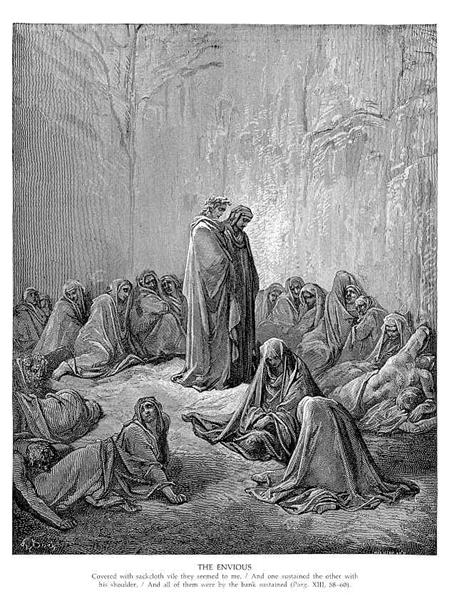
the-envious.jpg!Large

          The Envious


                  Gustave Doré


                             _______


all mythologies have their picture, their

rendition, their evocation of an afterlife,

states of either resignation, in earlier

traditions, perdition or bliss in the later

Christian view, manifest, these latter,

in Dante, his depictions of Hell,

Purgatory, and Heaven in his

Commediaare probably its most

explicit evocations


the Greek and Roman pictures of

their own representative Underworld,

available in Homer, Horace, Virgil,

notably, is less compartmentalized,

less extreme in its divisions, a gloom

pervades, but nowhere fire and

brimstone, nor the diametrically

opposed consolation of archangels

and trumpets, only an unending

sense of desolation, be one worthy

of it or not


limbo comes to mind


but Envy’s realm is actual, not

belated, in the Ancient Greek and

Roman traditions, it is of this world,

present, however horrid, a place

that lurks in the hearts of men, of

people, always, ever, accessible


Dante situates his nexus of Envy in

Purgatory, the afterlife, the nether

world, its Second Circle, of seven,

Wrath, Envy, Pride, Lust, Gluttony,

Greed, Sloth


for Ovid, you can reach Envy’s

dominion, in the nearby mountainous

areas, if only you’ll follow Minerva


the one course is transcendental,

the other, organic, note, physical,

carnate


            Directly to the cave her course she steer’d;

            Against the gates her martial lance she rear’d;

            The gates flew open, and the fiend appear’d.


the fiend, Envy herself


            A pois’nous morsel in her teeth she chew’d,

            And gorg’d the flesh of vipers for her food.


yech


             Minerva loathing turn’d away her eye;


as, incontrovertibly, would I


            The hideous monster, rising heavily,

            Came stalking forward with a sullen pace,

            And left her mangled offals on the place.

            Soon as she saw the goddess gay and bright,

            She fetch’d a groan at such a chearful sight.

            Livid and meagre were her looks, her eye

            In foul distorted glances turn’d awry;

            A hoard of gall her inward parts possess’d,

            And spread a greenness o’er her canker’d breast;

            Her teeth were brown with rust, and from her tongue,

            In dangling drops, the stringy poison hung.

            She never smiles but when the wretched weep,

            Nor lulls her malice with a moment’s sleep,

            Restless in spite: while watchful to destroy,

            She pines and sickens at another’s joy;

            Foe to her self, distressing and distrest,

            She bears her own tormentor in her breast.


the passage, without explication,

speaks for itself, I cede to its

manifest erudition


            The Goddess gave (for she abhorr’d her sight)


her sight, what she was looking

upon

 
            A short command: “To Athens speed thy flight;

            On curst Aglauros try thy utmost art,

            And fix thy rankest venoms in her heart.”


Minerva condemns, curs[es], 

Aglauros


            This said, her spear she push’d against the ground,

            And mounting from it with an active bound,

            Flew off to Heav’n:


Minerva reminds me of my own

generation’s Wonder Woman


meanwhile, the hag, Envy, with

eyes askew


            Look’d up, and mutter’d curses as she flew;

            For sore she fretted, and began to grieve

            At the success which she her self must give.


success, the humiliation of

Aglauros


            Then takes her staff, hung round with wreaths ofthorn,

            And sails along, in a black whirlwind born,


the picture of a witch on a

broomstick shouldn’t

here be unanticipated 


            O’er fields and flow’ry meadows: where she steers

            Her baneful course, a mighty blast appears,

            Mildews and blights; the meadows are defac’d,

            The fields, the flow’rs, and the whole years laidwaste:


the whole years, the yearly crops


            On mortals next, and peopled towns she falls,

            And breathes a burning plague among their walls.


the, not unfamiliar to us, season,

now, of the witch


R ! chard

“Metamorphoses” (The Giants’ War, III) – Ovid

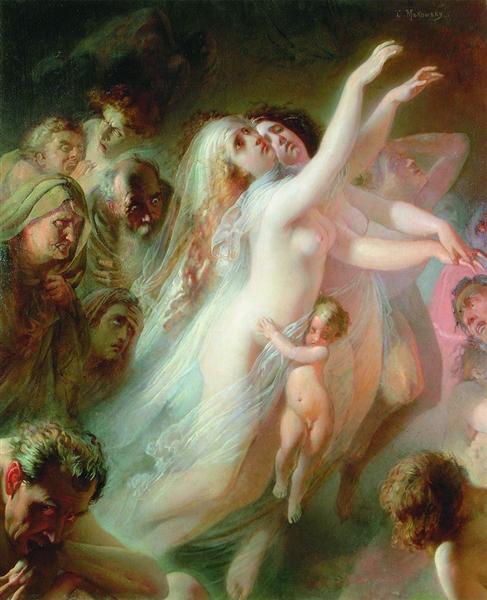
charon-carries-dead-souls-across-the-river-styx.jpg!Large

    “Charon Carries Dead Souls across the River Styx(1861)


           Konstantin Makovsky


                 ____________


Jove, god of Thunder, speaks


            I was not more concern’d in that debate
            Of empire, when our universal state
            Was put to hazard, and the giant race
            Our captive skies were ready to imbrace: 


I was not especially disturbed, Jove says,

when the state of our universe was 

challenged, or debate[d], when the giants 

tried to usurp our territory, were ready to 

imbrace, or embrace, take on, our  

vulnerable, [o]ur captive, skies


            For tho’ the foe was fierce, the seeds of all
            Rebellion, sprung from one original; 


because the enemy, then, the adversary, 

came from the one original source, its 

however manifold predations, its 

however myriad desecrations, would’ve

been identifiable to Jove, not foreign, not

unmanageable, he would’ve recognized

the black sheep of the Olympian family,

the giants  


            Now, wheresoever ambient waters glide,
            All are corrupt, and all must be destroy’d. 


ambient, nearby, related, infected, corrupt,

all has been corrupted


            Let me this holy protestation make,
            By Hell, and Hell’s inviolable lake, 


here’s another anachronism, for Hell wouldn’t’ve 

been even a concept in the era of Ovid, where

the Underworld, and Hades, entirely different

afterworlds, would’ve prevailed, areas of 

persistent gloom and shade, see Homer here,

for instance, or Virgil


the Underworld of the ancient world was 

surrounded by five rivers, Hell’s inviolable 

lake, the most famous of which was the 

river Styx


in the Divine Comedy, Dante updates this 

watery boundary for his own 14th Century

readers, and makes it the passageway to

the fifth circle of Hell, where Charon 

remains, after even over a thousand 

years, the very same ferryman


see above


nor was there either any of our present

conception of Heaven, Heaven would’ve 

been Olympus then, the exclusive domain 

of the Gods, either Greek or Roman 


            I try’d whatever in the godhead lay: 


Jove says, I tried everything a god 

could use


            But gangren’d members must be lopt away,
            Before the nobler parts are tainted to decay. 


you’ve got to lop[ ] away, cut off, the bad 

parts before they infect the more vital 

components of the body

 
            There dwells below, a race of demi-gods,
            Of nymphs in waters, and of fawns in woods:
            Who, tho’ not worthy yet, in Heav’n to live,
            Let ’em, at least, enjoy that Earth we give. 


not all beings are corrupt, but nymphs 

and fawns, innocents, Jove pleads, 

should be given consideration on 

Earth, if they be not yet worthy of the 

majesty of Heav’n, and granted earthly 

areas of enjoyment in the confines of 

their forsaken place 


            Can these be thought securely lodg’d below,
            When I my self, who no superior know,
            I, who have Heav’n and Earth at my command,
            Have been attempted by Lycaon’s hand? 


if Lycaon could attack me, Jove, god 

of Thunder, asks, how can these 

innocents, nymphs, fawns, ever be 

safe


             At this a murmur through the synod went,
             And with one voice they vote his punishment. 


the punishment of Lycaon, which we’ll 

soon encounter


             Thus, when conspiring traytors dar’d to doom
             The fall of Caesar, and in him of Rome,
             The nations trembled with a pious fear;
             All anxious for their earthly Thunderer: 


Thus, or in a similar manner, did the nations

of the earth tremble when Caesar, their 

earthly Thunderer, was assassinated 


nations, incidentally, is another anachronism,

nations didn’t appear on earth until the 

18th Century, with the French Revolution


             Nor was their care, o Caesar, less esteem’d
             By thee, than that of Heav’n for Jove was deem’d: 


Ovid addresses Caesar here, his contemporary,

and compares that emperor’s esteem for nations, 

his reliance on their allegiance, to the esteem 

Heav’n has for Jove


             Who with his hand, and voice, did first restrain
             Their murmurs, then resum’d his speech again. 


Jove calls for silence in the assembly

before speaking again


             The Gods to silence were compos’d, and sate
             With reverence, due to his superior state. 


The Gods … sate, or sat, then took heed,

bowing to Jove’s superior position


the tale of the punishment of Lycaon

will follow  


R ! chard


Evgeny Kissin – a bouquet of composers‏

midway in my considerations about music I
came to myself in a dark wood for the straight
way was lost, if I may paraphrase Dante for my
own purposes, I’d digressed to Elizabeth Barrett
Browning, Audrey Hepburnand others, and
forgot what I had been talking about with
respect to the development of music, but have
been wonderfully, and perhaps even karmically, 
put back on track by this correspondingly 
 
Evgeny Kissin had provided a resplendent
haven’t yet finished enjoying often, but
found among his other Internet offerings
 
 
at first I wondered about the Schubert/Liszt
connection in the written introduction to the
program, they’d been united by a forward
slash, implying that there’d been some kind
of cooperation, but I hadn’t ever heard of
those two ever meeting  
 
upon very little investigation however I found
out that Liszt had merely transcribed of course
some of the Schubert lieder, something which 
Liszt was wont to do, Liszt transcribed
everybody and everything, most famously all
of Beethoven’s symphonies, writing them
up for piano only, so that more remote areas
could also enjoy them, in often even there 
aristocratic salon settings
 
lieder are songs in German, a lied, a song,
works Schubert produced in astonishingly
great number
 
 
Liszt was paraphrasing Schubert for his own 
Lisztian purposes of course, artists do that, 
which is to say he was giving them much
more Lisztian fanfare and, not unwelcome,
I might add, extravagance, Schubert could
be pretty dry, I think, in his lieder,
uncharacteristically, even his fun ones, 
despite their being ever so eminently
 
 
und der Bach  from Die schöne Müllerin“, one
of his song cycles,Ständchen” from
Schwanengesang“, another cycle, Gretchen
 am Spinnrade“, and Erlkönigare all poems
of celebrated German poets Schubert set for
accompanied voice, and that Lizst, and Kissin,  
transform into something pretty special   
 
 
next on the program Schubert takes independent
flight with his wondrous “Wanderer” Fantasy,
opus 15, D760
 
 
a fantasy is not a sonata for having only one
movement, but note this fantasy goes through
all the motions of a sonata, fast, slow, fast, each
with its own structural contrasts, but without
any of the intervening pauses
 
so is a fantasy just a sonata without breaks, or is
a sonata just a fantasy with hiatuses, had the
sonata become a fantasy, had the fantasy
become a sonata, definitions were being
upended, then again that’s what revolutions
are about
 
before Beethoven this had been unheard of
when music hadn’t yet learned to actually talk,
mean something, Schubert, like Beethoven,
not only talks, not only narrates, as in for
 “Pastoral“,  nor either describes, as in
but actually speculates, ponders, moves 
metaphysically forward, in thrall to his
vagabond spirit much more than to his
wayward heart 
 
hence, incidentally, the more abstract, less
geographical, “Wanderer”, to compare with
for instance Liszt’s more panoramic
see also Caspar David Friedrich here for 
a close contemporary counterpart of his
in art
 
 
music has become no longer merely narration 
then but philosophy, it is finding its way like
the rest of us, and for the rest of us, to the
stars 
 
 
Bach then intervenes here with a Siciliana, a
Baroque composer in Kissin’s Romantic
clothing, but the shoe entirely fits, and
hauntingly, you’ll remember Bach was
composing for the harpsichord, which
had none of the piano’s resonance 
 
 
Brahms then returns us to a more abstruse
Romanticism, “7 Fantasies”, his opus 17,
pushes the limits of melodic continuity, you
can’t sing Brahms, you’re not even drawn to     
 
seven fantasies in one opus, incidentally,
suggests a sonata with seven movements,
with all of the permutations that have been  
suggested already for the fantasy I talked
about, it’s open season on sonatas, in
other words, and by extension their less
segmented fantasies  
 
it is the history of art 
 
 
the final piece is totally transcendent, some
incidental music from Glück, from his sublime
Orfeo ed Euridice“, one of my very favourite
operas, Orpheus approaches the Underworld
in order to retrieve his beloved bride, we are
about to enter the Elysian Fields, the actual,
original Champs Élysées, or Elysium, with
him, the moment is unforgettable
 
others have led us into the Underworld, most
notably Homer in the “Odyssey“, Virgil in the
Aeneid“, and of couse, somewhat more
recently but just, Dante in his Divine Comedy“,
even Bosch in his Garden of Earthly Delights”  
 
Glück is the one whose hereafter you won’t
not  remember  
 
 
Richard