Richibi’s Weblog

Just another WordPress.com weblog

Tag: Vincent van Gogh

how to listen to music if you don’t know your Beethoven from your Bach, Vl
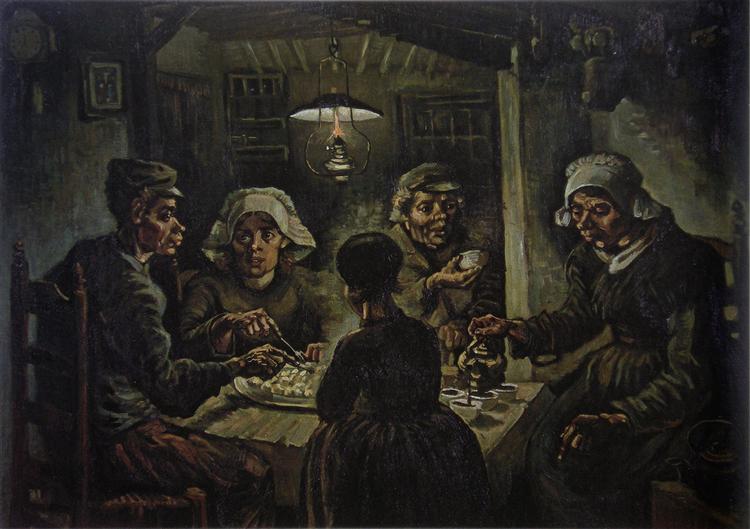
The Potato Eaters, 1885 - Vincent van Gogh

            The Potato Eaters” (1885)


                   Vincent van Gogh


                        ___________


where do you start with Chopin, he is

in our Western cultural bloodstream,

as identifiable in music as, say, van

Gogh is in painting, you don’t need 

to be interested in any kind of art to

have not been given even only a

whiff of these iconic artists


nearly anything I might present here

of Chopin you’ve probably already

heard somewhere before, if only in

bits


of van Gogh, well, he goes back in

the public imagination to at least

Vincent1971, the song, no one

doesn’t know about him, when I

heard it playing in Amsterdam at

the museum, with the first piece I

saw, The Potato Eatersdominating

the first wall, insisting on van Gogh’s

vision, his prophecy, his profound

compassion, I cried, I understood

what art is, see above


Chopin exerts a different kind of,

however equally potent, magic


Mozart might sound like Haydn,

Beethoven might sound like

Schubert, all of the Impressionists

sound like all of the Impressionists,

be they Ravel, Debussy, Satie, or

Saint-Saëns, to the untrained ear


but no one sounds like Chopin,

he’s, culturally, a North Star


here’s one of his nocturnes, the

moonlit one, in E flat major  


here’s a polonaisehere’s an étude,  

in English, a study, a finger exercise,

an iconic, here, prestidigitation


here’s an impromptu, his very,

indeed, Fantaisie-Impromptu, just

to get your categories going


consider its construction, having

some information already about

fantasias, a work of the imagination,

open to any experimentation within

the confines of one movement, with

an impromptu, something purported

to have been created on the spot,

also in one movement


the answer requires you to sharpen

your aesthetic pencil, always a

delight – an impromptu, a

spontaneous invention, a fantaisie,

a work of the imagination, how do

they differ, which part is a fantaisie,

which an impromptu, how do they

nevertheless coalesce


this exercise is the first step in

listening


enjoy


R ! chard

“Is Art Truth?”

paradise-jpglarge

  “Paradise” 

        Hieronymus Bosch

                   __________

Is Art Truth?“, a friend asks after speaking of 
its benefits, “Art accepts and tells the truth-Is
that it ?“, she inquires, wonders

art, like truth itself and beauty, is in the eye 
of the beholder, I submit, and therefore my 
definition is, once again, entirely personal, 
though I’ve rigorously plumbed it

it requires background

art died for a thousand years, it was 
essentially unrecorded, dormant from 
the fall of Rome to the Renaissance, nor 
promoted but for Catholic purposes, 
hence the majestic cathedrals and the 
magisterial altarpieces, works produced 
by, however, communities until eventually 
certain artisans were recognized as more 
inspired than others, and given autonomy

enter Duccio, for instance

in time these new, necessarily idiosyncratic
perspectives – see Hieronymus BoschDante
Alighieri – dominated, veering in their search 
for truth in their art and beauty – selling points,
incidentally – towards less strictly orthodox 
utterances

see above

art, and its contemporary science, were 
chipping away at ecclesiastical dogma

till God died, and artists continued their 
prescient march forward, shaping our 
zeitgeist, our spirit of the times, with 
their pronouncements for lack of any 
other guides

but the voices grew personal, see Mozart
often profound and prophetic, see 
Beethoven, till the confluence of disparate 
realities gave us secularism, each soul for 
itself as a tenet, a credo, a belief, a truth

what did they have in common

I believe it was their quest for beauty 
through truth, their quest for truth 
through beauty, with a nod here to 
the salient Keats 

art is prayer, a search for, as well as a 
manifestation of, one’s personal 
identification with the sacred

it is not truth, it is not beauty, it is the 
fervent intention itself, linked with a 
correspondent workmanship, craft, 
which inspires 

see for instance van Gogh for this, who, 
remember, nevertheless shot himself, 
artists are mortal, merely, messengers, 
ever, therefore, fallible, unsure, fearful 
even, often, of their, perhaps 
Promethean, fire

for consolation, or even maybe 
transcendence, see again,
pertinently here, Beethoven  

listen

Richard

psst: thanks, Joan

my Amsterdam, November 30, 2013

      Van Gogh Painting Sunflowers - Paul Gauguin

Van Gogh Painting Sunflowers (1888)

Paul Gauguin

_______

after experiencing a superb Gauguin,
and an, somewhat more reticent, though
ultimately entirely convincing, other, at
the Amsterdam Hermitage, an offshoot
of the mother house in St Petersburg
there, part of an exhibition on the Nabis,
I tempered my irritation around him and
determined to give him another chance,
he’d mistreated the sublime van Gogh,
enough for me to discredit him, if only for
his lack of aesthetic judgment, not bowing
before van Gogh’s manifest preeminence

the painting above, Van Gogh Painting
Sunflowers
“,
did much, also, to rehabilitate
him for me, and in the very instant

his Self-Portrait Dedicated to Vincent van
Gogh (Les Misérables)
“,
teeming with
flowers that seem to me like a swarm of
insects, is at least respectful

that’s apparently van Gogh in the upper
right hand corner

who ever would ‘a’ thunk it

Richard

sharpening one’s pencil‏

  Cottage and Woman with Goat - Vincent van Gogh

                     Cottage and Woman and Goat (1885)

 
                                       Vincent van Gogh 
 
                                            __________


  Village Street in Winter - Gustave Courbet

                               “Village Street in Winter(1865) 

 
                                     Gustave Courbet  
 
                                         __________


having considered that I’ve just spent
hours and days in some of the world’s
finest museums, you’ll perhaps pardon
my ebullience, I’ve never to date
juxtaposed two art works, I think, for
your consideration
 
but I scream, essentially, at everyone
with whom I visit a museum ever,
juxtapose, juxtapose, juxtapose, it
is the truest path to aesthetic erudition,
should you be so inclined, I call it,
sharpening one’s pencil 
 
 
having been overwhelmed by very
miracles of art, my mom and I, throughout
our European visit, in, specifically, Bruges,
Ghent, Amsterdam and Frankfurt, the
two above, van Gogh‘s Cottage“, called
at the Städel Museum in Frankfurt, and
some of, therefore, our last, burn for me
especially bright, standing naturally
together as comparable works of art,
though choosing between them is like
deciding between oranges and apples
 
but that’s the point, your aesthetic
sensibility says more about you than
it says about art, if you’ll surrender to 
that exploration 
 
and like apples and oranges, it depends
on your mood that day
 
which is also the point
 
 
Farmhouse” for me was a surprise, I’d
never seen this particular, wonderful, 
van Gogh, the Courbet, also a wonder,
stuck more to an anticipated style, where
van Gogh‘s more rural settings had never 
been for me his most successful, I’ll have
to change my mind about that
 
we’d visited the Städel for the splendid
Courbet exhibition we saw there the last
time we were there, when he became, 
along with Rembrandt – wow, Rembrandt – 
one of Mom’s now two favourite painters
 
right now for me it’s still, maybe, Canaletto,
either of them, or Chagall, Klimt, Schiele,
Monet, Avercamp, Filippo Lippi, and too
many others to really remember, I’ve
given up to merely enjoy 
 
here’s hoping you do too  
 
 
Richard  
 
        and follow the icon to enlarge it (+), for an
        alternate, more exact, if I remember, view of 
        Cottage“, which I couldn’t copy for this page,
        you’ll notice a remarkable difference


“Snow White And The Seven Dwarfs”‏

enchanted movie for children of all ages, that
means especially you, Manolito, that means
especially you, Aidan
 
you might however notice, in a more analytical
vein, the introduction of German Expressionism
already in more popular culture, Nolde, Kirchner,
even some Edvard Munch, the Norwegian, in the
bold, garish colours that expressed horror and
perversion for them following the First World War,
and did the same for Walt Disney later if you’ll
consider the evil queen’s mirror and mask, or
van Gogh branches in the threatening forest, flat
surfaces, notably on faces for instance, touched
with only daubs of colour for only perfunctory
shading and character, prefiguring incidentally,
Andy Warhol‘s Pop Art
 
artists talk to each other
 
  
musical atonalities, also, show up, to attest to
modernity, in the music tooted out by the pipe
organ, delivering ornery pipes and a climactic
cuckoo who can only emit a shrill, discordant 
screech, we can thank especially Prokofiev,
the popinjay among the atonalists, for that,
with necessary nods to, for their more
theoretical groundwork, the more exacting
Stravinsky and the too dour, not to mention
for many too dire, Schoenberg  
 
Walt Disney was introducing modern art not so
surreptitiously at all to the larger popular culture,
acclimatizing children especially to the new
upended and revolutionizing art, crayons at
the behest of individuality 
 
 
you’ll also find interesting that Snow White 
succumbs to an apple, much like Mother Eve, 
both of whom are absolved, it’s worth pointing 
out, by nothing other than transcendental,
transformational, regenerative and ever
inspirational, Love
 
think about it  
 
 
Richard


“Two Cut Sunflowers” (1887) – Vincent van Gogh

Vincent van Gogh's Two Cut Sunflowers Painting

                             “Two Cut Sunflowers” (1887)


                                     Vincent van Gogh 

                                       ___________


two cut sunflowers 

the painter apportions mostly gold and blue   

to let their moment last forever       


                    Richard