Richibi’s Weblog

Just another WordPress.com weblog

Tag: Venus

Piano Concerto no 1, opus 23 – Tchaikovsky

the-birth-of-venus-1485(1).jpg!Large

    “The Birth of Venus” (1485) 

          Sandro Botticelli

              ___________

if there’s a piano concerto that dominates
the 19th Century, it’s Tchaikovsky’s First
Piano Concerto, not even Beethoven’s
Fifth, to my mind, matches its celebrity,
one thinks Romantic Period, one thinks
this iconic masterpiece

Tchaikovsky had the advantage of 
absorbing not only Beethoven by this
point in history, but also Chopin, the
narrative power of the former, with 
the mesmerizing textures of the latter,
what could go wrong but insufficient 
genius 

of which Tchaikovsky manifestly had 
more than plenty, enough to verily 
stop your breath  

many towering performers have 
challenged this concerto‘s peaks, 
some even historically, you’ve 
heard them, I won’t reiterate

but listen to what Yuja Wang does with
this challenge, and you tell me if she 
doesn’t conquer its tribulations
despite, or abetted by, her 
controversial dress 

she is a vixen, manifestly, at least in, 
admittedly, her attire, but should a 
vixen play as brilliantly, what does 
one have to counter her provocative 
presentation but her innate femininity, 
her, too often castigated, female pulse, 
something the world could do with 
lot more of

Venuswith all her allure, was goddess 
for centuries before women were 
obliterated from the dominant Christian 
pantheon, the Father, the Son, the Holy, 
I ask you, Ghost, with no equal female 
foundational representative 

Yuja Wangmodern day Venus abetted 
by her evident attendant muses, the
symbolic, hereorchestra, see  above 
could play nude, as far as I’m concerned,  
she’d still be transcendent, and I’m not
even heterosexual 

girlfriend, I say, however proper, modest, 
blushing, get a grip

not to mention that Tchaikovsky is also, 
in this outing, once again, astounding

listen


R ! chard

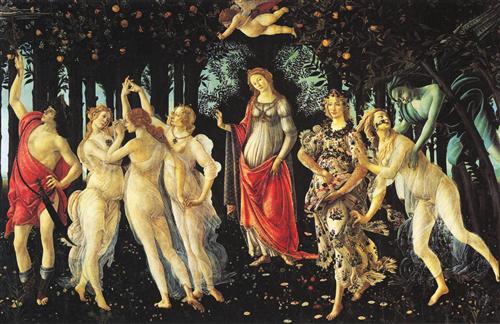
“Primavera” – Sandro Botticelli‏

Sandro Botticelli - "Primavera"

Primavera (1478)

Sandro Botticelli

_________

on the right, Zephyrus, god of the west
wind, and messenger of spring, having
prised Chloris from his brother, Boreas,
the icy north wind, ravishes her, the
naked nymph, who is being transformed
into Flora, goddess of flowers, note
Chloris‘ hand dissolving into Flora‘s
arm

but listen to Ovid tell it

“‘I, called Flora now, was Chloris: the first letter in Greek
Of my name, became corrupted in the Latin language.
I was Chloris, a nymph of those happy fields,
Where, as you’ve heard, fortunate men once lived.
It would be difficult to speak of my form, with modesty,
But it brought my mother a god as a son-in-law.
It was spring, I wandered: Zephyrus saw me: I left.
He followed me: I fled: he was the stronger,
And Boreas had given his brother authority for rape
By daring to steal a prize from Erechteus‘ house.
Yet he made amends for his violence, by granting me
The name of bride, and I’ve nothing to complain in bed.
I enjoy perpetual spring: the season’s always bright,
The trees have leaves: the ground is always green.
I’ve a fruitful garden in the fields that were my dower,
Fanned by the breeze, and watered by a flowing spring.
My husband stocked it with flowers, richly,
And said: “Goddess, be mistress of the flowers.”
I often wished to tally the colours set there,
But I couldn’t, there were too many to count.””

Fasti, Book V, May 2 – Ovid

________________

I love “It would be difficult to speak of my
form, with modesty”

go, girl, indeed goddess

on the left of the painting the three Graces,
Aglaea, Euphrosyne, and Thalia dance

on the far left, Mars, whence, incidentally,
our name for the month of March, is god
not only of war, but of also agriculture

Venus, who needs no introduction,
presides at the centre, accompanied
by her prankish son, Cupid, fluttering
above

“Love looks not with the eyes, but
with the mind”, Shakespeare says,
“And therefore is winged Cupid
painted blind” *

as he is in the painting above

no painting has yet replaced Botticelli‘s
Primavera as a universal symbol of
spring

may yours be equally timeless,
enchanted

Richard

* A Midsummer Night’s Dream
Act 1, scene 1, lines 234 – 235

– William Shakespeare