Symphony no 7 in C major, opus 60, the “Leningrad”- Dmitri Shostakovich
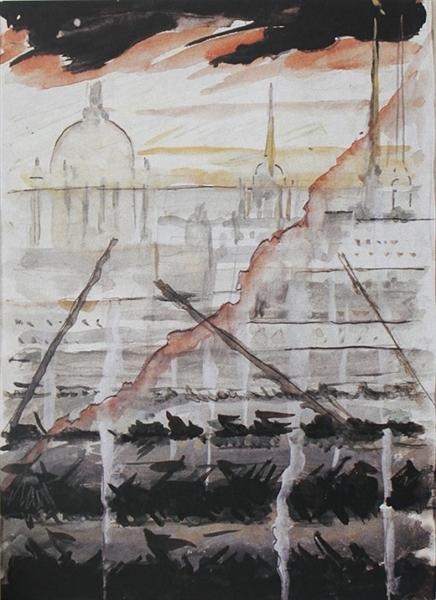
“Leningrad in blockade. Sketch on the theme of
“Leningrad Symphony” of D. D. Shostakovich.“
(c.1943)
__________
though I’ve been through the Seventh
three times already, consecutively, it
doesn’t reach, for me, the heights the
Fifth did, its first movement is
manifestly imperious, nearly even
overwhelming, certainly unforgettable,
I’ve been humming the ostinato in my
sleep
but the following movements seem to
me – not being Russian, nor having as
intimately incorporated their culture,
where rhythms and history are
inextricably intertwined – muddled
about the reconstruction of its
shattered world, melodies might be
lovely but are lost in a blur of musical
directions, there isn’t enough repetition
of musical motifs to find solid ground,
angry statements follow lyrical adagios
too often to get our bearings on what
might be going on
the first movement, however, remains a
triumph, note the debt owed to Ravel’s
“Bolero“ in the rousing ostinato, the
part where the same musical phrase
obstinately repeats its peremptory and
ever more vociferous mantra, its
headlong incantation, an interesting
blend in either symphonic work of the
sinuous, the seductive, the beguiling,
turning into the overtly martial, all to
do with pulse
the Symphony no 7, the “Leningrad”,
was first presented in that very city
during its siege by the Germans,
which lasted from 1941 to 1944,
however unbelievably, Shostakovich,
already a giant, was expected to deliver
a masterpiece by both the people and
by the regime, imagine Bono doing a
concert for Syria
Shostakovich doesn’t disappoint
players were culled from what remained
of instrumentalists among the survivors
of both Stalin’s criminal purges and of
the German siege itself left in the city,
those who hadn’t survived the famine
there, Valery Gergiev, an exalted
Russian conductor, describes them as
walking skeletons, meagre from
starvation, we’ve seen these before at
Auschwitz
the world heard, and was moved,
imperialism in any form was being
vociferously condemned, going back
to Napoleon even and his own failed
invasion, if not also to Hannibal
crossing the Alps, Caesar, his
Rubicon
much of this symphony is about cultural
resistance, the survival of a proud and
resilient seed, any proud and resilient
seed, hence its international standing
see Beethoven’s 9th Symphony for
comparable fanfare, flourish, and
circumstance, the only other work of
any such historical political importance
and, appreciably, still unsurpassed,
except for, maybe, Roger Waters
channeling Pink Floyd at the Berlin
Wall, along with, not incidentally
there, again Beethoven
R ! chard
psst: the other great composer of the
20th Century, Messiaen, also
composed a commemoration of
an awful moment in our history,
the Holocaust, his “Quartet for
the End of Time“, played originally
in his very concentration camp by
similarly “walking skeletons”, does
for me everything Shostakovich’s
Seventh didn’t

 Richibi's Weblog