Just another WordPress.com weblog
Tag: Uranus – personification of the Heavens
____
To keep his promise he ascends,
inamorata, that when next he[‘d]
court[ ] the rites of love, he’d
descend in those celestial charms
with which he enters Juno / Hera‘s
chambers, his goddess / wife, on
similar intimate occasions
and shrowds
His awful brow in whirl-winds and in clouds;
shrowds, shrouds, covers in
darkness, shields
awful, inspiring awe, inspiring
consternation
Whilst all around, in terrible array,
His thunders rattle, and his light’nings play.
shrowd[ ] /His awful brow, which is
to say he actively effects changes,
consciously and manifestly producing
identifiable outcomes, a shrouded brow,
in this instance, but he also inspires the
very elements, thunders rattle …
light’nings play, to rally round his
enterprise
And yet, the dazling lustre to abate,
He set not out in all his pomp and state,
/ Zeus chooses, set[s] … out, to rein
in, abate, elements of his pomp and
state, of his magnificence
Clad in the mildest light’ning of the skies,
And arm’d with thunder of the smallest size:
Not those huge bolts, by which the giants slain
Lay overthrown on the Phlegrean plain.
‘Twas of a lesser mould, and lighter weight;
Phlegrean plain, Phlegraean, site of the
war that won for the Olympians, Jove /
pantheon of other gods with whom
we’ve here become acquainted, control
of the cosmos, against the Titans, who’d
earlier ruled, the children of Uranus,
Sky, and Gaia, Earth, though that’s
an entirely other, earlier story, equally
entrancing
They call it thunder of a second-rate,
For the rough Cyclops, who by Jove’s command
Temper’d the bolt, and turn’d it to his hand,
Cyclops, any of the three Cyclopes,
Arges, Brontes, and Steropes, or in
English translation, Bright, Thunder,
and Lightning, sons of Uranus and
Gaia, one-eyed giants, who
Zeus‘s thunderbolts
Cyclops here is probably Cyclopes,
spelling of the now singular “Cyclops”,
all of whom [t]emper’d the bolt, and
turn’d … to his hand Jove / Jupiter /
Zeus‘s commissioned arsenal
Work’d up less flame and fury in its make,
And quench’d it sooner in the standing lake.
this particular thunderbolt therefore
would have been less menacing, in
wish his dazling lustre to abate
Thus dreadfully adorn’d, with horror bright,
Th’ illustrious God, descending from his height,
Came rushing on her in a storm of light.
I knew someone who came to me
like that once
The mortal dame, too feeble to engage
The lightning’s flashes, and the thunder’s rage,
Consum’d amidst the glories she desir’d,
And in the terrible embrace expir’d.
I broke only into a thousand million
pieces, did not expire, but ruefully,
rather, survived, but that’s another
story, perhaps too intimate
But, to preserve his offspring from the tomb,
his offspring, you’ll remember that
Jove took him smoaking from the blasted womb:
blasted, destroyed, [c]onsum’d[,]
amidst the glories she desir’d
And, if on ancient tales we may rely,
Inclos’d th’ abortive infant in his thigh.
in order to allow it to complete
incubated th’ abortive infant in
his [own] thigh
Here when the babe had all his time fulfill’d,
Here, in his thigh
Ino first took him for her foster-child;
Ino, sister of Semele, with too long
a story here, however fascinating
Then the Niseans, in their dark abode,
Niseans, Nysians, of Nysa, a
mountainous mythical land
beyond Greece, with dark
abode[s], caves, among its
mountains, presumably
Nurs’d secretly with milk the thriving God.
the thriving God, Bacchus, the Roman
Dionysus, god of wine, merriment, and
all kinds of mischievousness, which is
to say bacchanals, Dionysian revelries,
orgies
stay tuned
R ! chard
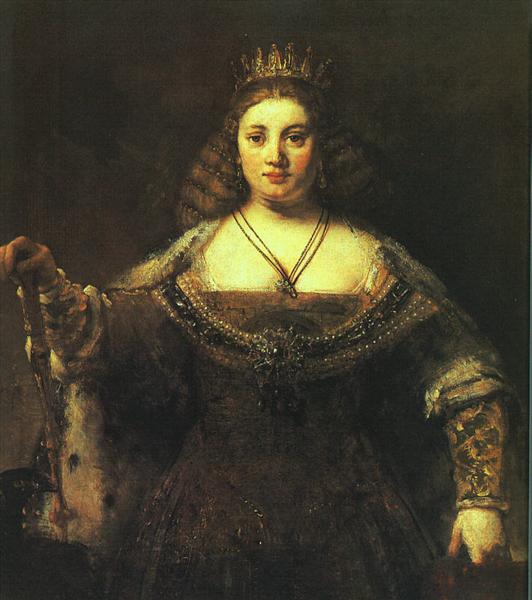
“Juno” (c.1662 – c.1665)
______
Actaeon’s suff’rings, and Diana’s rage,
Did all the thoughts of men and Gods engage;
Some call’d the evils which Diana wrought,
Too great, and disproportion’d to the fault:
Others again, esteem’d Actaeon’s woes
Fit for a virgin Goddess to impose.
The hearers into diff’rent parts divide,
And reasons are produc’d on either side.
remember, not all the gods were
on side
Juno alone, of all that heard the news,
Nor would condemn the Goddess, nor excuse:
queen, therefore, of the gods
She heeded not the justice of the deed,
But joy’d to see the race of Cadmus bleed;
For still she kept Europa in her mind,
And, for her sake, detested all her kind.
Europa had been whisked away
husband, and borne him several
children, to the enduring enmity
of the queen of the deities
Besides, to aggravate her hate, she heard
How Semele, to Jove’s embrace preferr’d,
Was now grown big with an immortal load,
And carry’d in her womb a future God.
philanderer apparently, had now
impregnated Semele, youngest
daughter of Cadmus, to Juno’s
utter disgust and dismay
Thus terribly incens’d, the Goddess broke
To sudden fury, and abruptly spoke.
let me reiterate here that the original
gods and goddesses of Olympus had
migrated with the Greeks to other
areas of the Mediterranean, but
became known, in the lands that
they’d settled, by other names
according to the languages and
customs that evolved in these new
territories, thus the Greek goddess
Hera was in Rome and its outlying
areas known as Juno, the Greek
though their home remained for
“Are my reproaches of so small a force?
‘Tis time I then pursue another course:
about his inveterate philandering,
her reproaches were not enough
to stop the god from his
determined activities
she therefore ordains
It is decreed the guilty wretch shall die,
If I’m indeed the mistress of the sky,
If rightly styl’d among the Pow’rs above
The wife and sister of the thund’ring Jove
(And none can sure a sister’s right deny);
It is decreed the guilty wretch shall die.
Juno / Hera is not only the wife of
sister, both children of Cronos /
were themselves children of the
earth goddess Gaia and the sky
She boasts an honour I can hardly claim,
Pregnant she rises to a mother’s name;
While proud and vain she triumphs in her Jove,
And shows the glorious tokens of his love:
though Juno / Hera did indeed have
she is probably no longer here
bearing him any, I am supposing,
while Semele, proud and vain, is
now show[ing] the glorious tokens
of his love
But if I’m still the mistress of the skies,
By her own lover the fond beauty dies.”
/ Zeus the cause of Semele’s
demise
This said, descending in a yellow cloud,
Before the gates of Semele she stood.
/ Zeus, would’ve been officiating at
the Cadmeia, the equivalent of the
Athenian Acropolis, at Thebes, the
city named after her father, its
sparks will surely fly
stay tuned
R ! chard

 Richibi's Weblog