“The Story of Phaeton” (II) – Ovid
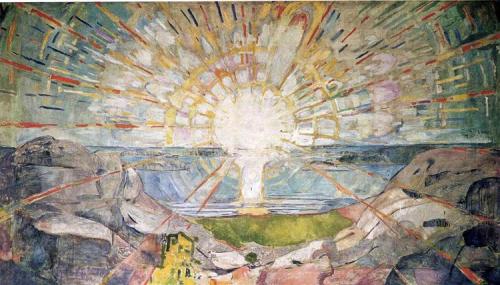
“The Sun“ (1911 – 1916)
Edvard Munch
_______
The Sun’s bright palace, on high columns rais’d,
The Sun, Helios / Phoebus / Apollo
With burnish’d gold and flaming jewels blaz’d;
The folding gates diffus’d a silver light,
And with a milder gleam refresh’d the sight;
since the folding gates of the bright
palace shimmered with a silver light
rather than with the glow of the gold
and flaming jewels of the palace itself,
their milder gleam was easier on the
eyes, refresh’d the sight
Of polish’d iv’ry was the cov’ring wrought:
the palace was covered with polish’d
wrought ivory
The matter vied not with the sculptor’s thought,
the execution of the palace was
everything that its sculptor, its
architect, had had in mind to
create
For in the portal was display’d on high
(The work of Vulcan) a fictitious sky;
Vulcan, god of fire, metal, smiths,
metalworkers
at the entrance to the palace, the
portal, Vulcan had painted the ceiling,
he’d display’d on high … a fictitious
sky, I suspect Dryden must’ve had
Michelangelo and his ceiling of the
Sistine Chapel in mind during his
translation of this passage of Ovid
A waving sea th’ inferiour Earth embrac’d,
inferiour, Earth, surging from under the
greater masses of water dominating it,
especially after the flood, is, therefore,
beneath the waving sea, inferiour to it
And Gods and Goddesses the waters grac’d.
remember that Ovid is describing a
painting here, on the ceiling at the
entrance, the portal, to the palace
of the god of the Sun
Aegeon here a mighty whale bestrode;
Aegeon, marine god, god of storms,
note the similarity of the name with
that of the Aegean Sea, but which
came first, the chicken or the egg,
the god or the expanse of water,
remains, as far as I’ve been able
to determine, undetermined
Triton, and Proteus (the deceiving God)
Triton, another god of the Sea, you’ll
remember him coming to the aid of
Neptune, his father, in settling the
waters after the flood at the request
of Jove / Jupiter / Zeus
Proteus, still another sea god,
described as deceiving, for his
ability to effortlessly, and
spontaneously, change his shape,
from which, incidentally, we get
the adjective protean, for easily
changeable, or versatile
With Doris here were carv’d, and all her train,
Doris, sea goddess, and all her train,
her fifty daughters, if you’ll remember,
are carv’d, etched, given graphic
representation
Some loosely swimming in the figur’d main,
figur’d, painted, depicted, drawn
main, the open ocean, but, probably
also here, the main, or central, part
of the painting itself
While some on rocks their dropping hair divide,
their hair divide, they loosen strands
of their wet hair
And some on fishes through the waters glide:
sea gods and goddesses are often
shown riding sea creatures, dolphins,
seahorses, even whales, see Aegeon
above
Tho’ various features did the sisters grace,
A sister’s likeness was in ev’ry face.
the sisters, the Nereids, all have different
features, but a family resemblance, sister’s
likeness, can always be detected in each
individual sibling’s rendering
On Earth a diff’rent landskip courts the eyes,
Earth doesn’t look, court[ ] the eyes,
at all like what’s painted on the
palace’s ceiling
landskip, landscape
Men, towns, and beasts in distant prospects rise,
distant prospects, from a distance, one
can see [m]en, towns, and beasts
appear, rise, arise
And nymphs, and streams, and woods, and rural deities.
nymphs, consigned, it appears, to
earthly duties, streams, and woods,
are not a feature of the Sun god’s
palace
O’er all, the Heav’n’s refulgent image shines;
the Heav’n’s refulgent, brightly shining,
image, expression, is manifest [o]’er all,
everywhere, the rays of the sun cast a
light on everything
On either gate were six engraven signs.
again I’m reminded of a Renaissance
wonder, Lorenzo Ghiberti‘s gilded bronze
doors for the Florence Baptistery, which
Michelangelo himself called the Gates of
Paradise, a work nearly as famous, then
and now, as his own Sistine Chapel ceiling
Ovid would never have known of these
masterworks, of course, having lived
over a millenium earlier, but I suspect
John Dryden, a cultured man, a couple
of hundred years later than these
cultural icons, would no doubt have
been fully aware of them, much as we,
however disinterested we might be,
can’t help but have heard of, say,
Rembrandt, Chopin, Charles Dickens,
for instance, though they be, similarly,
centuries separated from us
my point is that, without knowledge of
the original Latin, Dryden‘s cultural
heritage must’ve slipped, I think,
consciously or not, into his
translation, for better, or for worse
it should be remembered, however,
that Dryden was writing for an early
18th Century audience, much as I
am presently doing myself with
Dryden for a 21st, and maybe also
similarly skewing his idiom to better
adapt it to our own time, for better,
also, or for worse
Here Phaeton still gaining on th’ ascent,
gaining on th’ ascent, going faster
and faster, climbing higher and
higher
To his suspected father’s palace went,
suspected father, Phaeton doesn’t
yet know if Helios / Phoebus / Apollo
is indeed his father
‘Till pressing forward through the bright abode,
He saw at distance the illustrious God:
He saw at distance, or the dazling light
Had flash’d too strongly on his aking sight.
had Phaeton not been as far, at
distance, from what he was seeing,
the illustrious God, the dazling, or
dazzling, light would’ve hurt his
eyes, hurt his aking, or aching,
sight
The God sits high, exalted on a throne
Of blazing gems, with purple garments on;
Tyrian, surely, purple, a hue we’ve
seen here before, indicative of
stature, of imperial, if not even
divine, as in this instance,
pedigree
The Hours, in order rang’d on either hand,
And Days, and Months, and Years, and Ages stand.
Here Spring appears with flow’ry chaplets bound;
Here Summer in her wheaten garland crown’d;
Here Autumn the rich trodden grapes besmear;
And hoary Winter shivers in the reer.
this is no longer a picture, but the
real thing, Phoebus / Apollo / Helios
sits high, exalted on a throne / Of
blazing gems, with purple garments
on, while Time and all of the Seasons
hold court around him
Phoebus beheld the youth from off his throne;
That eye, which looks on all, was fix’d in one.
Phoebus, who sees everything, who
looks on all, beholds, fixes his eye on,
his son
He saw the boy’s confusion in his face,
Surpriz’d at all the wonders of the place;
And cries aloud, “What wants my son? for know
My son thou art, and I must call thee so.”
Phaeton, according to Phoebus /
Apollo / Helios‘ forthright admission,
is truly his son
“Light of the world,” the trembling youth replies,
“Illustrious parent! since you don’t despise
The parent’s name,
despise, refute
some certain token give,
That I may Clymene’s proud boast believe,
Nor longer under false reproaches grieve.”
your word is good, Phaeton allows,
but incontrovertibly, now, prove it,
some certain token give, he
challenges
The tender sire was touch’d with what he said,
And flung the blaze of glories from his head,
flung the blaze of glories from his head,
reduced the intensity of his presence,
the impact of his charisma, took off
his dazling crown, if only, maybe,
metaphorically, to be father to his son
And bid the youth advance: “My son,” said he,
“Come to thy father’s arms! for Clymene
Has told thee true; a parent’s name I own,
And deem thee worthy to be called my son.
As a sure proof, make some request, and I,
Whate’er it be, with that request comply;
By Styx I swear, whose waves are hid in night,
And roul impervious to my piercing sight.”
an oath upon Styx is incontrovertible,
like swearing on a Bible, as earlier
noted
The youth transported, asks, without delay,
To guide the sun’s bright chariot for a day.
Phaeton wants to drive his father’s
car, the sun’s bright chariot, how
contemporary, how immediate,
how timeless
stay tuned
R ! chard
 Richibi's Weblog