Richibi’s Weblog

Just another WordPress.com weblog

Tag: Tyre / Phoenicia

“The Story of Pentheus” – Ovid

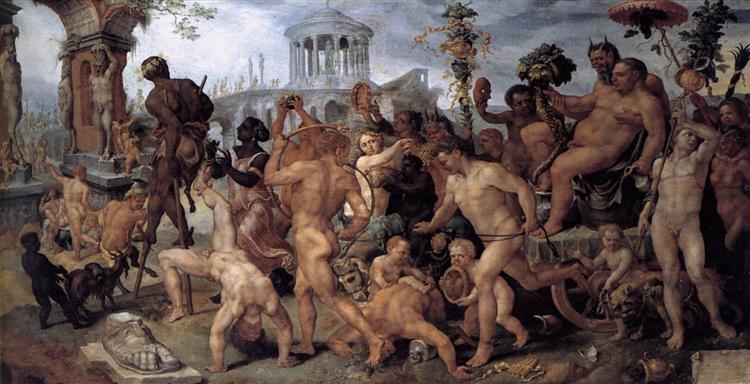
The Triumphal Procession of Bacchus, c.1536 - Maerten van Heemskerck

         The Triumphal Procession of Bacchus” (c.1536)


                   Maerten van Heemskerck


                             _______________


till now the separate stories in Ovid’s

Metamorphoses have been linked,

one being either a consequence of

the other,or its cause, but the story

of Pentheus, grandson of Cadmus,

king and founder of Thebes, who

earlier in this series had his own

tale told, starts, as my German

teacher used to say, from the

scratch


This sad event, therefore, in the

first line of the poem, refers to

what will follow, not what came

before


            This sad event gave blind Tiresias fame,

            Through Greece establish’d in a prophet’s name.


Tiresias, if you’ll remember, had been

blinded by Juno / Hera, goddess of the

gods, for having sided with Jove / Jupiter

/ Zeus, her husband, in a wager between

them he’d been called upon to decide,

Jove / Jupiter / Zeus, however, gave 

Tiresias, as consolation, having been

barred by a pact among the gods not

to undo each other’s spells, the gift

of insight, prophecy


the example that follows, of his divination,

establish[‘d] at that time his reputation

[t]hrough[out] Greece as a prophet


            Th’ unhallow’d Pentheus only durst deride

            The cheated people, and their eyeless guide.


unhallow’d, unholy, wicked, sinful


Pentheus, king of Thebes following

his grandfather, Cadmus, but that’s

an entirely other story


only, of all the people, none but

Pentheus durst, dared, deride,

mock, their eyeless guide, Tiresias

            To whom the prophet in his fury said,

            Shaking the hoary honours of his head:


hoary, grizzled, gray, aged


            “‘Twere well, presumptuous man, ’twere well forthee

            If thou wert eyeless too, and blind, like me:

            For the time comes, nay, ’tis already here,

            When the young God’s solemnities appear:


the young God[], Bacchus / Dionysus,

son of Semele and Jove / Jupiter / Zeus,

if you’ll remember, god of revelry,

intoxication, wild abandon


            Which, if thou dost not with just rites adorn,

            Thy impious carcass, into pieces torn,

            Shall strew the woods, and hang on ev’ry thorn.


impious carcass, dishonoured corpse, 

of any thou who wouldn’t’ve honoured

the celebrations


            Then, then, remember what I now foretel,

            And own the blind Tiresias saw too well.”


own, agree to, admit

            Still Pentheus scorns him, and derides his skill;

            But time did all the prophet’s threats fulfil.

            For now through prostrate Greece young Bacchus rode,


prostrate, beholden, reverent, observant

of the solemnities


            Whilst howling matrons celebrate the God:

            All ranks and sexes to his Orgies ran,

            To mingle in the pomps, and fill the train.


the rites of Bacchus were bacchanals,

orgies, celebrations of abandon, Mardi

Gras, for instance, in New Orleans,

annual Gay Parades, now everywhere,

or Hallowe’en since time immemorial


see above


            When Pentheus thus his wicked rage express’d:

            “What madness, Thebans, has your souls possess’d?

            Can hollow timbrels, can a drunken shout,


timbrels, tambourines


            And the lewd clamours of a beastly rout,

            Thus quell your courage;


quell your courage, overcome your

sense of discipline


                                            can the weak alarm

            Of women’s yells those stubborn souls disarm,


those stubborn souls, the Theban

spirit of pride and honour


            Whom nor the sword nor trumpet e’er could fright,

            Nor the loud din and horror of a fight?

            And you, our sires, who left your old abodes,


our sires, the older generation of

Thebans, of his grandfather

Cadmus‘ ilk


            And fix’d in foreign earth your country Gods;


foreign earth, very Thebes, from Tyre,

where Cadmus and his followers had

come from, in search of Europa, if

you’ll remember


            Will you without a stroak your city yield,


stroak, stroke


            And poorly quit an undisputed field?


undisputed field, there are no

military obstructions


            But you, whose youth and vigour should inspire

            Heroick warmth, and kindle martial fire,

            Whom burnish’d arms and crested helmets grace,

            Not flow’ry garlands and a painted face;


Remember him to whom you stand ally’d:


him, Pentheus himself, their king


            The serpent for his well of waters dy’d.


The serpenta reference here to the

dragon that Cadmus slew, which had

guarded the cavern where his crew

had been scouting for water, if you’ll

remember


            He fought the strong; do you his courage show,

            And gain a conquest o’er a feeble foe.


a feeble foe, licentiousness, abandon,

undisciplined revelry


            If Thebes must fall, oh might the fates afford

            A nobler doom from famine, fire, or sword.


Pentheus appeals to a loftier reason

for defeat, famine, fire, or sword, than

mere, and ignoble, debauchery


            Then might the Thebans perish with renown:

            But now a beardless victor sacks the town;


beardless victor, the young Bacchus /

Dionysus


            Whom nor the prancing steed, nor pond’rous shield,

            Nor the hack’d helmet, nor the dusty field,

            But the soft joys of luxury and ease,

            The purple vests, and flow’ry garlands please.


Bacchus / Dionysus is not impressed

by armour, military accomplishments,

prowess, but by grace, elegance, and

poetry


            Stand then aside, I’ll make the counterfeit

            Renounce his god-head, and confess the cheat.


the counterfeit, Bacchus / Dionysus


            Acrisius from the Grecian walls repell’d

            This boasted pow’r; why then should Pentheus yield?


Acrisius, a king of Argos, who must’ve

also repell’d from his city Bacchus /

Dionysus, according to the poem


            Go quickly drag th’ impostor boy to me;


th’ impostor boy, the counterfeit,

Bachus / Dionysus


            I’ll try the force of his divinity.”


try, test


            Thus did th’ audacious wretch those rites profane;


th’ audacious wretch, Pentheus


            His friends dissuade th’ audacious wretch in vain:

            In vain his grandsire urg’d him to give o’er

            His impious threats; the wretch but raves the more.


his grandsire, Cadmus

            So have I seen a river gently glide,

            In a smooth course, and inoffensive tide;

            But if with dams its current we restrain,

            It bears down all, and foams along the plain.


nature will have its way, so will the

gods, watch out, the narrator says,

who it is that you challenge

            But now his servants came besmear’d with blood,

            Sent by their haughty prince to seize the God;


his servants, Pentheus‘ men


the God, Bacchus / Dionysus


            The God they found not in the frantick throng,

            But dragg’d a zealous votary along.


votary, follower, adherent,

acolyte


the servants, Pentheus‘ men,

who did not, apparently, deliver


stay tuned


R ! chard
“The Story of of Cadmus” (V) – Ovid

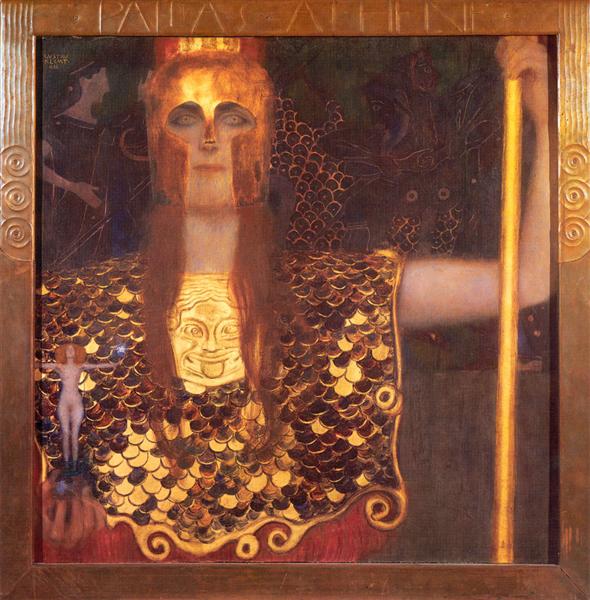
Minerva or Pallas Athena, 1898 - Gustav Klimt

         Minerva or Pallas Athena” (1898)


                Gustav Klimt


                       ______


an interesting thing has happened with

the story of Cadmus, he is not only a

mythical figure, but also a legendary

one, which is to say that Cadmus has

roots in actual history, he’s not just an

imaginary construct like those that

until now have peopled Ovid’s text


Cadmus appears to have actually

founded Thebes, whose origins,

however, are lost in antiquity, going

back to, it appears, the late Bronze

Age, around 2000 BC, goodness


stories evidently grew around

Cadmus, that transformed him into

our first documented hero, indeed

superhero


counterparts exist in other traditions,

consider David, for instance, who

slew his own dragon, Goliath, before

becoming king of the Israelites, 10th

Century BCE, at Jerusalem, where

he consorted, incidentally, later, with

Bathsheba, however illicitly, but

that’s another story


King Arthur, late 5th to early 6th

Centuries CE, stems from British

lore, though his historical actuality

has been contested, is also a hero

with preternatural capabilities based

on some historical accountability


in our day, there’s James Bond,

based on real, living and breathing,

personalities


or, dare I say, even Jesus


the point here is that actual people

are being included in the, however

culturally specific, mythologies,

which, in each, had earlier consisted

of metaphorical constructs merely,

the concept of History, in other words,

was being born, memorable events

were to be remembered, recorded,

documented, if only, originally, orally,

around, say, campfires, however

aggrandized might have been their

recollected heroes


Cadmus, meanwhile, in our story, is

about to establish his own historical,

and archeologically confirmed, note,

credentials


            The dire example ran through all the field,
            ‘Till heaps of brothers were by brothers kill’d;


The dire example, the dragon’s teeth,

grown into men, had begun, if you’ll

remember, to slaughter one another


example, display


            The furrows swam in blood: and only five
            Of all the vast increase were left alive.
            Echion one, at Pallas’s command,
            Let fall the guiltless weapon from his hand,


Echion, one of the five surviving

brothers


Pallas, Pallas Athena, goddess of

Wisdom, also of War


see above


            And with the rest a peaceful treaty makes,
            Whom Cadmus as his friends and partners takes;


the rest, the four other survivors


            So founds a city on the promis’d earth,
            And gives his new Boeotian empire birth.


promis’d earth, the premonition of

the oracles whose counsel Cadmus

had sought at Delphi, if you’ll

remember


            Here Cadmus reign’d; and now one would have guess’d
            The royal founder in his exile blest:


his exile, from Tyre, Cadmus’ original

home, from which his father, Agenor,

had sent him, not to return, he’d

warnedwithout his sister, Europa


            Long did he live within his new abodes,
            Ally’d by marriage to the deathless Gods;


Ally’d by marriage, at the end of a

period of penance for having killed

the dragon, which had been sacred

to Ares, god of War, the gods gave

Cadmus Harmonia, goddess of

Concord, to be his wife


Ares would eventually exact mighty

vengeance, but that’s another story


            And, in a fruitful wife’s embraces old,
            A long increase of children’s children told:
            But no frail man, however great or high,
            Can be concluded blest before he die.


even Cadmus, though he might

enjoy a long life, and many, a long

increase of, children, is not immune

to any of the vicissitudes of life either

until his own time has come, the poet

advises, however ominously


and here Ovid also introduces the

subject of his next metamorphosis,

Actaeon, however early, luring us

thereby, deftly, literarily, towards

his next instalment, Actaeon’s

story, eponymously, there, given

its title


            Actaeon was the first of all his race,

            Who griev’d his grandsire in his borrow’d face;

            Condemn’d by stern Diana to bemoan
            The branching horns, and visage not his own;


his grandsire, his grandfather,

Cadmus was the father of Autonoë,

who was the mother of Actaeon


borrow’d face, Actaeon was

transformed into a stag by the

goddess Diana / Artemis, of the

Hunt, of the Moon, of Chastity,

for having seen her naked as

she was bathing


he now has the face, the visage, of

someone, something, he hadn’t

been before, borrow’d


            To shun his once lov’d dogs, to bound away,
            And from their huntsman to become their prey,


having been transformed into a

stag, or metamorphized, Actaeon

would end up hunted, and worse,

by his own, once lov’d, dogs


            And yet consider why the change was wrought,
            You’ll find it his misfortune, not his fault;
            Or, if a fault, it was the fault of chance:
            For how can guilt proceed from ignorance?


to have been at the wrong place

at the wrong time, yet to suffer,

however unfairly, the consequences,

that, Ovid asks, is the question, the

conundrum


stay tuned


R ! chard

“The Story of of Cadmus” (ll) – Ovid

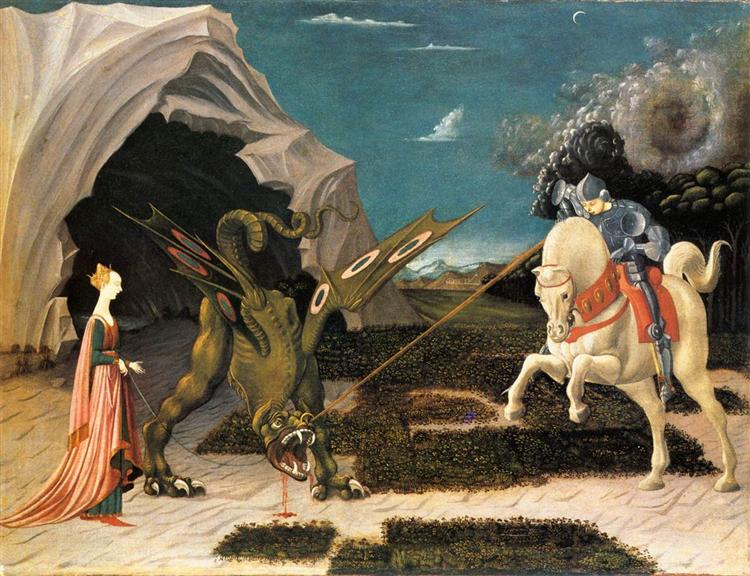
St. George and the Dragon, c.1470 - Paolo Uccello

          “St. George and the Dragon” (c.1470)


                 Paolo Uccello


                            _______


             Cadmus salutes the soil, and gladly hails

             The new-found mountains, and the nameless vales,

             And thanks the Gods, and turns about his eye

             To see his new dominions round him lye;


Cadmus, son of Agenor, brother of

Europa, has, on the advice of the

Delphick oracles, settled where

the lonely cow, / Unworn with yokes,

unbroken to the plow had stoop’d,

and couch’d amid the rising grass,

and stakes there his new appointed

home


vales, valleys


             Then sends his servants to a neighb’ring grove

             For living streams, a sacrifice to Jove.


Cadmus, a prince, would’ve had

a retinue, followers, Hamlet for

instance, his Horatio, his

Rosencrantz and Guildenstern


Jove, note, is the god who abducted

Europa, though Cadmus, according

to our story, isn’t yet supposed to 

know this, never having found his

sister, nor identified, consequently,

her ravisher, namely Jovethe god

to whom Cadmus is now about to

give sacrifice, give thanks


             O’er the wide plain there rose a shady wood

             Of aged trees; in its dark bosom stood

             A bushy thicket, pathless and unworn,

             O’er-run with brambles, and perplex’d with thorn:


perplex’d, a wonderful metaphor

here for entangled, enmeshed


             Amidst the brake a hollow den was found,

             With rocks and shelving arches vaulted round.


brake, bracken, brush


             Deep in the dreary den, conceal’d from day,

             Sacred to Mars, a mighty dragon lay,


Mars, god of War


a mighty dragon, dragons, it appears,

go back to very prehistory, perhaps

as a memory in our reptilian brain of

dinosaurs, and the like, that made its

way into our poetic imagination


see above 


             Bloated with poison to a monstrous size;

             Fire broke in flashes when he glanc’d his eyes:


glanc’d his eyes, threw glances at


             His tow’ring crest was glorious to behold,


crest, as in roosters, or reptiles


             His shoulders and his sides were scal’d with gold;


scal’d, having scales, plates,

overlapping surfaces


             Three tongues he brandish’d when he charg’d his foes;

             His teeth stood jaggy in three dreadful rowes.


rowes, rows, three dreadful ones,

one behind the other


             The Tyrians in the den for water sought,


The Tyrians, Cadmus and his men,

all originally from Tyre


             And with their urns explor’d the hollow vault:


urns, to collect from living streams

within the vault a sacrifice to Jove


             From side to side their empty urns rebound,


rebound, knock against a harder

surface repeatedly


             And rowse the sleeping serpent with the sound.


rowse, rouse


             Strait he bestirs him, and is seen to rise;


he bestirs him, he bestirs himself


             And now with dreadful hissings fills the skies,

             And darts his forky tongues, and rowles his glaring eyes.


rowles, rolls


             The Tyrians drop their vessels in the fright,


vessels, urns


             All pale and trembling at the hideous sight.

             Spire above spire uprear’d in air he stood,


Spire above spire, scale upon scale


uprear’d, reared up


he, the serpent


             And gazing round him over-look’d the wood:


overlook’d, looked over, surveyed


             Then floating on the ground in circles rowl’d;


rowl’d, rolled


             Then leap’d upon them in a mighty fold.


fold, embrace, encirclement


             Of such a bulk, and such a monstrous size

             The serpent in the polar circle lyes,

             That stretches over half the northern skies.


The serpent in the polar circle, Serpens,

a constellation in the Northern Hemisphere

in close proximity to the North Pole


lyes, lies


             In vain the Tyrians on their arms rely,


their arms, their weapons


             In vain attempt to fight, in vain to fly:
             All their endeavours and their hopes are vain;
             Some die entangled in the winding train;


the winding train, the serpent’s

tail


             Some are devour’d, or feel a loathsom death,
             Swoln up with blasts of pestilential breath.


stay tuned


R ! chard

“The Story of of Cadmus” – Ovid

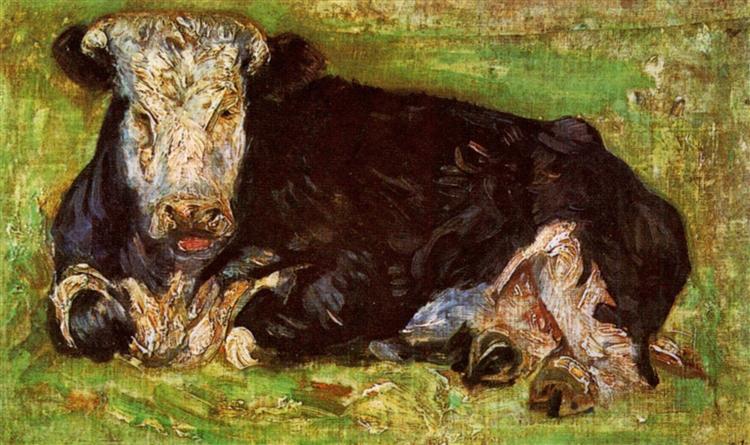
Lying Cow, 1883 - Vincent van Gogh

        Lying Cow(1883)


             Vincent van Gogh


                           ______

            When now Agenor had his daughter lost,


Agenor, king of Tyre, father of

Europahis daughter lost


            He sent his son to search on ev’ry coast;


his son, Agenor’s son, Cadmus,

Europa’s brother


            And sternly bid him to his arms restore
            The darling maid, or see his face no more,
            But live an exile in a foreign clime;
            Thus was the father pious to a crime.


pious to a crime, intent on, devoted to,

having justice restored


            The restless youth search’d all the world around;
            But how can Jove in his amours be found?


amours, loves, trysts, entanglements


            When, tir’d at length with unsuccessful toil,
            To shun his angry sire and native soil,


his angry sire, Agenor, father, sire


            He goes a suppliant to the Delphick dome;


suppliant, supplicant, petitioner,

one in search of a favour


Delphick dome, the Temple of Apollo

at Delphi, where the oracle, Pythia,

proclaimed her cryptic prognostications,

her famously ambiguous prophecies


Delphi, incidentally, was one of several

sacred sites in Greece, sanctuaries,

open to any Greek, or person who

could speak Greek, regardless of

geographical provenance, any

city-statefor instance then, or

kingdom, akin to embassies today,

or places where people can expect

to find similar political haven


Delphi was the destination then also of

pilgrimages, comparable to our own

Santiago de Compostela today, an

ancient path I dearly would’ve, but

never have, unfortunately, undertaken


though I did walk to Mission B.C. some

several years ago, from my home in

Vancouver, to a monastery there, a

place of recuperation when I needed

one, three days there, and a half, three

days and an equal half back, my feet

were blistered, I noticed at one point,

but hadn’t at all registered any pain,

a truth I gathered about the power of

intention, one’s very aim can be a

salve, a balm, a solace, against any

adversity


but back to Cadmus


            There asks the God what new appointed home
            Should end his wand’rings, and his toils relieve.


where do I land, asks Cadmus,where

is my appointed home, my final

destination


            The Delphick oracles this answer give.


The Delphick oracles, subordinates

to Pythia, the high priestess at Delphi


            “Behold among the fields a lonely cow,

            Unworn with yokes, unbroken to the plow;

            Mark well the place where first she lays her down,

            There measure out thy walls, and build thy town,

            And from thy guide Boeotia call the land,

            In which the destin’d walls and town shall stand.”


Boeotiaa region still of Greece


            No sooner had he left the dark abode,
            Big with the promise of the Delphick God,


the Delphick God, Apollo, god of

music, dance, truth, prophecy,

healing, the sun, light, poetry,

among many other things


            When in the fields the fatal cow he view’d,
            Nor gall’d with yokes, nor worn with servitude:


fatal, fateful


gall’d, irritated, frustrated


            Her gently at a distance he pursu’d;
            And as he walk’d aloof, in silence pray’d
            To the great Pow’r whose counsels he obey’d.


the great Pow’r, Apollo, by way of his

Delphick oracles,the high priestesses,

through their counsel, their divinations


            Her way thro’ flow’ry Panope she took,


Panope, plural, were sea nymphs, not

places, in Ancient Greece, therefore

Cadmus must’ve been crossing water,

however flow’ry, I’ll have to check my

Latin text for, maybe, inaccuracies in

the translation


            And now, Cephisus, cross’d thy silver brook;


Cephisus, or Cephissus, a river in Boeotia,

a brook, a stream, anthropomorphized here,

which is to say Cephissus, the flow, the

waterway, is being addressed as a rational

being, I have cross’d thy silver brook, he 

says, speaking to the torrent


meanwhile, to brook, to conquer, to

overcome, a wonderful, a shimmering,

literarily speaking, homonym, which is

to say, a word with two faces


            When to the Heav’ns her spacious front she rais’d,
            And bellow’d thrice, then backward turning gaz’d
            On those behind, ’till on the destin’d place
            She stoop’d, and couch’d amid the rising grass.


she, the fatal cow, see abovehas led

Cadmus to his famed, his mythic,

destination, destin’d place, destiny


stay tuned


R ! chard

“Metamorphoses” (The Giants’ War, XI) – Ovid

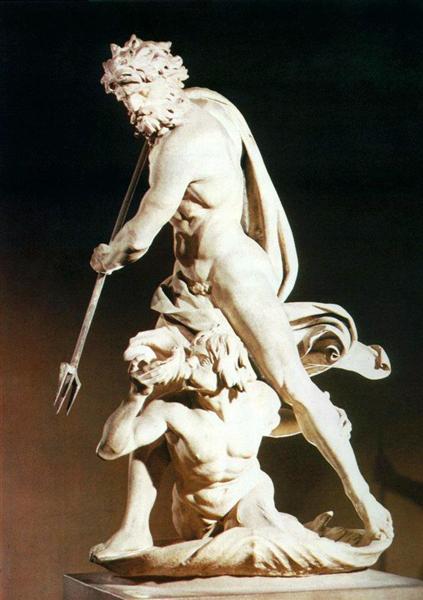
david-1624(4).jpg!Large

    “Neptune and Triton (1620 – 1622) 


          Gian Lorenzo Bernini


                ____________


              When Jupiter, surveying Earth from high,
              Beheld it in a lake of water lie,
              That where so many millions lately liv’d,
              But two, the best of either sex, surviv’d;
              He loos’d the northern wind; 


the new world begins


                                                       fierce Boreas flies
              To puff away the clouds, and purge the skies:
              Serenely, while he blows, the vapours driv’n,
              Discover Heav’n to Earth, and Earth to Heav’n. 


Boreas, ruler of the northern wind, as in 

aurora borealis, at the instigation of the

officiating Jupiter, disperses the clouds, 

drives away the vapours, allowing Heav’n 

to see Earth, and Earth  to see Heav’n, 

nothing between the earth and the 

clear blue sky


              The billows fall, while Neptune lays his mace
              On the rough sea, and smooths its furrow’d face. 


while billows fall, gusts of boreal wind, 

Neptune, god of the Sea, as well and 

simultaneously in the service of Jupiter

smooths the surface of the water by 

laying his mace, a club with spikes, 

upon it, to still the unruly waves


              Already Triton, at his call, appears
              Above the waves; 


Triton, son of Neptune, also a sea deity


                                           a Tyrian robe he wears; 


Tyrian, of Tyre, a city in what is now

Lebanon, but was then Phoenicia, it 

was famous at the time for its cloth 

of a particular colour, Tyrian purple


Tyre is one of the oldest continuously

inhabited cities in the world


              And in his hand a crooked trumpet bears. 


Triton is characteristically depicted 

with a conch shella crooked trumpet 


see above


              The soveraign bids him peaceful sounds inspire,
              And give the waves the signal to retire. 


[t]he soveraign, or sovereign, is none

other than Neptune, his father 


              His writhen shell he takes; whose narrow vent
              Grows by degrees into a large extent, 


writhen, twisted, contorted, as is typical 

of a conch shell, which grows from 

where one blows into it, by degrees,  

towards the much larger opening from 

which the sound emanates


              Then gives it breath; the blast with doubling sound,
              Runs the wide circuit of the world around: 


Triton blows into the conch, gives it 

breath, the blast [ ] doubling [the]

sound, resounding, reverberating, 

the world around, the world over


              The sun first heard it, in his early east,
              And met the rattling ecchos in the west.
              The waters, listning to the trumpet’s roar,
              Obey the summons, and forsake the shore.


the waters begin to recede


R ! chard