the infinitive in Shakespeare’s “To be, or not to be”
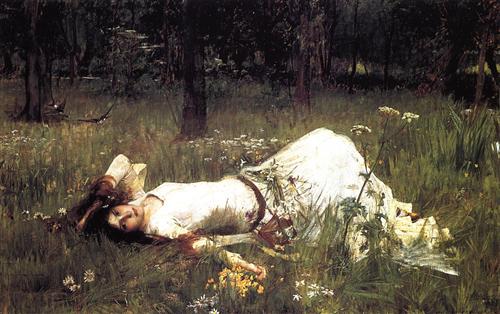
“Ophelia“ (1889)
___________
though death is not an especially
appealing topic for many, it was
nevertheless of fundamental
consideration during the
Romantic Period
Goethe, the German poet, had
already created a sensation
with his “The Sorrows of Young
Werther“, a young man,
disappointed in love, takes his
own life, a potent seed for the
new era, secularism was
overtaking theocracy, the
autocracy of the Christian
Church was giving way to the
prevalence of human rights,
a private opinion, well disputed,
was holding sway against the
rigidities of religious orthodoxies,
science and reason had been
chipping away at the very idea
of God
but with human rights there was
the question of personal
responsibility, if not an imposed
authority, then each man, woman
was in charge of his, her own
the fundamental question,
therefore, was Shakespeare’s
“To be or not to be“, or, for that
matter, Burt Bacharach’s and
Hal David’s “What’s it all about“
this is not me, this is Albert Camus
talking, who formalized the situation
in the 1940s
“There is but one truly serious
philosophical problem, and that
is suicide. Judging whether life
is or is not worth living amounts
to answering the fundamental
question of philosophy. All the
rest — whether or not the world
has three dimensions, whether
the mind has nine or twelve
categories — comes afterwards.”
after Werther, Madame Bovary followed,
Anna Karenina, suicide had become an
option, the penalty was no longer
opprobrium, castigation, as it had been
under unforgiving religious constraints
death itself, fatefully rather than
personally determined, was, of course,
no less considered when the era of
heartfelt declarations dominated,
Mendelssohn had written his
“Quartet no 6 in F minor, opus 80”
for his deceased sister, Beethoven
and Chopin, each his “Funeral March“,
either, incidentally, still iconic, and
perhaps the most poignant work
of all in this manner, Schubert’s
“Death and the Maiden“, a precursor
of his own much too premature
demise
this is music as if your life depended
on it
Richard
psst:
the Alban Berg Quartet, a group who
set the standard for several significant
string quartets in the ’80s, do no less
with this one
you’re not likely to see a better
performance of it ever, nor, for that
matter, of anything, pace even Glenn
Gould, a statement I think nearly
against my religion
you be the judge
 Richibi's Weblog