Richibi’s Weblog

Just another WordPress.com weblog

Tag: Tiresias – prophet

“The Story of Pentheus” – Ovid

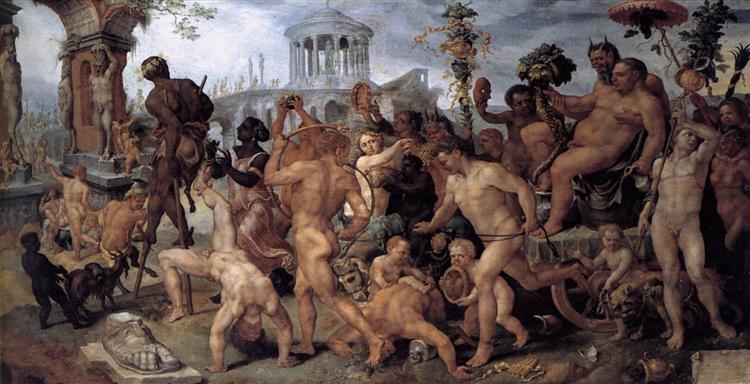
The Triumphal Procession of Bacchus, c.1536 - Maerten van Heemskerck

         The Triumphal Procession of Bacchus” (c.1536)


                   Maerten van Heemskerck


                             _______________


till now the separate stories in Ovid’s

Metamorphoses have been linked,

one being either a consequence of

the other,or its cause, but the story

of Pentheus, grandson of Cadmus,

king and founder of Thebes, who

earlier in this series had his own

tale told, starts, as my German

teacher used to say, from the

scratch


This sad event, therefore, in the

first line of the poem, refers to

what will follow, not what came

before


            This sad event gave blind Tiresias fame,

            Through Greece establish’d in a prophet’s name.


Tiresias, if you’ll remember, had been

blinded by Juno / Hera, goddess of the

gods, for having sided with Jove / Jupiter

/ Zeus, her husband, in a wager between

them he’d been called upon to decide,

Jove / Jupiter / Zeus, however, gave 

Tiresias, as consolation, having been

barred by a pact among the gods not

to undo each other’s spells, the gift

of insight, prophecy


the example that follows, of his divination,

establish[‘d] at that time his reputation

[t]hrough[out] Greece as a prophet


            Th’ unhallow’d Pentheus only durst deride

            The cheated people, and their eyeless guide.


unhallow’d, unholy, wicked, sinful


Pentheus, king of Thebes following

his grandfather, Cadmus, but that’s

an entirely other story


only, of all the people, none but

Pentheus durst, dared, deride,

mock, their eyeless guide, Tiresias

            To whom the prophet in his fury said,

            Shaking the hoary honours of his head:


hoary, grizzled, gray, aged


            “‘Twere well, presumptuous man, ’twere well forthee

            If thou wert eyeless too, and blind, like me:

            For the time comes, nay, ’tis already here,

            When the young God’s solemnities appear:


the young God[], Bacchus / Dionysus,

son of Semele and Jove / Jupiter / Zeus,

if you’ll remember, god of revelry,

intoxication, wild abandon


            Which, if thou dost not with just rites adorn,

            Thy impious carcass, into pieces torn,

            Shall strew the woods, and hang on ev’ry thorn.


impious carcass, dishonoured corpse, 

of any thou who wouldn’t’ve honoured

the celebrations


            Then, then, remember what I now foretel,

            And own the blind Tiresias saw too well.”


own, agree to, admit

            Still Pentheus scorns him, and derides his skill;

            But time did all the prophet’s threats fulfil.

            For now through prostrate Greece young Bacchus rode,


prostrate, beholden, reverent, observant

of the solemnities


            Whilst howling matrons celebrate the God:

            All ranks and sexes to his Orgies ran,

            To mingle in the pomps, and fill the train.


the rites of Bacchus were bacchanals,

orgies, celebrations of abandon, Mardi

Gras, for instance, in New Orleans,

annual Gay Parades, now everywhere,

or Hallowe’en since time immemorial


see above


            When Pentheus thus his wicked rage express’d:

            “What madness, Thebans, has your souls possess’d?

            Can hollow timbrels, can a drunken shout,


timbrels, tambourines


            And the lewd clamours of a beastly rout,

            Thus quell your courage;


quell your courage, overcome your

sense of discipline


                                            can the weak alarm

            Of women’s yells those stubborn souls disarm,


those stubborn souls, the Theban

spirit of pride and honour


            Whom nor the sword nor trumpet e’er could fright,

            Nor the loud din and horror of a fight?

            And you, our sires, who left your old abodes,


our sires, the older generation of

Thebans, of his grandfather

Cadmus‘ ilk


            And fix’d in foreign earth your country Gods;


foreign earth, very Thebes, from Tyre,

where Cadmus and his followers had

come from, in search of Europa, if

you’ll remember


            Will you without a stroak your city yield,


stroak, stroke


            And poorly quit an undisputed field?


undisputed field, there are no

military obstructions


            But you, whose youth and vigour should inspire

            Heroick warmth, and kindle martial fire,

            Whom burnish’d arms and crested helmets grace,

            Not flow’ry garlands and a painted face;


Remember him to whom you stand ally’d:


him, Pentheus himself, their king


            The serpent for his well of waters dy’d.


The serpenta reference here to the

dragon that Cadmus slew, which had

guarded the cavern where his crew

had been scouting for water, if you’ll

remember


            He fought the strong; do you his courage show,

            And gain a conquest o’er a feeble foe.


a feeble foe, licentiousness, abandon,

undisciplined revelry


            If Thebes must fall, oh might the fates afford

            A nobler doom from famine, fire, or sword.


Pentheus appeals to a loftier reason

for defeat, famine, fire, or sword, than

mere, and ignoble, debauchery


            Then might the Thebans perish with renown:

            But now a beardless victor sacks the town;


beardless victor, the young Bacchus /

Dionysus


            Whom nor the prancing steed, nor pond’rous shield,

            Nor the hack’d helmet, nor the dusty field,

            But the soft joys of luxury and ease,

            The purple vests, and flow’ry garlands please.


Bacchus / Dionysus is not impressed

by armour, military accomplishments,

prowess, but by grace, elegance, and

poetry


            Stand then aside, I’ll make the counterfeit

            Renounce his god-head, and confess the cheat.


the counterfeit, Bacchus / Dionysus


            Acrisius from the Grecian walls repell’d

            This boasted pow’r; why then should Pentheus yield?


Acrisius, a king of Argos, who must’ve

also repell’d from his city Bacchus /

Dionysus, according to the poem


            Go quickly drag th’ impostor boy to me;


th’ impostor boy, the counterfeit,

Bachus / Dionysus


            I’ll try the force of his divinity.”


try, test


            Thus did th’ audacious wretch those rites profane;


th’ audacious wretch, Pentheus


            His friends dissuade th’ audacious wretch in vain:

            In vain his grandsire urg’d him to give o’er

            His impious threats; the wretch but raves the more.


his grandsire, Cadmus

            So have I seen a river gently glide,

            In a smooth course, and inoffensive tide;

            But if with dams its current we restrain,

            It bears down all, and foams along the plain.


nature will have its way, so will the

gods, watch out, the narrator says,

who it is that you challenge

            But now his servants came besmear’d with blood,

            Sent by their haughty prince to seize the God;


his servants, Pentheus‘ men


the God, Bacchus / Dionysus


            The God they found not in the frantick throng,

            But dragg’d a zealous votary along.


votary, follower, adherent,

acolyte


the servants, Pentheus‘ men,

who did not, apparently, deliver


stay tuned


R ! chard
“The Transformation of Echo” – Ovid

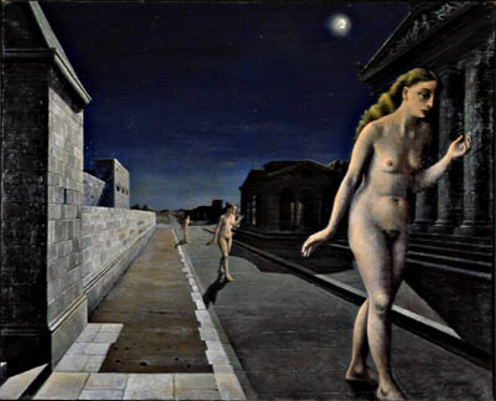
Echo, 1943 - Paul Delvaux


        “Echo” (1943)

           Paul Delvaux


                _______


Fam’d far and near for knowing things to come,

             From him th’ enquiring nations sought their doom;


him, Tiresias, the prophet, if you’ll

remember


their doom, their auguries, their

fates, their destinies


             The fair Liriope his answers try’d,


Liriopea water nymph, a naiad


             And first th’ unerring prophet justify’d.


justify’d, gave credence to, believed


             This nymph the God Cephisus had abus’d,


Cephisusa river god


             With all his winding waters circumfus’d,


circumfus’d, surrounded, enveloped


And on the Nereid got a lovely boy,


the Nereid, Liriopedaughter of Nereus,

god of the Sea, in Dryden’s, inaccurate

however, translation of Ovid, Liriope is,

rather, a fresh water nymph, a naiad,

not listed among the fifty, fifty, I say, 

daughters of Nereus, the Nereids,

sea nymphs


Whom the soft maids ev’n then beheld with joy.


soft maids, sister, the other 49,

presumably, Nereids


             The tender dame, sollicitous to know

             Whether her child should reach old age or no,

             Consults the sage Tiresias, who replies,

             “If e’er he knows himself he surely dies.”


The tender dame, Liriope


“If e’er he knows himself he surely dies.”,

typically cryptically for a prophecy, see,

for instance, your daily horoscope


             Long liv’d the dubious mother in suspence,

             ‘Till time unriddled all the prophet’s sense.


in the depth of time, all is revealed

             Narcissus now his sixteenth year began,


Narcissus, son, however illicit, of

Liriope and Cephisus


             Just turn’d of boy, and on the verge of man;

             Many a friend the blooming youth caress’d,

             Many a love-sick maid her flame confess’d:


I’ve noted that beautiful people are

pursued by men and women, be 

that beautiful person either a man 

or a woman, a situation they have 

to ever undergo, if not even endure


             Such was his pride, in vain the friend caress’d,

             The love-sick maid in vain her flame confess’d.


pride, independence, personal

distance

             Once, in the woods, as he pursu’d the chace,

             The babbling Echo had descry’d his face;


Echo, a mountain nymph


babbling, like water rippling


descry’d, espied, caught sight of


             She, who in others’ words her silence breaks,


who can only speak when others have

spoken


             Nor speaks her self but when another speaks.


Echo‘s curse since time immemorial


             Echo was then a maid, of speech bereft,


bereft, deprived


             Of wonted speech;


wonted, usual, habitual, ordinary


                             for tho’ her voice was left,

             Juno a curse did on her tongue impose,

             To sport with ev’ry sentence in the close.


To sport with, have fun with


in the close, at the end


             Full often when the Goddess might have caught

             Jove and her rivals in the very fault,


the Goddess, Juno / Hera, wife of

Jove / Jupiter / Zeus, God of gods


             This nymph with subtle stories would delay

             Her coming, ’till the lovers slip’d away.


it is interesting to note that not only

Echo, but any, in such a culture of

many gods, would’ve had to choose

among them, despite their, however

divine, individual inconsistencies, 

to the sure detriment of any mortal

caught in the middle, personal guilt

wouldn’t’ve been as foundational a

driving element, therefore, in such

a culture as it would be under

monotheistic religions, where the

moral path is categorically ordained,

specifically determined, as in, for

instance, the Ten Commandments,

but Fate, rather, or the will of the

gods, however frivolous, plays a

much larger role there, we are

putty in this alternate theological

universe, in the hands of

essentially disinterested deities


             The Goddess found out the deceit in time,


The Goddess, Juno / Hera, wife of
Jove / Jupiter / Zeus, God of gods


             And then she cry’d, “That tongue, for this thy crime,

             Which could so many subtle tales produce,

             Shall be hereafter but of little use.”


one would think that Jove / Jupiter /

Zeus, the instigator, might’ve had

something to say about that, though

the challenger be his wife, but he

doesn’t


Hence ’tis she prattles in a fainter tone,

             With mimick sounds, and accents not her own.


a mere shadow of her former self


see above


             This love-sick virgin, over-joy’d to find

             The boy alone, still follow’d him behind:


the pining of a woman for a man

without moral judgment in a

theological text is radical in our

monotheistic tradition, where

lust, voluptuousness, in either

direction, have been the work

of the Devil, not the natural

inclination, brought on by very

springtime, instinctive, rather

than premeditated or predatory,

that more pantheistic belief

systems present


When glowing warmly at her near approach,

             As sulphur blazes at the taper’s touch,

             She long’d her hidden passion to reveal,


long’d, desired, hoped, wished for


             And tell her pains, but had not words to tell:

             She can’t begin, but waits for the rebound,

             To catch his voice, and to return the sound.


Echo cannot voice, begin, her own

words, sentences, needs an already

vocalized statement, a prompt, in

order to utter whatever, is therefore,

before Narcissus, her intended, her

desired, ever mute


             The nymph, when nothing could Narcissus move,

             Still dash’d with blushes for her slighted love,


dash’d, undone, thrown asunder


             Liv’d in the shady covert of the woods,

             In solitary caves and dark abodes;

             Where pining wander’d the rejected fair,


or Where the rejected fair, Echo,

wander’d pining


             Till harrass’d out, and worn away with care,

             The sounding skeleton, of blood bereft,


sounding skeleton, reverberating

remains, resonating essence


see, again, above


             Besides her bones and voice had nothing left.


Echo, the entity itself, herself,

barren, indeed bereft


             Her bones are petrify’d, her voice is found

             In vaults, where still it doubles ev’ry sound.


listen, you’ll hear it, despite the

intervening centuries


R ! chard