Richibi’s Weblog
Just another WordPress.com weblog
Tag: “The Wanderer above the Sea of Fog” – Caspar David Friedrich
November 7, 2023
November / Month of the Sonata – 7
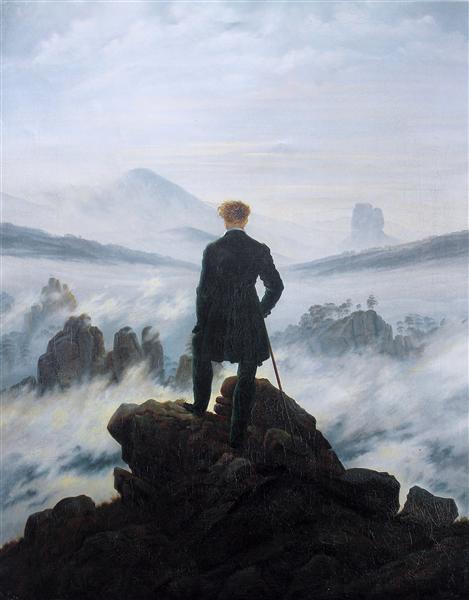
“The Wanderer Above the Sea of Fog” (1818)
Caspar David Friedrich
_____________
meanwhile, back at sonatas for one
instrument, it’s about time I brought
up Chopin, the one composer that
everyone associates before anyone
else with Romanticism, 1800, say,
till about 1880, he incorporates it,
not without reason, Chopin
personifies the Romantic Era, like
Mozart represents the Classical
others who count would be Elizabeth
Barrett Browning, her “Sonnets from
the Portuguese” – How do I love thee?
Let me count the ways – Victor Hugo’s
“Les Misérables”, and Charles Dickens
preaching, in all his works, humanity
Caspar David Friedrich‘s, also, iconic
Wanderer Above the Sea of Fog“,
see above
Chopin sounds a lot like Beethoven,
indeed, the first notes of his Second
Piano Sonata, in B-flat minor, Op. 35
are a reference to Beethoven’s
Sonata no 8, his “Pathétique“, listen,
you’ll hear the same peremptory,
commanding, chord, demanding
attention, the rest is consummate,
however, Chopin
in the last movement, you’ll specifically
hear what Chopin brought to the table,
texture, soundscape, rather than a
narrative line, music as background,
atmosphere, context
enjoy
R ! chard
September 1, 2017
an homage to the victims of the Titanic
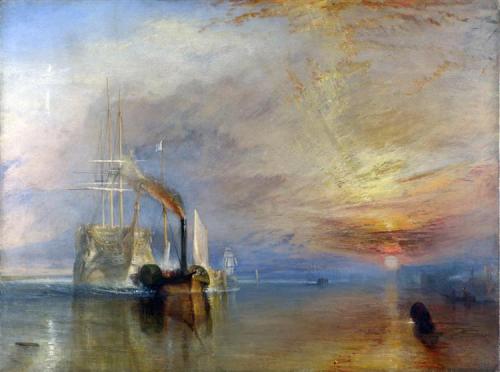
“The Fighting Temeraire tugged to her last berth to be broken up“ (1839)
_______
while I’m on the subject of threnodies,
which is to say “song[s] of lamentation
for the dead”, as I earlier stated, let me
bring your attention to this extraordinary
piece, an homage to the victims of the
Titanic
it doesn’t even have a title, much as
Mozart and Haydn didn’t before music
went mainstream, into public forums
rather than merely aristocratic salons,
and when an identifying moniker
instead of a number became manifestly
more practical, especially when the
emerging Middle Classes were
becoming the ones who were paying
the composer’s bills, at the opera
houses and the other sprouting
concert venues, when some composers
had even up to 32 sets of piano sonatas
to remember, three and four often to
a single set, opus number, as many as
there are movements in a very sonata
and that’s not counting the numbered
symphonies and string quartets of
theirs, left to similarly calculate,
decipher, extricate
it doesn’t have a title, I think, because
to my knowledge, it is the first of its
kind, a composition created by
computer, for computer, an entirely
self-contained digital work of,
manifestly, art – I’d been waiting,
diligently, for one – and like Beethoven,
after the work was done, the artist(s)
just felt the title best left to the
wordsmiths, thus – you’re welcome –
“Threnody for the Victims of the
Titanic“
sure, computers have done practical
things before, admirably, but never
told a story, and certainly never one
as profound as this one
these are the last moments of the
Titanic, digitally reproduced, in real
time, 2 hours and 40 minutes, they
are mesmerizing, you don’t want
to miss a thing
there are no voices, apart from a
few radio transmissions at the
start, spotting the iceberg, calling
out commands to beware, stop
the engines
afterwards only silence, and the
sound of the waves, the churning
of the engines, which have been
restarted, sounding as rhythmic,
incidentally, and numbing, as the
wheels on the railroad tracks of
Steve Reich‘s “Different Trains“,
another powerful threnody
later the flash and crack of flares,
the crunch of the ship sinking
the pervasive, however disrupted,
silence and the inexorable passage
of ever ticking time combine to be,
thereafter, transfixing, meditative,
ultimately transcendent, a fitting
setting for a threnody
I know of only another work to take
you to that venerable place,
Beethoven’s opus 111
and often enough Pink Floyd, for
that matter, and the visionary
Alan Parsons Project, of course,
discoursing on inexorable Time
and, now that I think of it, Elgar‘s
“The Dream of Gerontius“, whose
character goes from his deathbed
in the first act, to his afterlife in
the second, effecting transcendence
for us by, yes, ingenious
metaphorical proxy
but I digress
what I call “Threnody for the Victims
of the Titanic“ is a narrative with
sound, not a movie, not a television
program, it has more commonality
with a musical production than
anything else but painting in art
history, though its means are
intuitively literary, ship stories go
back to “The Odyssey“ through
“Gulliver’s Travels“ , “Treasure
Island“ and to one of my very
favourites, “Ship of Fools“,
relatively recently
I could add “Mutiny on the Bounty“,
“Moby Dick“, “The Caine Mutiny“
in art, a precedent would’ve been set
in our collective consciousness by
William Turner‘s celebrated “The
Fighting Temeraire …“, but I would
mention as well Caspar David
Friedrich‘s “The Wanderer above
the Sea of Fog“ for its existential
pertinence
a few literary points I’d like to stress
to back up my overt adulation, I find
it impressive that the Classical rules
of tragedy have been maintained,
unity of action, time, and place,
prescriptions going back to
Aristotle‘s “Poetics“ in our cultural
history, to profoundly express
tragedy, iconic, epic, misfortune
not to mention the Classical musical
imperatives of tempo, tonality and
repetition, none of which can be
faulted here in this consummate
composition
there is a no greater leveller of tempo
than time, larghissimo here*, in the
largest sense of that word, the
cosmic, the inexorable pace of
temporality in our brief heavens
a greater leveller of tonality neither
is there than the rigorously impartial
hum of the imperturbable Cosmos
nor is there greater repetition than
uniformity, however disrupted by
however fervent ever human
intervention, see Sisyphus, or
Martha in “Who’s Afraid of Virginia
Woolf“ for iconic disrupters
R ! chard
* Shostakovich had asked the
Beethoven Quartet to play the first
movement of his 15th String Quartet,
“Elegy: Adagio“, “so that flies
drop dead in mid-air, and the
audience start leaving the hall from
sheer boredom“
well this inspired elucidation is even
slower than that
August 21, 2015
Fantasie in C Major, D. 760 (“Wanderer”) – Franz Schubert
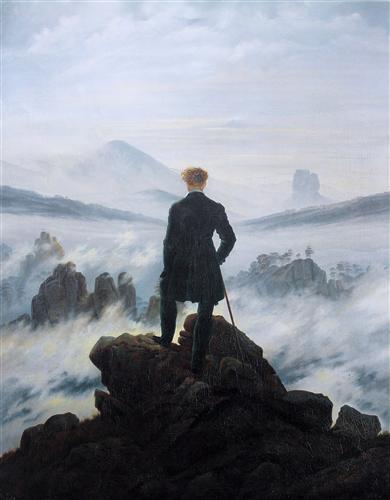
“The Wanderer above the Sea of Fog“ (1818)
____________
a great way of learning to speak music,
approfondir, we say in French, to plumb
the intellectual depths of, is to count the
tenuti, as I quasi-humorously suggested
in my last piece one should, a tenuto, of
course, holds, caresses, one note, or one
chord, only, before proceeding any
further
music is a language, like French, English,
indeed I even include it as a language I
speak as professional qualification, people
find it amusing who don’t speak it
but you need to start somewhere, and
tenuti are as good a place as any, they’re
like an exclamation mark, denote intensified
intention, these give direction, and structure
to the statement, separating the units of
what’s being said
pauses between words, when you’re learning
a language, for learners is a godsend, and
thank goodness for them at least at the end
of sentences
tenuti do the same, count the tenuti, you’ll
discover an enchanted world of music,
right there between the lines
surprisingly you’ll find, rubati, tenuti,
rallentandi, accelerandi don’t occur much
in Romantic music, where you’d expect
the grand passions to swoop and sway
and swoon, but gripped still by the
rigours of Classicism, and its own roots
in the harpsichord, its beats were rigid
still, mostly, right through to Schubert,
Chopin, whereupon more lachrymose
composers began to use these devices
nearly indiscriminately
count the tenuti in this wonderful
Fantasie in C Major, D. 760 of Schubert,
his “Wanderer” Fantasy, you won’t find
that many, nor rubati, rallentandi,
accelerandi, for that matter, and that’s like
someone not crying on your shoulder,
Schubert gives it to you straight, whether
emphatic, earning empathy, or making
magic
Richard
psst:
the “Wanderer” Fantasy, incidentally,
is, again, programmatic music, it is
based on Schubert‘s own lied, song,
to Georg Philipp Schmidt von
Lûbeck‘s “The Wanderer“
 Richibi's Weblog