Richibi’s Weblog

Just another WordPress.com weblog

Tag: the waltz

how to listen to music if you don’t know your Beethoven from your Bach, V

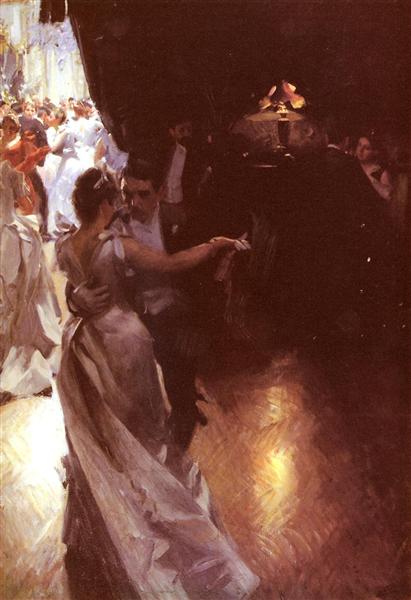
Waltz, 1891 - Anders Zorn


       “Waltz” (1891)


        Anders Zorn


           ________


having brought up the idea of

longevity in my last communication,

the fantasia, a musical form that

lasted about 150 years, with hats

off nevertheless to the later Disney

classic, Fantasia, a tribute, which,

full of Classical music references,

followed in its spiritual mode, and,

after introducing Chopin, perhaps

the very representation of the

Romantic Era, that we carry, or

intuit, in our very bones, I thought

I’d talk about the waltz, a Chopin

specialty, where he created,

incontrovertibly, utter magic


who hears of the waltz anymore, an

antiquated curiosity, though even in

our not so distant blood we feel the

reverberations of its memory, the

throb of its still vibrant cultural

intensity, relevance, rhythm


tangos, incidentally followed, and

other intimate interactions, which

had been earlier frowned upon


the waltz had been the minuet,

the difference was the physical

contact, young nobles left their

aristocratic salons, however

discreetly, to frequent the

more liberal, if disreputable,

establishments – like to

speakeasies during Prohibition

– where they could explore the

new, licentious venues, as

young nobles, ever, would, for

the lure of intimate connection

with the partner


the waltz was thereby born,

couples touched, breast upon

breast, composers followed


Chopin was metaphysical, you

didn’t dance to his waltzes, you

experienced them, here’s his

Minute Waltz, Opus 64, no 1,

here’s his equally delightful

Opus 64, no 2, its companion


but Strauss ll, Johann l‘s son,

got all of Vienna to dance his, 

and everywhere else after, until  

the waltz fell out of favour 

somewhere in the 1950s, leaving

only its memories behind,  here’s          

his incandescent By the Beautiful

Blue Danube, makes you wish

you’d been there


in the one case, the waltz is

idealized, in the other, it’s the

waltz in action, listen, you can

tell the difference, you won’t 

want to dance, for instance, to 

Chopin, though you might give

it an ineffectual try, to Strauss, 

you’ll careen


R ! chard

on the origins of the waltz

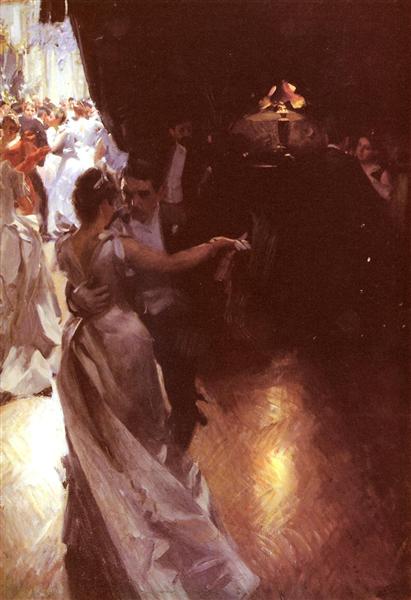
waltz-1891.jpg!Large.jpg

       “Waltz“ (1891) 

         Anders Zorn

        ____________

had the waltz been confided to any 
other but the Johann Strausses, 
father and inveterate son, we may
never have distinguished it from 
the polka 

at the start, this amorphous new 
dance was deemed shameless, 
even shocking, by a scandalized, 
apparently, aristocracy, used to 
the more discreet, less conjugal, 
minuet

some nobles, sowing wild, 
irresistible oats, however, at the
festivities of their more irreverent 
servants, brought the new dance 
back home to their more informal, 
less stuffy, entertainments, avidly, 
though surely under their hats

to Belvedere, Schönbrunn, even 
Schloss Esterházy, Haydn‘s  
stately old stomping haunt

thus was the waltz born, whirling 
indiscriminately like a polka at first, 
with indefinite still, however, timing

which then was reduced to only ever 
3/4 time, by the Strausses, the metre 
in which this comment, coincidentally, 
is written

read it aloud, you’ll want to wrap 
your arms around the nearest  
partner, I assure you, and whirl, 
twirl, deliriously surrender

had we not had the Strausses, neither 
had we had Fred Astaire, Ginger Rogers,
“Shall We Dance” from the glorious 
“The King and I”, nor the irrepressible 
“So You Think You Can Dance“ either

nor me, for that matter, writing in 3/4 
verse, essentially, dactylic poetic metre,  
about these celebrated accomplishments, 
something I deem eminently worthy of
reporting 

such is the impact of veritable art, I
warrant, the waltz was not inevitable

listen to Strauss Jr’s’ “Wiener Blut”, 
“Viennese Blood“, or “… Spirit“
in English, for instance, for 
corroborating confirmation, and
corresponding, however inadvertent,
even, inspiration   

ever 

R ! chard