Richibi’s Weblog

Just another WordPress.com weblog

Tag: the Ten Commandments

November / Month of the Sonata – 30

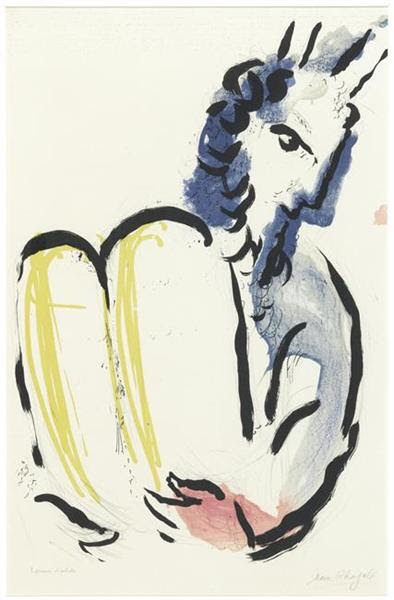
Moses, 1956 - Marc Chagall

    Moses (1956) 


      Marc Chagall


         ________


Beethoven’s Opus 111 is, to my mind,

the equivalent of the Sermon on the 

Mount, or Moses’s rendering of the 

Ten Commandments, see above, in 

our post-Christian world, the world 

where God is dead and where we’re 

all left to our own devices for better 

or for worse 


Beethoven confronts a Listener, 

who is, or is not, there, pleading 

for meaning, purpose


the first movement is rebellious,

despite, ever, his reverence for 

his abstract Interlocutor, bowing 

before, heeding, this self-anointed 

Adjudicator, the Deity we fashion 

for ourselves 


we are witness to this interchange


the second movement is more

subservient, pleading more 

rationally, less explosively, his

case, we hear this too


there are only two movements,

dichotomies, war, peace, man,

woman, chaos, order, none of 

them a choice


Beethoven says to exist, to be,

itself, encompasses its own 

glory, that is our grace, 

whether or not there is a 

hereafter


listen


R ! chard


psst: thank you so much for your 

          participation, however 

          intermittent, in my Month 

          of Sonatas, I am not only 

          grateful, but honored, by 

          your presence

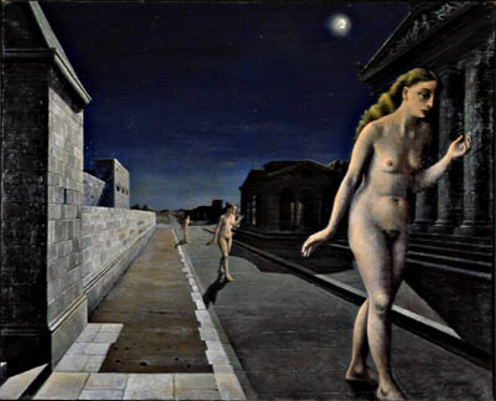
“The Transformation of Echo” – Ovid

Echo, 1943 - Paul Delvaux


        “Echo” (1943)

           Paul Delvaux


                _______


Fam’d far and near for knowing things to come,

             From him th’ enquiring nations sought their doom;


him, Tiresias, the prophet, if you’ll

remember


their doom, their auguries, their

fates, their destinies


             The fair Liriope his answers try’d,


Liriopea water nymph, a naiad


             And first th’ unerring prophet justify’d.


justify’d, gave credence to, believed


             This nymph the God Cephisus had abus’d,


Cephisusa river god


             With all his winding waters circumfus’d,


circumfus’d, surrounded, enveloped


And on the Nereid got a lovely boy,


the Nereid, Liriopedaughter of Nereus,

god of the Sea, in Dryden’s, inaccurate

however, translation of Ovid, Liriope is,

rather, a fresh water nymph, a naiad,

not listed among the fifty, fifty, I say, 

daughters of Nereus, the Nereids,

sea nymphs


Whom the soft maids ev’n then beheld with joy.


soft maids, sister, the other 49,

presumably, Nereids


             The tender dame, sollicitous to know

             Whether her child should reach old age or no,

             Consults the sage Tiresias, who replies,

             “If e’er he knows himself he surely dies.”


The tender dame, Liriope


“If e’er he knows himself he surely dies.”,

typically cryptically for a prophecy, see,

for instance, your daily horoscope


             Long liv’d the dubious mother in suspence,

             ‘Till time unriddled all the prophet’s sense.


in the depth of time, all is revealed

             Narcissus now his sixteenth year began,


Narcissus, son, however illicit, of

Liriope and Cephisus


             Just turn’d of boy, and on the verge of man;

             Many a friend the blooming youth caress’d,

             Many a love-sick maid her flame confess’d:


I’ve noted that beautiful people are

pursued by men and women, be 

that beautiful person either a man 

or a woman, a situation they have 

to ever undergo, if not even endure


             Such was his pride, in vain the friend caress’d,

             The love-sick maid in vain her flame confess’d.


pride, independence, personal

distance

             Once, in the woods, as he pursu’d the chace,

             The babbling Echo had descry’d his face;


Echo, a mountain nymph


babbling, like water rippling


descry’d, espied, caught sight of


             She, who in others’ words her silence breaks,


who can only speak when others have

spoken


             Nor speaks her self but when another speaks.


Echo‘s curse since time immemorial


             Echo was then a maid, of speech bereft,


bereft, deprived


             Of wonted speech;


wonted, usual, habitual, ordinary


                             for tho’ her voice was left,

             Juno a curse did on her tongue impose,

             To sport with ev’ry sentence in the close.


To sport with, have fun with


in the close, at the end


             Full often when the Goddess might have caught

             Jove and her rivals in the very fault,


the Goddess, Juno / Hera, wife of

Jove / Jupiter / Zeus, God of gods


             This nymph with subtle stories would delay

             Her coming, ’till the lovers slip’d away.


it is interesting to note that not only

Echo, but any, in such a culture of

many gods, would’ve had to choose

among them, despite their, however

divine, individual inconsistencies, 

to the sure detriment of any mortal

caught in the middle, personal guilt

wouldn’t’ve been as foundational a

driving element, therefore, in such

a culture as it would be under

monotheistic religions, where the

moral path is categorically ordained,

specifically determined, as in, for

instance, the Ten Commandments,

but Fate, rather, or the will of the

gods, however frivolous, plays a

much larger role there, we are

putty in this alternate theological

universe, in the hands of

essentially disinterested deities


             The Goddess found out the deceit in time,


The Goddess, Juno / Hera, wife of
Jove / Jupiter / Zeus, God of gods


             And then she cry’d, “That tongue, for this thy crime,

             Which could so many subtle tales produce,

             Shall be hereafter but of little use.”


one would think that Jove / Jupiter /

Zeus, the instigator, might’ve had

something to say about that, though

the challenger be his wife, but he

doesn’t


Hence ’tis she prattles in a fainter tone,

             With mimick sounds, and accents not her own.


a mere shadow of her former self


see above


             This love-sick virgin, over-joy’d to find

             The boy alone, still follow’d him behind:


the pining of a woman for a man

without moral judgment in a

theological text is radical in our

monotheistic tradition, where

lust, voluptuousness, in either

direction, have been the work

of the Devil, not the natural

inclination, brought on by very

springtime, instinctive, rather

than premeditated or predatory,

that more pantheistic belief

systems present


When glowing warmly at her near approach,

             As sulphur blazes at the taper’s touch,

             She long’d her hidden passion to reveal,


long’d, desired, hoped, wished for


             And tell her pains, but had not words to tell:

             She can’t begin, but waits for the rebound,

             To catch his voice, and to return the sound.


Echo cannot voice, begin, her own

words, sentences, needs an already

vocalized statement, a prompt, in

order to utter whatever, is therefore,

before Narcissus, her intended, her

desired, ever mute


             The nymph, when nothing could Narcissus move,

             Still dash’d with blushes for her slighted love,


dash’d, undone, thrown asunder


             Liv’d in the shady covert of the woods,

             In solitary caves and dark abodes;

             Where pining wander’d the rejected fair,


or Where the rejected fair, Echo,

wander’d pining


             Till harrass’d out, and worn away with care,

             The sounding skeleton, of blood bereft,


sounding skeleton, reverberating

remains, resonating essence


see, again, above


             Besides her bones and voice had nothing left.


Echo, the entity itself, herself,

barren, indeed bereft


             Her bones are petrify’d, her voice is found

             In vaults, where still it doubles ev’ry sound.


listen, you’ll hear it, despite the

intervening centuries


R ! chard

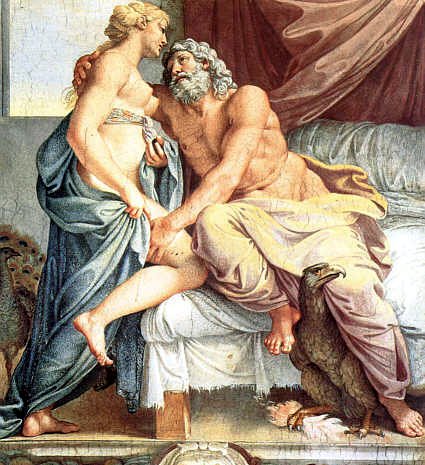
“The Transformation of Tiresias” – Ovid

Jupiter and Juno, 1597 - Annibale Carracci

          Jupiter and Juno” (1597)


                   Annibale Carracci


                             ________


                ‘Twas now, while these transactions past on Earth,

                And Bacchus thus procur’d a second birth,


second birth, Bacchus / Dionysus

had been granted a second birth

after he’d been plucked from

Semele‘s womb in a first, abortive,

birth, and carried in Jove / Jupiter

/ Zeus‘s thigh to term for the

second, if you’ll remember


                When Jove, dispos’d to lay aside the weight

                Of publick empire and the cares of state,

                As to his queen in nectar bowls he quaff’d,

                “In troth,” says he, and as he spoke he laugh’d,

                “The sense of pleasure in the male is far

                More dull and dead, than what you females share.”


you might note here that these last

eight verses have been one long

sentence, incorporating here and

there other full sentences, but

within commas, like railroad cars

pulled along by a locomotive, none

independent of the others, it seems

to me I’ve seen that kind of thing

before


quaff’d, drank, took a draught


to his queen, in her honour


in troth, in truth, truly


Jove / Jupiter / Zeus has a question

to settle with Juno / Hera, he claims

that men are less attuned to

pleasure than women are


               Juno the truth of what was said deny’d;


Juno / Hera doesn’t at all agree


                Tiresias therefore must the cause decide,


Tiresias will be the arbiter, he will

the cause decide


Tiresias, mythical prophet


                For he the pleasure of each sex had try’d.


hmmm, you don’t hear stuff like

that in the Bible, the monotheistic

counterpart to Ovid’s pantheistic

Metamorphoses


a pantheistic religion would have

no categorical set of values, no

Ten Commandments, the gods

themselves would not agree on 

a code of behaviour, morality

would be in the eye of the

beholder, not divinely mandated,

Nietzsche will have a lot to say

about that in the 19th Century

eminently pertinent to ensuing 

generations


                It happen’d once, within a shady wood,

                Two twisted snakes he in conjunction view’d,


in conjunction, mating


                When with his staff their slimy folds he broke,

                And lost his manhood at the fatal stroke.


you shouldn’t mess around with

snakes, it appears


                But, after seven revolving years, he view’d

                The self-same serpents in the self-same wood:


self-same serpents, surely he means

the same species, not the same

snakes


                “And if,” says he, “such virtue in you lye,

                That he who dares your slimy folds untie

                Must change his kind, a second stroke I’ll try.”


if it worked once, it might work a

second time, Tiresias supposes


                Again he struck the snakes, and stood again

                New-sex’d, and strait recover’d into man.


it worked, Tiresias is reconfigured,

reconstituted, as a man


                Him therefore both the deities create

                The sov’raign umpire, in their grand debate;


create, appoint, assign duties to


the grand debate, the question,

the calculus, of pleasure


sov’raign umpire, chief, ruling,

irreversible by consent, judge


               And he declar’d for Jove:


women are more susceptible to

pleasure than men are, Tiresias

definitively decides


                                                     when Juno fir’d,

               More than so trivial an affair requir’d,


fir’d, not happy, furious, motivated


More than so trivial an affair, this

incident shouldn’t’ve been the

cause of, requir’d, the extreme

response to which Juno / Hera

condemns Tiresias


                Depriv’d him, in her fury, of his sight,

                And left him groping round in sudden night.


Tiresias, the blind prophet, the

apocryphal blind prophet, so

grimly subjected, finds powerful

resonance, incidentally, in Homer,

another, even more famous, and

actual, which is to say historically

authenticated, blind prophet, both,

nevertheless, of immeasurable

cultural consequence


                But Jove (for so it is in Heav’n decreed,

                That no one God repeal another’s deed)


an honour code among the gods,

to balance competing, however

august, visions, morality, in other

words, by consensus


                Irradiates all his soul with inward light,

                And with the prophet’s art relieves the want of sight.


thus Tiresias becomes the famed

prophet, for better, it’ll turn out,

or for worse, cursed, and blessed,

simultaneously


stay tuned


R ! chard

Beethoven – piano sonata no.31, op.110 (3rd movement)‏

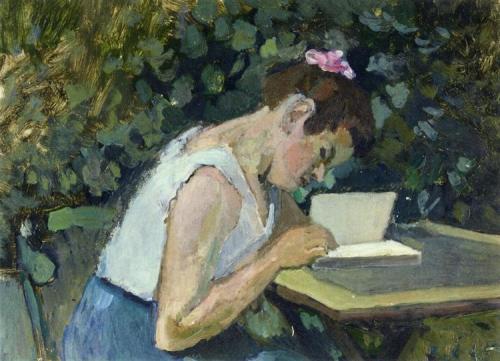
woman-reading-in-a-garden-1903.jpg!Large

Woman Reading in a Garden (1902-03)


         _______


perhaps my best teacher ever was
my father, others never questioned
the orthodoxy, spewing out the
curriculum like it was sacred, dead,
untouchable, depriving it of its very
worth

my father was a philosopher, God 
was a question, not an answer, I,
at the time, needed an answer
 
we were sent to a Catholic school,
my sister and I, where God was in 
everything, everywhere, omnipotent,
omniscient, and, like a father then, 
autocratic, industrious, demanding,
not unopposed to punishment
 
sins against the Father could be 
summarized, at that age, briefly,
do not kill, do not lie, do not 
disobey your parents, do not 
cheat on your husband, wife, 
and follow all the rituals of the 
Church, the Ten Christian 
Commandments, brought to 
you universally then by Charlton 
“Moses” Heston, under the aegis 
 
none of these graded offences  
applied to me, really, then, but 
lying, and disobeying one’s 
parents, the others were all so 
remote as to be inconsequential, 
though the Church kept up on 
our family’s abrogations of 
religious rites – non-attendance 
at Sunday mass, eating meat 
on Fridays, worse – while 
nevertheless tending dutifully
to our wayward souls, they told 
us, holding out for a final repentant 
confession
 
we never lied at home, I’d lied about 
something once, and was so daunted
when my father probed, I sweated,
must’ve turned purple, not just red,
of embarrassment, I knew I couldn’t 
use that tactic again, I’d inexorably 
blush, flush
 
who put the Brylcreem on the dog,
he’d queried
 
not me, I trembled
 
my sister stood beside me, might 
not have even known anything 
about it, I can’t remember, though 
I recall her dismay, I think, at having 
been so blithely thrown under the 
bus, or maybe that’s just me 
extrapolating 
 
my dad turned back to what he’d 
been doing, having, I’d understood, 
got his answer, proving himself to 
be to me thereby omniscient, I’d 
have no chance, I gathered, against 
something like that, this turned me 
into a good, an at least conscientious, 
person
 
my teachers, paradoxically, only 
ever took marks off for technical 
stuff, Math, History, French, they 
never taught me lessons   
 
a teacher, once, had asked me to
stand at the head of the class and 
read a passage from Shakespeare,
be Romeo, Mark Antony, Lear, I
can’t remember which
 
“O, pardon me, thou bleeding 
piece of earth, / That I am meek 
and gentle with these butchers!”,
I uttered, fraught with emotion,
“Thou art the ruins of the noblest 
man / That ever lived in the tide 
of times”
 
in my mind and in my body I was 
Mark Antony there, shot through 
with the weight of his friend’s 
brutal death, his own irretrievable 
loss 
 
my teacher laughed
 
what, I asked
 
you’re right into it, aren’t you, he 
replied, and shut me up right there 
to any public display of expression 
 
 
I didn’t stop reading Shakespeare 
though, but by myself
 
later I read Homer, Ovid, Proust,
others, did the same with music 
and art, made countless lifelong 
friends thereby, people I’ve always 
been able to turn to, even just in 
ruminative thought as their stories 
still pervaded me, diligently leading   
still the way, like guardian angels,  
maybe


Richard
a Chopin Fantasia‏, opus 61

 
to be specific, opus 61, you’ll more easily notice 
already the more abstract peregrinations of his
disciple, Debussyand even the first stirrings of
improvisation incidentally, which is to say the
free-wheeling of idiosyncratic jazz, the very 
inversion of Classical order, personal expression
was trumping even ecclesiastical dictates, those 
very earlier immutable fundamentals of the long
unimpeachable Ten Commandments  
 
Oh Moses, Moses you stubborn, splendid, adorable 
fool, as Anne Baxter, Nefertiri, pagan, therefore 
insidious seductress, would admonish in the film
pronouncementsa film which of course fashioned 
the Biblical iconography of my entire generation,
a veritable Divine Comedy” for our still recent
enough times, nothing has come up to displace it
meanwhile, though a progressively alternative
cultural morality seems steadily to harken
 
was Moses then a fool, a Prometheus in Christian
clothing 
 
time alone tells, and time is an inveterately
temperamental arbiter
 
 
it would appear now that faith equals
unconditional conformity, when I thought
that faith could not, by definition, be
constrained, faith had been meticulously
a considered personal conviction, an
individual emancipation rather than a
conformist, and nefarious ultimately, it
would appear, code 
 
I count on thoughtful efflorescence then,
and a garden of societal consideration, 
a pantheistic and cooperative accord
 
not excluding, let it be noted, the indeed
worthiest, by thoughtful process, of those
very Ten Commandments 
 
without my own children, for instance, I
still recommend honouring one’s parents,
this will bring, I knowlegeably warrant, 
untold benefits, indeed grace, peace and
profound satisfaction, plenary solace to
the very reaches of each our indeterminate
soul
 
take it right here from an appropriately  
distinctive Chopin, unparalleled poet to
the panoply of possible gods   
 
 
Richard