Richibi’s Weblog

Just another WordPress.com weblog

Tag: the subjunctive

rhapsodies – Gershwin / Rachmaninov
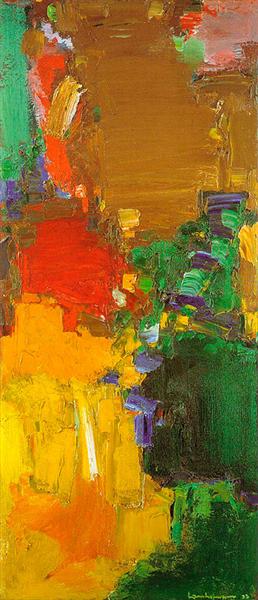
rhapsody-1958.jpg!Large

  “Rhapsody (1958) 


      Hans Hofmann


          _________


if a sonata is a piece of music with more

than one section, by definition a rhapsody

is not a sonata, a rhapsody has only one 

section, only one movement, all that is 

required, therefore, essentially, of a 

rhapsody, is that it be – a subjunctive 

here, incidentally, the mood of aspiration, 

high hopes, ideals – that it be, I reiterate, 

rhapsodic


in the spirit of juxtaposition, here are two

rhapsodies, the first, George Gershwin’s 

Rhapsody in Blue“, the other 

Rachmaninov’s, his Rhapsody on a 

Theme of Paganini


how are they different, you tell me


I’ll just point out that the one seems, to 

my ears, steeped still in the Romantic 

Period, the early 19th Century, despite 

its publishing date, 1934, the other

earlier, composition, 1924, sounds like 

full blown, in comparison, 20th Century

America, the future 


Old Europe, in other words, meets the 

New World, however chronologically 

counterintuitively


listen, you can hear all of it, both are,

either era, extraordinary, time is what

eventually tells


R ! chard


who’s afraid of the subjunctive

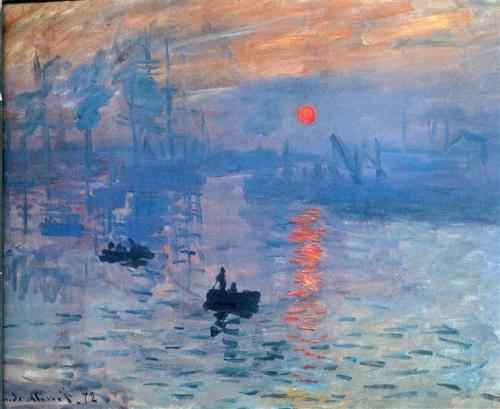
impression-sunrise.jpg!Large

Impression, Sunrise” (1873)

Claude Monet

________

who’s afraid of the subjunctive

much like Elizabeth Taylor as Martha
in “Who’s Afraid of Virginia Woolf?”,
my answer is, I am, George, I am

the subjunctive is an esoteric mood,
even more abstruse in English than
in other languages, where the verb’s
conjugation highlights its presence,
in English, it’s nearly identical to the
indicative, the mood everybody
instinctively speaks in, facts

the subjunctive is about aspiration,
like the conditional, abstract, not
real, but its intention, rather than
the conditional’s inherent
impediment, a condition, shoots
for the stars, isn’t introspective,
but adamant, imperative

it is necessary that one be, it is
urgent that one have, it is
important that one effect, a
particular thing or event, all
subjunctives after the
doorkeeper word, “that”

one finds the subjunctive in
Shakespeare, master of grammar,
perhaps unparalleled in English,
a lot – O, that this too solid flesh
would melt, / Thaw and resolve
itself into a dew!
– and follows
with Elizabeth Barrett Browning –
Pardon, o pardon that my soul
should make, / Of all that strong
divineness which I know / For
thine and thee …,
for instance,
who is so profoundly indebted to
Shakespeare for her aesthetics

one wondrous day, I realized that
Proust’s entire À la recherche du
temps perdu
, his “In Search of
Lost Time
“, my Bible, was set in
the, French however, subjunctive,
the mood, there as well, of
possibility, therefore rather than
the definitive recreation of an
earlier time, Proust was
describing a sensibility, a personal
interpretation of a previous reality,
however bolstered by intimate and
apparently precise recollection of
shimmeringly imprecise, though
personally accurate, impressions

note here the similar preoccupations
of Proust’s contemporaries, the, aptly
named, Impressionists

everything, Proust was saying, as
were also the Impressionists, is in
the eye of the beholder

the subjunctive is the mood that
sets this instinct in motion

R ! chard

psst: Somerset Maugham I remember
being noteworthy as well for his
immaculate use, in his South
Pacific tales, of the subjunctive,
extremely elegant in its refined
construction, even with its
English austerities, like making
lace out of mere cloth, impressive
despite its impracticality, or
perhaps even because of it

the indicative

grammar.jpg!Large

        Grammar 


              Gentile da Fabriano


                          ____________


since I’d only recently vaunted both the 

infinitive and the imperative moods of 

verbs in this venue, you might’ve 

expected that the indicative would 

soon follow


and here it is, the indicative, the mood 

of narratives, storytelling, the default 

mode, essentially, where most of our 

communication takes place, be it

oral or written


famous first lines of novels will attest

to that, lines you’ve probably heard 

before, however only incidentally, if 

not actually read


        It was the best of times, it was the worst of times,


from Charles Dickens’ A Tale of Two Cities


and the rest is so good, I can’t, in all 

consciousness, exclude it


        it was the age of wisdom, it was the age of foolishness, it was 

        the epoch of belief, it was the epoch of incredulity, it was the 

        season of light, it was the season of darkness, it was the 

        spring of hope, it was the winter of despair. 


or


        Last night I dreamt I went to Manderley again. 


from Daphne du Maurier’s eerily Gothic 

Rebecca“, heiress to not only Charlotte 

Brontë’s Jane Eyre“, but also to her 

sister Emily’s, to my mind, much more 

accomplished work, Wuthering“, and 

indeed wonderful, Heights“, whereupon 

I’ll refrain from continuing to follow the

sentences, however compelling, for 

lack of space and time


but


        I had a farm in Africa, at the foot of the Ngong Hills.


from Out of Africa“, Karen Blixen’s

unforgettable novel, however brilliantly

translated to film, must take its place

here among towering introductory

sallies 


       Longtemps, je me suis couché de bonne heure. 


Proust’s answer to Homer, his “À la 

recherche du temps perdu“, his

Remembrance of Things Past  


      For a long time, I’d go to bed early.


which, as I read on, no less than

changed my life 


but that’s another story, however

totally engrossing


everywhere above, let me point out, 

the mood has been indicative, to a 

very verb, so unobtrusive you 

probably didn’t even notice 


in music, a counterpart for the 

indicative would be the allegro, 

the baseline, not too fast, not 

too slow, the tempo listeners 

would most easily respond to


but more about that only later, after

a traipse through the speculative 

conditional, then  the aspirational 

subjunctive


meanwhile, check this out, The

Heart of the Matter“, the Eagles, a

ballad, mostly indicatives, but with

here and there an infinitive, and a

peppering of conditionals, however

might these be signal, to utterly break 

your heart


listen


R ! chard