Richibi’s Weblog

Just another WordPress.com weblog

Tag: the string quartet

String Quartet no. 14 in G major, K. 387, (“Spring”) – Mozart
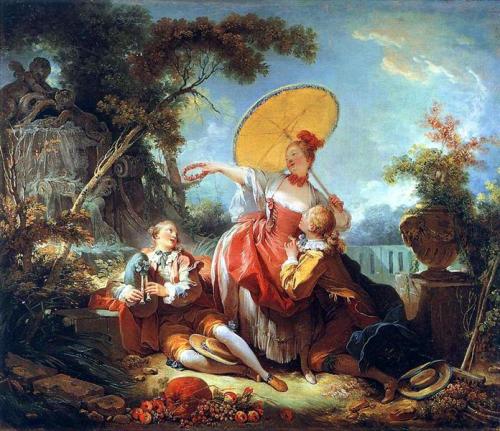
the-musical-contest-1755.jpg!Large     
     “The Musical Contest (c.1754 – 1755) 

            Jean-Honoré Fragonard

                     ____________

right about this time, 1782 to 1785, Mozart 
was writing his Haydn Quartetssix of 
them, in the very fashion, not incidentally, 
of Haydnas a tribute to the master, the 
father, the very originator of the string 
quartet 

here’s the first of them, a not at all 
unimpressive tribute

Mozart follows the master in kind, the
number of movements, the selection
of tempi, there’s even again a minuet,
an aristocratic prerequisite, note even 
the delicate, the deferential, endings,  
to all, not just one, of the movements,
a trait indicative of Haydn, his courtly, 
courteous reserve before any too
personalized spotlight, however 
manifest his brilliance – noblesse, 
in other words, oblige

Mozart follows immaculate suit

you might find it difficult to distinguish
between Mozart and Haydn, I do, the 
differences are so subtle as to be 
nearly, for the most part, 
indistinguishable, their periods overlap, 
their contexts were not at all dissimilar, 
just even Vienna as their musical core

the aristocracy was still, evidently, in 
charge, however henceforth briefly, 
and paying the bills, and the mood 
required remained respectful, polite, 
unpolitical, which both composers
dutifully obliged, neither subjecting 
himself to any constraints around 
his higher manifest destiny, his 
irresistible muse, the pursuit of 
pure, and unadulterated, music

this will unfurl, see, for instance,
Shostakovich


R ! chard
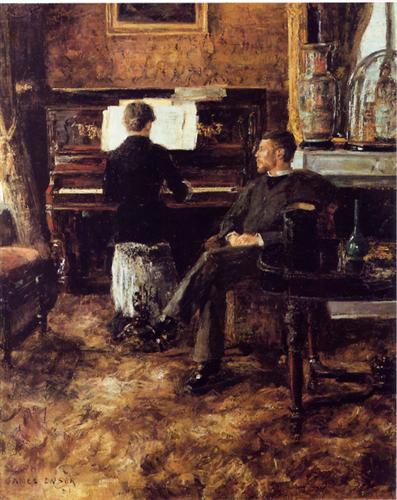
‏‏String Quartet no 2 in D major – Alexander Borodin‏


 "Russian Music" - James Ensor

Russian Music (1881)

James Ensor

_______

Alexander Borodin’s ravishing String
Quartet no 2 in D major
, from 1881,
was written only a few years after
Smetana’s 1876 From My Life“, and
sounds surprisingly similar, the same
number of movements all in the same
order, fast, a dance step, polka or
waltz, then slow, then fast

their second movements are notably
united by their common use of long
bowing of paired notes from the
violins, to establish, irresistibly,
the rhythm of their individual dances

their eccentric, even strident notes,
stretching towards atonality but
remaining this side of the divide,
thus surprisingly welcome, even
captivating

the change of tempo right in the
middle of every movement to
separate and sharpen contrast
between the exposition and the
development, then the whole
thing all over again, all quirks
of the evolution of the
nevertheless stalwart string
quartet structure, as unassailable,
it would appear, as that of the,
also inveterate, sonnet

I could go on

the difference is in the intention,
the appropriation of the Viennese
model to express more culturally
expanded varietals of the original
mode, in these two cases, Czech
and Russian, it’s all in each their
homegrown cadence

and that’s how music speaks if
you lend an ear

think of the European Pinot Noir,
for instance, taking root in other,
foreign soil not being necessarily
any longer inferior, sometimes
even superior, downright even
celebrated, you’ll get, essentially,
the big picture

Alexander Borodin’s ravishing
String Quartet no 2 in D major,
note, is such a prize, an utterly
intoxicating wine you wouldn’t
want to eschew, miss

Gesundheit

Richard