Richibi’s Weblog

Just another WordPress.com weblog

Tag: “The Story of Coronis and Birth of Aesculapius” – Ovid

“The Story of Coronis, and Birth of Aesculapius” (III) – Ovid

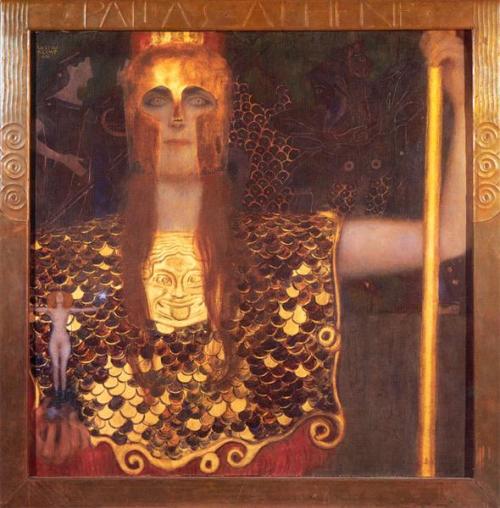
minerva-or-pallas-athena.jpg!Large

   “Minerva, or Pallas Athena (1898) 


             Gustav Klimt


                  ______


             But you, perhaps, may think I was remov’d, 

             As never by the heav’nly maid belov’d:


says the daw to the still snowy plume[d], 

[w]hite as the whitest dove’s unsully’d 

breast raven


remov’d, rejected, discarded and

disgrac’d 


the heav’nly maid, Minerva


             But I was lov’d; ask Pallas if I lye; 


Pallas, another name for Minerva


             Tho’ Pallas hate me now, she won’t deny: 


hate, note, is in the subjunctive here, 

the mood of conjecture, where the s 

is removed from the ending of the 

third person singular, that she, he, or 

one, for instance, read, no s on read, 

Ovid, would be a part of any Latin 

curriculum


             For I, whom in a feather’d shape you view, 
             Was once a maid (by Heav’n the story’s true) 
             A blooming maid, and a king’s daughter too. 
             A crowd of lovers own’d my beauty’s charms; 


own’d, admitted to, acknowledged


             My beauty was the cause of all my harms; 


to a vain friend once who complained 

to me of the rigours of being beautiful, 

I said, your beauty, girl, to upend the, 

otherwise tiresome, conversation, is 

your curse, get over it, which he did, 

it did, in at least that instance


             Neptune, as on his shores I wont to rove, 


Neptune, god of the Sea


wont, to be used to, predisposed to


             Observ’d me in my walks, and fell in love. 
             He made his courtship, he confess’d his pain, 
             And offer’d force, when all his arts were vain; 


all of the gods, it appears, are engines, 

ever, of irrepressible lust, perhaps 

allegorically alluding to the unquenchable 

generative powers of very Nature 


             Swift he pursu’d: I ran along the strand, 
             ‘Till, spent and weary’d on the sinking sand, 
             I shriek’d aloud, with cries I fill’d the air 
             To Gods and men; nor God nor man was there: 


who hasn’t been there, forlorn, 

abandoned, desolate, forsaken


             A virgin Goddess heard a virgin’s pray’r. 


virgin Goddess, Minerva / Pallas 

Athena


note that Minerva / Pallas / Athena,

the virgin Goddess, remains, however 

unconventionally, however irregularly,

the mother of Erichthonius 


             For, as my arms I lifted to the skies, 
             I saw black feathers from my fingers rise; 
             I strove to fling my garment on the ground; 
             My garment turn’d to plumes, and girt me round: 
             My hands to beat my naked bosom try; 
             Nor naked bosom now nor hands had I: 


the king’s daughter, still unnamed, note, 

attesting to the interchangeability of 

virgin’s in Greek and Roman mythology, 

is in the process of becoming a daw, a

black bird


             Lightly I tript, nor weary as before 
             Sunk in the sand, but skim’d along the shore; 


it appears there are advantages 

to becoming a bird


             ‘Till, rising on my wings, I was preferr’d 
             To be the chaste Minerva’s virgin bird: 


go, girl


             Preferr’d in vain! I am now in disgrace: 
             Nyctimene the owl enjoys my place. 


Nyctimene, Minerva’s owl


friendship, it appears, can turn 

on a dime, or an inadvertent,

but decisive, irritation


R ! chard


“The Story of Coronis, and Birth of Aesculapius” (II) – Ovid

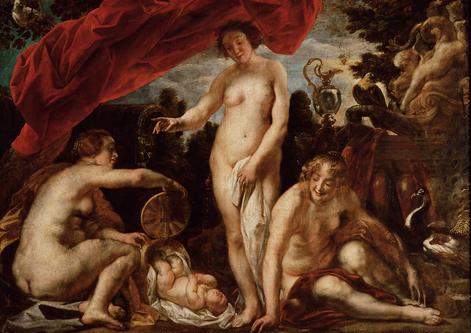
the-daughters-of-cecrops-finding-the-child-erichthonius

     “The Daughters of Cecrops Finding the Child Erichthonius (1640) 


               Jacob Jordaens


                   _________


                                 Once upon a time, 


something interesting happens here,

where earlier in this particular myth

we had a fable, a story in which 

animals play major roles, Aesop is 

famous for his, for instance, as is

Jean de la Fontainewith the

opening catchphrase above, a line

as old at least as Dryden, we’re

suddenly in the land of fairy tales,

structurally, technically


              The two-shap’d Ericthonius had his birth 
              (Without a mother) from the teeming Earth; 


Ericthonius, son of Minervagoddess 

of Wisdom, and of several other traits 

and abilities, and Hephaestus, god of 

Craftsmen, Metallurgy, Fire, among

other, again, areas of malleability 

and possibility


Without a mother, not in the usual,

mammalian, manner


two-shap’d, half human, half serpent,

don’t ask


              Minerva nurs’d him, and the infant laid 
              Within a chest, of twining osiers made. 


Minerva hid her fearsome child in  

a box, a chest, closed the lid, and 

entrusted the secret contents to a 

trio of sisters


              The daughters of king Cecrops undertook 
              To guard the chest, commanded not to look 
              On what was hid within.


king Cecrops, mythical founder and

first king of Athens


                                                               I stood to see 
              The charge obey’d, perch’d on a neighb’ring tree. 


I, the daw, the storyteller


              The sisters Pandrosos and Herse keep 
              The strict command; Aglauros needs would peep, 


Pandrosos, not to be cofused with 

Pandora, Herseand Aglauros, the

three daughters of Cecrops


              And saw the monstrous infant, in a fright, 
              And call’d her sisters to the hideous sight: 
              A boy’s soft shape did to the waste prevail, 
              But the boy ended in a dragon’s tail. 


there’s the ring here, nevertheless,

of Pandora’s tale, though this story

is not at all as dire for humanity as 

Pandora‘s fateful introduction of 

very evil into the world


              I told the stern Minerva all that pass’d; 
              But for my pains, discarded and disgrac’d, 
              The frowning Goddess drove me from her sight, 
              And for her fav’rite chose the bird of night. 


the bird of night, the owl, with which

Minerva is often associated, often

portrayed


              Be then no tell-tale; for I think my wrong 
              Enough to teach a bird to hold her tongue. 


and aptly, we learn the lesson a

fable is meant, by definition, to 

expose


R ! chard


“The Story of Coronis, and Birth of Aesculapius” – Ovid

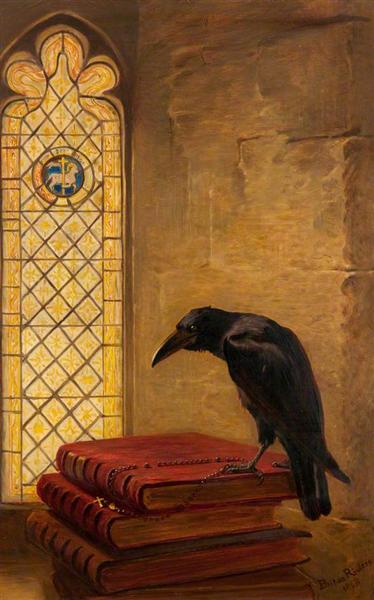
a-saint-from-the-jackdaw-of-rheims-1868(1).jpg!Large

   “A Saint, from ‘The Jackdaw of Rheims’ (1868) 


           Briton Rivière


              _______


             The raven once in snowy plumes was drest, 
             White as the whitest dove’s unsully’d breast, 
             Fair as the guardian of the Capitol, 
             Soft as the swan; a large and lovely fowl; 
             His tongue, his prating tongue had chang’d him quite 
             To sooty blackness, from the purest white. 


the Capitol, the Temple of Jupiter, only 

portions of which remain, on exhibit in

the Capitoline Museums, on the 

Capitoline Hill, one of the Seven Hills 

of Rome


the guardian of the Capitol, the Vestalis

Maxima, or the greatest of the Vestals,

who were charged with ensuring the 

security of the city


the raven was white once, Ovid says, 

[f]air as the guardian of the Capitol, 

[s]oft as the swan, but it seems his 

prating tongue got him in trouble


prating, chattering, tattling


here’s what happened


            In Thessaly there liv’d a nymph of old, 
             Coronis nam’d; a peerless maid she shin’d, 
             Confest the fairest of the fairer kind. 
             Apollo lov’d her, ’till her guilt he knew, 
             While true she was, or whilst he thought her true. 


Thessaly, a region of Greece


contrary to what’s taken place in

these myths till now, Coronis, a 

nymph, in name only, it appears,

was found out to be untrue to 

Apollowho lov’d her


                   his own bird the raven chanc’d to find 
             The false one with a secret rival joyn’d. 
             Coronis begg’d him to suppress the tale, 
             But could not with repeated pray’rs prevail. 


the raven, Apollo‘s own bird, was not 

going to not tell his master about his 

mistress’ indiscretion, despite [t]he 

false one’s pray’rs not to


              His milk-white pinions to the God he ply’d;


pinion, the outer part of a bird’s wing,

including the flight feathers


             [A] busy daw flew with him, side by side, 


daw, jackdaw, a black bird related to 

the crow


             And by a thousand teizing questions drew
             Th’ important secret from him as they 
flew. 


teizing, teasing


             The daw gave honest counsel, 
tho’ despis’d, 


tho’ despis’d, though the honest

counsel would be unpleasant to 

hear


              And, tedious in her tattle, thus advis’d: 


listen, said the daw, cautioning

the raven 


              “Stay, silly bird, th’ ill-natur’d task refuse, 


silly bird, the raven 


              Nor be the bearer of unwelcome news. 
             Be warn’d by my example: 


pay attention, the daw insists, be 

wary, [b]e warn’d


                                                         you discern 
             What now I am, and what I was shall learn. 
             My foolish honesty was all my crime; 
             Then hear my story.


here’s what happened to me,

says the pitch black bird


                                             Once upon a time, 


to follow


R ! chard
 

psst: The Jackdaw of Reims, by

            Richard Harris Barham