Richibi’s Weblog

Just another WordPress.com weblog

Tag: The Silver Age

Metamorphoses (The Silver Age) – Ovid

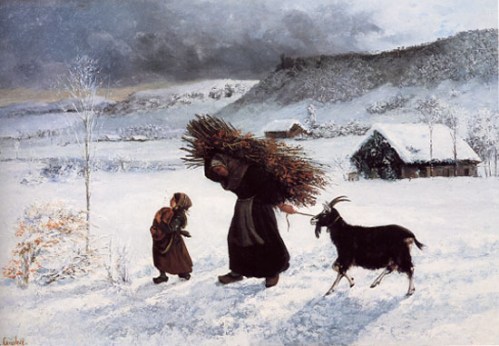
poor-woman-of-the-village

      “Poor Woman of the Village” 


              Gustave Courbet


                 ___________


the good times wouldn’t last, however,

discord among the gods would bring 

on the Silver Age 


           But when good Saturn, banish’d from above,
           Was driv’n to Hell, the world was under Jove. 


Saturn, god of plenty, had presided over 

the Golden Age


Jove, or Jupiter, god of thunder, was 

king of the gods


there would be consequences for this

disarrangement, this strife


           Succeeding times a silver age behold,
           Excelling brass, but more excell’d by gold. 


silver might not have been gold, but it

was still better than brass, as, later,

we’ll see


           Then summer, autumn, winter did appear:
           And spring was but a season of the year. 


no longer “immortal” 


by casting Saturn into the Underworld, Jove

set off the cycle of the seasons, whereby

Saturn, clutching his way back to the realm

of the deities, after his initial fall, would inspire

regeneration, the return of springtime, for a

while, before being ousted again, and again, 

and again


           The sun his annual course obliquely made,
           Good days contracted, and enlarg’d the bad. 


in keeping with the suns “oblique[ ]” 

progressions, not parallel, not at  

right angles


           Then air with sultry heats began to glow;
           The wings of winds were clogg’d with ice and snow; 


the emergence of heat and cold


           And shivering mortals, into houses driv’n,
           Sought shelter from th’ inclemency of Heav’n. 


see above


           Those houses, then, were caves, or homely sheds;
           With twining oziers fenc’d; and moss their beds. 


oziers, or osiers, shrubs of which the 

branches have traditionally been used 

to make baskets, basketry


           Then ploughs, for seed, the fruitful furrows broke, 
           And oxen labour’d first beneath the yoke.


not to mention Man, the advent of agriculture,

toil


R ! chard


the ensuing Ages – Ovid‏

    The Silver Age - Lucas Cranach the Elder

                            The Siver Age  (c.1516)

                              Lucas Cranach the Elder

                                                     ________


it is interesting to note how profoundly Ovid‘s mythological
setting marked Christian notions of the Creation, which at
least in the West have held sway now for some nearly two
thousand years
 
it is a tale then twice told, the last time however with not
half even the first one’s contagious exuberance, I think  
 
I believe more in Ovid then, also in Cranach and da Cortona,
worthy indeed proponents of that earlier oracular deity 
 
 
Richard
 
                       ____________________


But when good Saturn, banish’d from above,
Was driv’n to Hell, the world was under Jove.
Succeeding times a silver age behold,
Excelling brass, but more excell’d by gold.
Then summer, autumn, winter did appear:
And spring was but a season of the year.
The sun his annual course obliquely made,
Good days contracted, and enlarg’d the bad.
Then air with sultry heats began to glow;
The wings of winds were clogg’d with ice and snow;
And shivering mortals, into houses driv’n,
Sought shelter from th’ inclemency of Heav’n.
Those houses, then, were caves, or homely sheds;
With twining oziers fenc’d; and moss their beds.
Then ploughs, for seed, the fruitful furrows broke,
And oxen labour’d first beneath the yoke.
 
 
To this came next in course, the brazen age:
A warlike offspring, prompt to bloody rage,
Not impious yet…


   The Age of Iron - Pietro da Cortona
 
                             The Age of Iron”  (1637)
 
                                      Pietro da Cortona
 
                                            __________


Hard steel succeeded then:
And stubborn as the metal, were the men.
Truth, modesty, and shame, the world forsook:
Fraud, avarice, and force, their places took.
Then sails were spread, to every wind that blew.
Raw were the sailors, and the depths were new:
Trees, rudely hollow’d, did the waves sustain;
E’re ships in triumph plough’d the watry plain.

Then land-marks limited to each his right:
For all before was common as the light.
Nor was the ground alone requir’d to bear
Her annual income to the crooked share,
But greedy mortals, rummaging her store,
Digg’d from her entrails first the precious oar;
Which next to Hell, the prudent Gods had laid;
And that alluring ill, to sight display’d.
Thus cursed steel, and more accursed gold,
Gave mischief birth, and made that mischief bold:
And double death did wretched Man invade,
By steel assaulted, and by gold betray’d,
Now (brandish’d weapons glittering in their hands)
Mankind is broken loose from moral bands;
No rights of hospitality remain:
The guest, by him who harbour’d him, is slain,
The son-in-law pursues the father’s life;
The wife her husband murders, he the wife.
The step-dame poyson for the son prepares;
The son inquires into his father’s years.
Faith flies, and piety in exile mourns;
And justice, here opprest, to Heav’n returns.

 
                                               Ovid 
                                                                    
                                   (fromMetamorphoses“, Book I, in a translation by
                                   Sir Samuel Garth, John Dryden, Alexander Pope,
                                   Joseph Addison, William Congreve and other
                                   eminent hands)