Richibi’s Weblog

Just another WordPress.com weblog

Tag: the Seven Hills of Rome

“The Story of Coronis, and Birth of Aesculapius” – Ovid
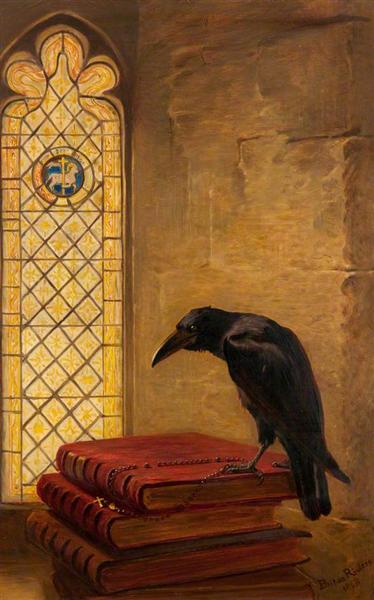
a-saint-from-the-jackdaw-of-rheims-1868(1).jpg!Large

   “A Saint, from ‘The Jackdaw of Rheims’ (1868) 


           Briton Rivière


              _______


             The raven once in snowy plumes was drest, 
             White as the whitest dove’s unsully’d breast, 
             Fair as the guardian of the Capitol, 
             Soft as the swan; a large and lovely fowl; 
             His tongue, his prating tongue had chang’d him quite 
             To sooty blackness, from the purest white. 


the Capitol, the Temple of Jupiter, only 

portions of which remain, on exhibit in

the Capitoline Museums, on the 

Capitoline Hill, one of the Seven Hills 

of Rome


the guardian of the Capitol, the Vestalis

Maxima, or the greatest of the Vestals,

who were charged with ensuring the 

security of the city


the raven was white once, Ovid says, 

[f]air as the guardian of the Capitol, 

[s]oft as the swan, but it seems his 

prating tongue got him in trouble


prating, chattering, tattling


here’s what happened


            In Thessaly there liv’d a nymph of old, 
             Coronis nam’d; a peerless maid she shin’d, 
             Confest the fairest of the fairer kind. 
             Apollo lov’d her, ’till her guilt he knew, 
             While true she was, or whilst he thought her true. 


Thessaly, a region of Greece


contrary to what’s taken place in

these myths till now, Coronis, a 

nymph, in name only, it appears,

was found out to be untrue to 

Apollowho lov’d her


                   his own bird the raven chanc’d to find 
             The false one with a secret rival joyn’d. 
             Coronis begg’d him to suppress the tale, 
             But could not with repeated pray’rs prevail. 


the raven, Apollo‘s own bird, was not 

going to not tell his master about his 

mistress’ indiscretion, despite [t]he 

false one’s pray’rs not to


              His milk-white pinions to the God he ply’d;


pinion, the outer part of a bird’s wing,

including the flight feathers


             [A] busy daw flew with him, side by side, 


daw, jackdaw, a black bird related to 

the crow


             And by a thousand teizing questions drew
             Th’ important secret from him as they 
flew. 


teizing, teasing


             The daw gave honest counsel, 
tho’ despis’d, 


tho’ despis’d, though the honest

counsel would be unpleasant to 

hear


              And, tedious in her tattle, thus advis’d: 


listen, said the daw, cautioning

the raven 


              “Stay, silly bird, th’ ill-natur’d task refuse, 


silly bird, the raven 


              Nor be the bearer of unwelcome news. 
             Be warn’d by my example: 


pay attention, the daw insists, be 

wary, [b]e warn’d


                                                         you discern 
             What now I am, and what I was shall learn. 
             My foolish honesty was all my crime; 
             Then hear my story.


here’s what happened to me,

says the pitch black bird


                                             Once upon a time, 


to follow


R ! chard


psst: The Jackdaw of Reims, by

            Richard Harris Barham


“Metamorphoses” (The Giants’ War, II) – Ovid, 110

the-marriage-at-cana-1563.jpg!Large

      “The Marriage at Cana (1563) 


              Paolo Veronese


                  _________


Jove “sigh’d;” if you’ll remember, “nor 

longer with his pity strove; / But kindled 

to a wrath” which was worthy of him


           Then call’d a general council of the Gods;

           Who summon’d, issue from their blest abodes,

           And fill th’ assembly with a shining train. 


Jove calls the gods together to discuss 

the abhorrent conditions on Earth, who, 

upon being summon’d, leave their blest, 

or blessed, homes, and fill Jove’s 

assembly hall with their glittering train, 

their advancing pageantry


           A way there is, in Heav’n’s expanded plain,

           Which, when the skies are clear, is seen below,

           And mortals, by the name of Milky, know. 


when the skies are clear in Heaven’s

expanded plain, its wide expanse, 

mortals can see the Milky Way


           The ground-work is of stars; through which the road

           Lyes open to the Thunderer’s abode: 


this Milky Way is paved with stars, which

lead to Jove’s, the Thunderer’s, domain


           The Gods of greater nations dwell around, 

           And, on the right and left, the palace bound;


the dwellings of the gods who represent 

the greater nations of the era, of Rome, 

for instance, or Greece, surround,

encircle, the Thunderer’s abode, his 

palace 


           The commons where they can: the nobler sort

           With winding-doors wide open, front the court. 


the more common gods, those of 

lesser nations, live where they can, 

while the winding-doors of the nobler 

gods, doors which can be activated

mechanically, on hinges, though 

perhaps here divinely, stand wide 

open for this colloquy, this exalted 

conference, before the celestial 

court 


           This place, as far as Earth with Heav’n may vie,

           I dare to call the Louvre of the skie. 


if one were to compare [t]his place

this court, to anything on Earth, have 

it vie with, one would liken it, Ovid 

says, to the Louvre


there’s evidently an anachronism 

here since the Louvre didn’t exist at

the time of Ovid, so that the translators 

have replaced the “Palatia” of Ovid’s 

original Latin, which refers to the 

Palatine, the most central of Rome’s

Seven Hillswhere imperial palaces

were built at the time of Augustus

63 B.C. to 14 A.D., which is to say 

during Ovid’s time, 43 B.C. to 

17 /18 A.D., by this relatively more 

recent palatial residence, the Louvre,

in order to make the text more

contemporary, like settings and 

attire are used in Renaissance

art to kindle the viewer’s sense 

of connection


see, for instance, above, where 

Veronese depicts the scene of Jesus 

attending a marriage at Cana, a village 

in Galilee, and transforms water there 

into wine to accommodate a shortage,

midst Roman, note, rather than Galilean, 

trappings, splendour


           When all were plac’d, in seats distinctly known, 

           And he, their father, had assum’d the throne,


seats distinctly known means the

traditionally assigned places, with 

Jove, “their father”, at the head of

the convocation 


           Upon his iv’ry sceptre first he leant,
           Then shook his head, that shook the firmament: 


leant, or leaned, [t]hen shook his head

in revulsion


           Air, Earth, and seas, obey’d th’ almighty nod;
           And, with a gen’ral fear, confess’d the God. 


the elements, Air, Earth, and seas“, 

acknowledge, or confess’d, the God, 

with quivering anxiety


           At length, with indignation, thus he broke
           His awful silence, and the Pow’rs bespoke. 


Jove, after a silence, bespeaks, or 

addresses, the assembled Pow’rs, 

the other divinities


R ! chard