November / Month of the Sonata – 20
______________
Through the travail of the ages,
Midst the pomp and toil of war,
I have fought and strove and perished
Countless times upon this star.
In the form of many people
In all panoplies of time
Have I seen the luring vision
Of the Victory Maid, sublime.
I have battled for fresh mammoth,
I have warred for pastures new,
I have listed to the whispers
When the race trek instinct grew.
I have known the call to battle
In each changeless changing shape
From the high souled voice of conscience
To the beastly lust for rape.
I have sinned and I have suffered,
Played the hero and the knave;
Fought for belly, shame, or country,
And for each have found a grave.
I cannot name my battles
For the visions are not clear,
Yet, I see the twisted faces
And I feel the rending spear.
Perhaps I stabbed our Savior
In His sacred helpless side.
Yet, I’ve called His name in blessing
When after times I died.
In the dimness of the shadows
Where we hairy heathens warred,
I can taste in thought the lifeblood;
We used teeth before the sword.
While in later clearer vision
I can sense the coppery sweat,
Feel the pikes grow wet and slippery
When our Phalanx, Cyrus met.
Hear the rattle of the harness
Where the Persian darts bounced clear,
See their chariots wheel in panic
From the Hoplite’s leveled spear.
See the goal grow monthly longer,
Reaching for the walls of Tyre.
Hear the crash of tons of granite,
Smell the quenchless eastern fire.
Still more clearly as a Roman,
Can I see the Legion close,
As our third rank moved in forward
And the short sword found our foes.
Once again I feel the anguish
Of that blistering treeless plain
When the Parthian showered death bolts,
And our discipline was in vain.
I remember all the suffering
Of those arrows in my neck.
Yet, I stabbed a grinning savage
As I died upon my back.
Once again I smell the heat sparks
When my Flemish plate gave way
And the lance ripped through my entrails
As on Crecy’s field I lay.
In the windless, blinding stillness
Of the glittering tropic sea
I can see the bubbles rising
Where we set the captives free.
Midst the spume of half a tempest
I have heard the bulwarks go
When the crashing, point blank round shot
Sent destruction to our foe.
I have fought with gun and cutlass
On the red and slippery deck
With all Hell aflame within me
And a rope around my neck.
And still later as a General
Have I galloped with Murat
When we laughed at death and numbers
Trusting in the Emperor’s Star.
Till at last our star faded,
And we shouted to our doom
Where the sunken road of Ohein
Closed us in it’s quivering gloom.
So but now with Tanks a’clatter
Have I waddled on the foe
Belching death at twenty paces,
By the star shell’s ghastly glow.
So as through a glass, and darkly
The age long strife I see
Where I fought in many guises,
Many names, but always me.
And I see not in my blindness
What the objects were I wrought,
But as God rules o’er our bickerings
It was through His will I fought.
So forever in the future,
Shall I battle as of yore,
Dying to be born a fighter,
But to die again, once more.
____________
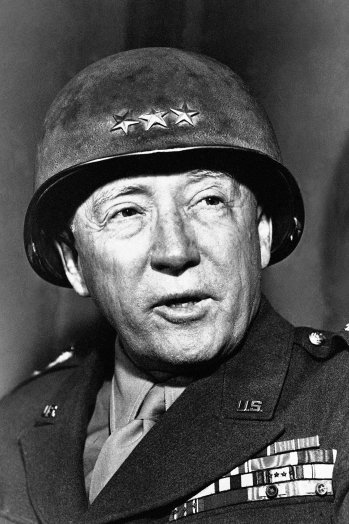
General George S. Patton, Jr., a
celebrated American general who
fought bravely during the Second
World War, is known to my
generation especially through the
much acclaimed film, “Patton“,
which lionized him then, 1970
George C. Scott portrayed him
impeccably, indelibly searing him
into our collective consciousness
he appears to have been the very
paradigm of American heroism,
rough, coarse even, wilful,
inflexible, unforgiving, righteous
to a fault, but instilled with a
sense of divine mission
he believed in reincarnation, notably,
the poem above recounts throughout
history his many lives as a warrior
to me he seems the very incarnation
of the Greek god Ares, rather, come
down from high Olympus, again
throughout history and time, to
effect his defining role as the
immortal God of War
George S. Patton was also, it would
appear, a poet, if the example above
is to count, maybe he was, indeed,
inspired
Richard
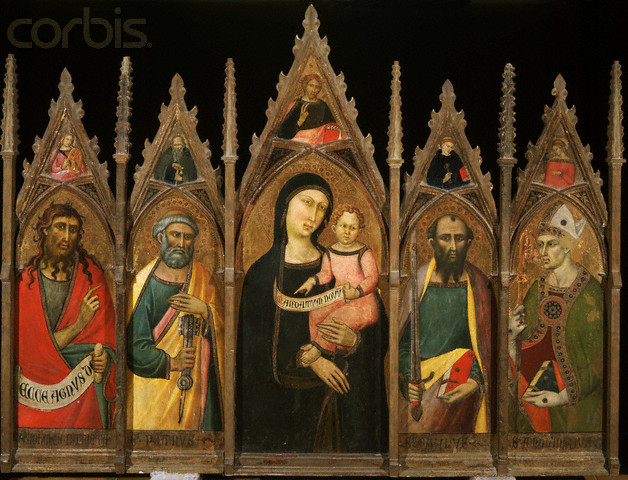 “Madonna and Child Pentaptych“
__________
“Suite française“, had it not been for
its musical associations, would’ve
been called a “quintette”
a suite is, of course, a series of five
dance movements, a sarabande, a
minuet, a gigue, for instance, most
commonly with reference to Bach’s
Baroque masterpieces
which is to say that without its dance
implications, a suite would’ve been
called simply a sonata with five
movements, or a duet, trio, quartet,
and so forth, depending on the
participating instruments
in fiction, a sequence of five books
equals a quintet, see Durrell’s
“Avignon Quintet“, for instance
in art, five panels are called a
pentaptych, see above
five books had been intended for her
“Suite française“, but in 1942 their
author, Irène Némirovsky, was arrested
for being Jewish, and died later at
Auschwitz, she’d completed only two
of her intended manuscripts, a tragic
account of day-to-day life during the
Second World War
these texts were only discovered by her
daughters in 1998, who then had them
published in 2002, in just one volume
called “Suite française“
the superb movie came out last year
it’s a whiff of another era, a
recollection of things past
also a timely consideration of the
flawed foundations of any occupation,
I thought
Richard
psst: incidentally, in French, capital
letters are eschewed – gesundheit –
after the first initial, therefore
the French title, “Suite française“,
sports a lower case f
the film, “Suite Française“ uses
the English construction
 Richibi's Weblog