String Quintets – Mozart / Beethoven


“St. George and the Dragon“ (c.1470)
________
it isn’t easy for me to leave Bach behind
whenever I start listening to him, I could
ride his musical train forever
but the middle of the 18th Century did, put
him aside, for about a hundred years, until
Mendelssohn rediscovered him
Bach’s Cello Suites were themselves only
reinstated in the 1930s by Pablo Casals,
the Classical 18th Century had considered
Bach too fussy, his pieces, they thought,
were technical exercises rather than
actual entertainments, form was
overtaking, for them, function
there’s a wonderful book about all this,
“The Cello Suites“, written by Eric Siblin,
a Canadian journalist, which is not only
amazingly informed and probing, but also
beautifully written, it holds a place of
honour on my bookshelf, along with other
inspired, and inspiring, texts
not only was Bach set asunder, dismissed,
during the Classical Era, but all of the
formative music also he had written, for
cello, violin, keyboard, in other words,
the entire curriculum
which, since Bach’s reinstatement, has
become, paradoxically, the very
foundation for learning these instruments
imagine playing a tune with the right
hand, then a few notes later, picking
it up in the left hand while the right
hand keeps on going, imagine what
that does to your fingers, never mind
to your mind, that’s what his Two-Part
Inventions are all about, fifteen of
them, eight in major keys, seven in
minor, consider the technical
difficulties, intricacies, imposed
both compositionally and upon
the harried performer
then Bach follows through with his
Three-Part Inventions to top it all
off, for the keyboard at least, and
only for the moment – there’ll still
be his transcendental “Goldberg
Variations” among other
incandescent masterpieces –
wherein one juggles three tunes at
a time, and all of them in the same
assortment of fifteen contrasting,
foundational, keys, the “Inventions“
– if you can do that, you’re on your
way, one would think, to knowing
entirely what you’re doing
but time marches on, the Classical
Era hits, Haydn takes over, not
unimpressively
the same thing happened in my
generation to Frank Sinatra via
the Beatles, not to mention, a little
later, to either, with Pink Floyd
listen to Haydn’s First Cello Concerto,
note the bravura inherent in the
composition, this is not Bach’s
meditative music, the very Romantic
Period is, through Classical reserve,
expressing already its imminence,
individual prowess is taking over
from community, which is to say
religious, affiliation, the same way
the Renaissance artists, Duccio,
Giotto, Fra Angelico, Filippo Lippi,
Uccello had stood out, incidentally,
from their brethren in the standard
communal art schools dedicated to
decorating the ever burgeoning
churches sprouting out in the still
fervent European environment
musical, though unaristocratic,
talents, this time, were beginning,
within a German context, to flex
their decidedly not unimpressive
muscles, and gaining some
significant purchase
and who wouldn’t when a Cello
Concerto would’ve sounded like
this, listen
R ! chard

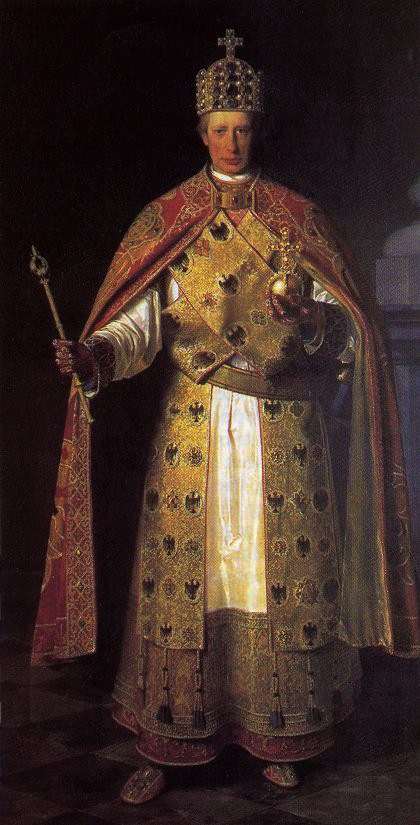
“Francis II as Holy Roman Emperor“ (1874)
_____________
Haydn’s String Quartet, opus 76, no 3,
is nicknamed the “Emperor“ cause the
second movement, the poco adagio;
cantabile, is a recapitulation of an
anthem Haydn had earlier written for
Francis ll, the Holy Roman Emperor
– not, incidentally, for Napoleon, the
Emperor of the moment, who was to
defeat Francis ll, eventually, at the
Battle of Austerlitz, December 2, 1805,
thereby dissolving that Holy Roman
Empire, which had been established
by Leo, the very Pope, lll when, on
December 25th, 800, which is to say
preceding Austerlitz by a thousand
years, he crowned Charlemagne its
Emperor
Haydn must’ve been a monarchist
you’ll recognize that second movement
as the present day anthem of Germany
but listen to how Haydn makes it glisten,
explicitly, with articulations and filigree
that render it utterly irresistible
the adagio is usually the moment that
remains immutable, if the composer
is doing hir stuff, it’s the one you walk
home singing, the faster movements,
however histrionic, are nearly a dime
a dozen, though ever nevertheless
often dazzling
this adagio is utterly Romantic, though
I’m sure Haydn didn’t know what he
was doing, cause despite their push
against the democratic surge, even
monarchists, princes, dukes, dutiful
composers, were finding, and voicing,
their personal, and individual, which
is to say, their democratic, opinions,
however aristocratic their pedigree
artists had done a similar thing when
their personalities began to single
themselves out as especially gifted
when the Renaissance was
happening, it was now music’s hour,
individual voices were staking their
claim, Haydn’s manifestly superior
based on talent and, after widespread
economic affluence, audience appeal,
Haydn’s commercial boots were made
for walking, and he filled them both
magnificently and incontrovertibly
the poco adagio; cantabile is not
courtly music, it reaches for not
merely elegance, but the heart,
we’ve entered another
transformational generation,
something like the revolution
that triggered change in the
cultural upheaval of the1960s
our first step then was the Beatles,
theirs was Haydn, or rather Elvis
Presley shoring up the Beatles,
Beethoven was more aptly John,
Paul, George and Ringo
but watch the rapture on the players’
faces, Francis ll would’ve been
appalled, much like parents in my
generation facing the pill, drugs,
unorthodox sexual couplings, and,
of course, raucous and unruly rock
music
today, under the spell of the
Romantic Period, and encouraged
by that very Sexual Revolution, the
Calidore String Quartet’s Elysium,
their evident bliss, emotionally
manifest, and utterly arresting, sells
tickets, for better or, hopefully not,
for worse
but you call the shots, to decorum or
not to decorum, that is the question
R ! chard
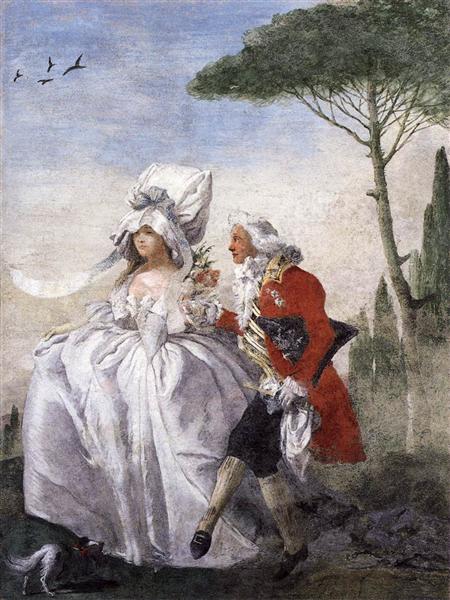
“Minuet in Villa“ (c.1791)
_____________
for my father
the Opus 74, along with the Opus 71, were
written as a unit, to deliver to the English
public for presentation, if the opus numbers
differ, it’s probably to do with publication
dates, the 74‘s being later than the earlier,
but they fit the bill together, batches of six
string quartets for Haydn’s opuses up until
now being the standard, each opus here
comprising only half the normal number,
just three
Haydn’s sponsor, Prince Nicholas Esterházy,
had died, leaving his son, Anton, to preside,
but being tone deaf, the descendant fired
the orchestra, however until then illustrious
the fact that these works were no longer,
therefore, court pieces but intended for
larger, paying, audiences, changed the
dynamics, Haydn is not only peripheral
music at an aristocratic court any longer,
he’s the host, and you can hear it
fermatas, where the note, or the pause,
are accentuated, deliver drama, so does
volume, and sudden tempo changes
therefore the Romantic Period
but, interestingly, the Classical
foundation remains, the established
structure – a musical statement, an
elaboration, a second musical,
related, statement, in usually a
complementary key, it’s own
elaboration, then a recapitulation
of either, or both
the minuet, incidentally, stalwart
still, holding on to the very end of
the 18th Century, still applies, a
sure enough, though residual
sign of the earlier Classical
supremacy, even as that era was
inexorably disintegrating
music is an entertainment, it
inspires, however so incidentally,
though it ever, perhaps even
intentionally, makes you often,
indeed, cry, it’s needed, even in
the direst circumstances, for
courage, however ironically,
however contrapuntally, in any
particular moment, it might even
seem cynical so to arouse spirit,
inspiration, I mean the French had
just turned the world upside down,
and here was sparkling creativity
Haydn was doing his stuff, keeping
us musically integrated, speaking
music instead of politics, turning a
bad situation into pearls, keeping
the world going, the very stuff of
oracles
listen
R ! chard

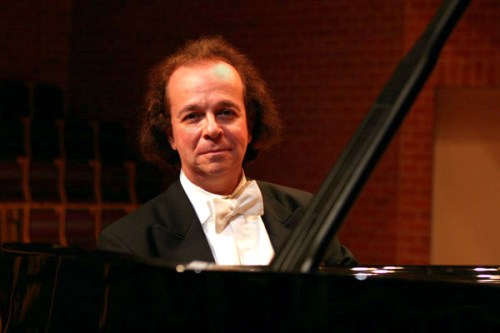
Cyprien Katsaris
________
if there’s only one concert you see
this week – I would’ve said this year
but I have way too many irresistible
concerts to promote – make it this
one, like none I’ve ever seen before,
Cyprien Katsaris, who wowed us in
my last encomium, delivers, not one,
but two concertos, when emotionally
I can usually deal with only one
but you can pause between the pieces,
like I did, to wipe a tear or two away
after the adagios, which remind me,
always, of my beloved, John
but that’s another story
Katsaris starts with an improvisation,
which he elucidates as an art form
much more expertly than I would,
then delivers a stunning rendition of
his mastery of that gift
though I couldn’t identify the first part
of it, the melting melody in the last
section of his homage to, essentially,
the Romantic Period, rushed back
memories for me of a piece I could
never forget, the music from Fellini’s
heartbreaking masterpiece “La Strada“
– listen, listen – right out of Romantic
Period idioms, its very story even, like
Dickens’ “Oliver Twist“, his Little Nell
from the “The Old Curiosity Shop“,
staples of my adolescence, married
to a nearly mythic lyrical invention
let me add that improvisations have
been an integral part of concertos for
a very long time, the cadenzas, an
interpolation by the performing artist,
hir riff, a strutting of hir stuff, late
in the, usually final, movement, a
consequence, incidentally, of the
more forward, individualistic,
18th-Century progression towards
individual rights, some left to the
performing artist, but many
prescribed by the composer himself,
where, here, I must, gender sensitive
myself, unceremoniously interject to
explain my deference to the
designation above, “himself“, to male
merely composers, who were then the
only ones, however culturally ignobly,
to nevertheless shape our quite, I
think, extraordinary musical trajectory,
for better, of course, or for worse
in this instance, I suspect Katsaris
wrote his own cadenzas for the
Mozart, notice his arm at the end of
the first movement fly up in an
especial transport, and in the last
movement, watch his very
exuberance mark the spot, but I
couldn’t put it past Mozart to have
written something so historically
visionary
Bach, incidentally, wasn’t doing
cadenzas, so don’t look for them
the two concertos that follow the
improvisation, Bach’s, my favourite
of his – you’ll understand why when
you hear it – then Mozart’s 21st –
everyone’s favourite – are both
played transcendentally
consider the difference in period,
the earlier Baroque, with Bach’s
notes skipping along inexorably,
the pace required by the
harpsichord, which didn’t have
hold pedals to allow notes to
resonate, the music moves along
therefore nearly minimalistic tracks,
a pace, and musical motif, that don’t
stop, they keep on chugging, until
they reach their destination, their,
as it were, station, or even their
stasis
Mozart’s music is as effervescent,
but conforms to a different cadence,
where a theme is presented, then a
musical, and contrasting, second,
with recapitulation, sometimes
merely partial, which is to say that
the call and response dynamic of
the dance, or for that matter, by
extension, modern ballads, is
being established, codified, and
elucidated
an era has intervened
then as an encore, Katsaris delivers,
not a cream puff, but Liszt, of all
people, we’re used to performers
giving us trifles at this point, but not
Katsaris
then to top it all off, he plays the Chopin
you thought you’d never ever hear again,
but here immaculate and utterly
inspirational
the orchestra alone performs after the
intermission, works by Ravel and Bizet,
surprisingly similar, I thought, the two
composers, in their musical idiom, the
use of the winds as metaphors, for
instance, for originality, eccentricity,
unmitigated poetry within the context
of what is not unnatural
neither is either composer adverse to
atonality, they work in textures, instead
of melodies, all of which is very
Impressionistic, see of course Monet
and others for historical reference
did I say I want to be Cyprien Katsaris
when I grow up, well there, it’s said,
he’s lovely
R ! chard
“Niccolo Paganini“ (c.1819)
_____________
for Apollo, who alerted me to my error
having egregiously misspelled “Akiko”
in my recent commentaries about Ms
Suwanai, since, however, corrected, I
can only heap upon her greater praise
now for again an immaculate
performance of, this time, Paganini’s
First Violin Concerto, itself an event,
as atonement
not only does she play this thrilling
masterpiece with precision and
consummate artistry, this is the
performance with which she wins
the Tchaikovsky Competition, the
one Van Cliburn had secured so
illustriously back in the late Fifties,
at the height of Soviet Communism,
she in 1990, moments only after its
fall, a full, now, 25 years ago
it astounds me that such a talent
would’ve taken so long to reach my
ears, which have been attuned to
Classical music and its
peregrinations for as long as I can
remember
then again there was no ticker tape
parade for Ms Suwanai when she
triumphed, the world has changed,
it seems such excellence is no longer
so universally paraded, not even
much advertised
the Paganini Violin Concerto was
composed around 1818, late
Beethoven, early Chopin, Paganini
defines for the violin the Romantic
Period, what Chopin did for the piano,
Beethoven had given them the push
if you can get past your astonishment
you’ll note that the foundation of the
piece is Classical, tight tempi, tonality,
no discordant notes, and repetition
always of the themes, still the triple
pillars of our understanding of music,
its Trinity, despite some strong forays
into their deconstructions, see, for
instance, the haunting George Crumb
what Paganini adds to Classicism is
personality, Romanticism, same as
Beethoven did, and at about the
same time
aristocratic formality was giving way
to the voices of the crowd, some highly
articulate, representative, formidable,
as the shackles of servitude fell with
the French Revolution and human
rights became central, and
indomitable
Richard