Richibi’s Weblog

Just another WordPress.com weblog

Tag: the river Cephissus

“The Story of of Cadmus” – Ovid

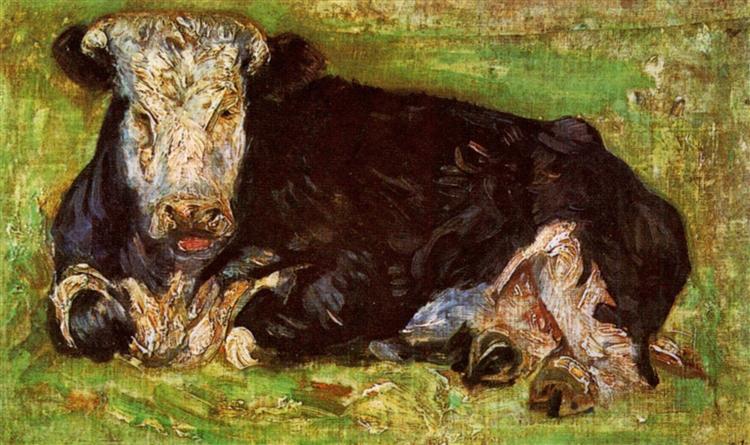
Lying Cow, 1883 - Vincent van Gogh

        Lying Cow(1883)


             Vincent van Gogh


                           ______

            When now Agenor had his daughter lost,


Agenor, king of Tyre, father of

Europahis daughter lost


            He sent his son to search on ev’ry coast;


his son, Agenor’s son, Cadmus,

Europa’s brother


            And sternly bid him to his arms restore
            The darling maid, or see his face no more,
            But live an exile in a foreign clime;
            Thus was the father pious to a crime.


pious to a crime, intent on, devoted to,

having justice restored


            The restless youth search’d all the world around;
            But how can Jove in his amours be found?


amours, loves, trysts, entanglements


            When, tir’d at length with unsuccessful toil,
            To shun his angry sire and native soil,


his angry sire, Agenor, father, sire


            He goes a suppliant to the Delphick dome;


suppliant, supplicant, petitioner,

one in search of a favour


Delphick dome, the Temple of Apollo

at Delphi, where the oracle, Pythia,

proclaimed her cryptic prognostications,

her famously ambiguous prophecies


Delphi, incidentally, was one of several

sacred sites in Greece, sanctuaries,

open to any Greek, or person who

could speak Greek, regardless of

geographical provenance, any

city-statefor instance then, or

kingdom, akin to embassies today,

or places where people can expect

to find similar political haven


Delphi was the destination then also of

pilgrimages, comparable to our own

Santiago de Compostela today, an

ancient path I dearly would’ve, but

never have, unfortunately, undertaken


though I did walk to Mission B.C. some

several years ago, from my home in

Vancouver, to a monastery there, a

place of recuperation when I needed

one, three days there, and a half, three

days and an equal half back, my feet

were blistered, I noticed at one point,

but hadn’t at all registered any pain,

a truth I gathered about the power of

intention, one’s very aim can be a

salve, a balm, a solace, against any

adversity


but back to Cadmus


            There asks the God what new appointed home
            Should end his wand’rings, and his toils relieve.


where do I land, asks Cadmus,where

is my appointed home, my final

destination


            The Delphick oracles this answer give.


The Delphick oracles, subordinates

to Pythia, the high priestess at Delphi


            “Behold among the fields a lonely cow,

            Unworn with yokes, unbroken to the plow;

            Mark well the place where first she lays her down,

            There measure out thy walls, and build thy town,

            And from thy guide Boeotia call the land,

            In which the destin’d walls and town shall stand.”


Boeotiaa region still of Greece


            No sooner had he left the dark abode,
            Big with the promise of the Delphick God,


the Delphick God, Apollo, god of

music, dance, truth, prophecy,

healing, the sun, light, poetry,

among many other things


            When in the fields the fatal cow he view’d,
            Nor gall’d with yokes, nor worn with servitude:


fatal, fateful


gall’d, irritated, frustrated


            Her gently at a distance he pursu’d;
            And as he walk’d aloof, in silence pray’d
            To the great Pow’r whose counsels he obey’d.


the great Pow’r, Apollo, by way of his

Delphick oracles,the high priestesses,

through their counsel, their divinations


            Her way thro’ flow’ry Panope she took,


Panope, plural, were sea nymphs, not

places, in Ancient Greece, therefore

Cadmus must’ve been crossing water,

however flow’ry, I’ll have to check my

Latin text for, maybe, inaccuracies in

the translation


            And now, Cephisus, cross’d thy silver brook;


Cephisus, or Cephissus, a river in Boeotia,

a brook, a stream, anthropomorphized here,

which is to say Cephissus, the flow, the

waterway, is being addressed as a rational

being, I have cross’d thy silver brook, he 

says, speaking to the torrent


meanwhile, to brook, to conquer, to

overcome, a wonderful, a shimmering,

literarily speaking, homonym, which is

to say, a word with two faces


            When to the Heav’ns her spacious front she rais’d,
            And bellow’d thrice, then backward turning gaz’d
            On those behind, ’till on the destin’d place
            She stoop’d, and couch’d amid the rising grass.


she, the fatal cow, see abovehas led

Cadmus to his famed, his mythic,

destination, destin’d place, destiny


stay tuned


R ! chard

“Metamorphoses” (The Giants’ War, XII) – Ovid

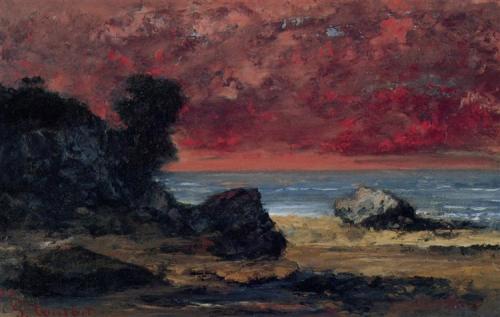
after-the-storm-1872.jpg!Large

      “After the Storm (1872)


            Gustave Courbet


                __________


                  A thin circumference of land appears;
                  And Earth, but not at once, her visage rears,
                  And peeps upon the seas from upper grounds; 


as the land begins to peep[ ] through 

the water, a circumference of land 

appears, a circle of Earth within the 

earlier universal water


to rear, to raise upright, boldly, the better,

here, for Earth‘s visage, Earth‘s face, to 

peep[ ] upon the seas from newly gained 

upper grounds


                  The streams, but just contain’d within their bounds,
                  By slow degrees into their channels crawl; 


streams, just recently redefining their  

boundaries, or bounds[b]y slow 

degrees settle, become waterways, 

channels, rivers, rivulets, rills


I love crawl here, incidentally, the slow, 

insidious, infiltration of a territory, silent 

and immutable, as [t]he streams, at the 

dispassionate pace of nature, find their 

individual course


                  And Earth increases, as the waters fall. 


the waters fall, the waters recede


                  In longer time the tops of trees appear, 


[i]n longer time, after a while


                  Which mud on their dishonour’d branches bear. 


for which the only solution here, would

be, I thought, however ironically, a

shower, rain


but I digress

                 
                  At length the world was all restor’d to view;

                  But desolate, and of a sickly hue:  

see, for instance, above


                  Nature beheld her self, and stood aghast,
                  A dismal desart, and a silent waste. 


desart, is desert, even my spellcheck 

insisted


meanwhile, back on Mount Parnassus

our two survivors, look around


                  Which when Deucalion, with a piteous look
                  Beheld, he wept, and thus to Pyrrha spoke: 


let me point out that what follows, 

which is to say when Deucalion 

… thus to Pyrrha spoke, we have 

an extended monologue, rather 

than a narration, the poet, Ovid

has given a voice to Deucalion

his character, his creation


I was reminded of Shakespeare‘s 

monologues, especially since the 

metre is iambic pentameter,

Shakespeare‘s signature poetic

rhythm 


it should be noted that this translation

of Metamorphoses is from 1717, a

century and a very year after 

Shakespeare‘s demise, in 1616, time 

for poets to have imbibed his already 

profound influence


nor could they not have been marked

by the spirit of their own time, and the 

many transformative epochs since 

Metamorphoses had been written, in 

the year 1, that would’ve affected the 

translation 


the original Latin text, for instance,

was in dactylic hexameter, not 

iambic pentameter


                  Oh wife, oh sister, oh of all thy kind
                  The best, and only creature left behind,
                  By kindred, love, and now by dangers joyn’d;
                  Of multitudes, who breath’d the common air,
                  We two remain; a species in a pair:
                  The rest the seas have swallow’d; nor have we
                  Ev’n of this wretched life a certainty.
                  The clouds are still above; and, while I speak,
                  A second deluge o’er our heads may break.
                  Shou’d I be snatcht from hence, and thou remain,
                  Without relief, or partner of thy pain,
                  How cou’dst thou such a wretched life sustain?
                  Shou’d I be left, and thou be lost, the sea
                  That bury’d her I lov’d, shou’d bury me.
                  Oh cou’d our father his old arts inspire,
                  And make me heir of his informing fire,
                  That so I might abolisht Man retrieve,
                  And perisht people in new souls might live.
                  But Heav’n is pleas’d, nor ought we to complain,
                  That we, th’ examples of mankind, remain. 


cou’d our father, JoveDeucalion asks,

breathe into me his inspiration, his old 

arts, his informing fire, so that I could 

reconstitute Man, retrieve him, and 

supply the perisht people with new, and

presumably more honourable, souls


                  He said; the careful couple joyn their tears: 


He said, or this he spoke, and the

couple joyn their tears


                  And then invoke the Gods, with pious prayers.
                  Thus, in devotion having eas’d their grief,
                  From sacred oracles they seek relief;
                  And to Cephysus’ brook their way pursue: 


Cephysus, or Cephissus, was a river god,

associated with the river Cephissus, which 

runs through Central Greece


                  The stream was troubled, but the ford they knew; 


the ford, the way across the stream


                  With living waters, in the fountain bred, 


living waters would gush from a 

spring, around which a fountain 

would’ve been built


                  They sprinkle first their garments, and their head,
                  Then took the way, which to the temple led.
                  The roofs were all defil’d with moss, and mire,
                  The desart altars void of solemn fire.
                  Before the gradual, prostrate they ador’d;
                  The pavement kiss’d; and thus the saint implor’d.


the gradual is a hymn sung within

the context of a full religious service


desart here is again desert, but in

this instance signifying deserted


the saint, an anachronism here, 

for saints were not at all even a

concept at the time of Ovid

would’ve been Themis, goddess,

at Delphi, on Mount Parnassus

of Divine Justice


R ! chard