November / Month of the Sonata – 10
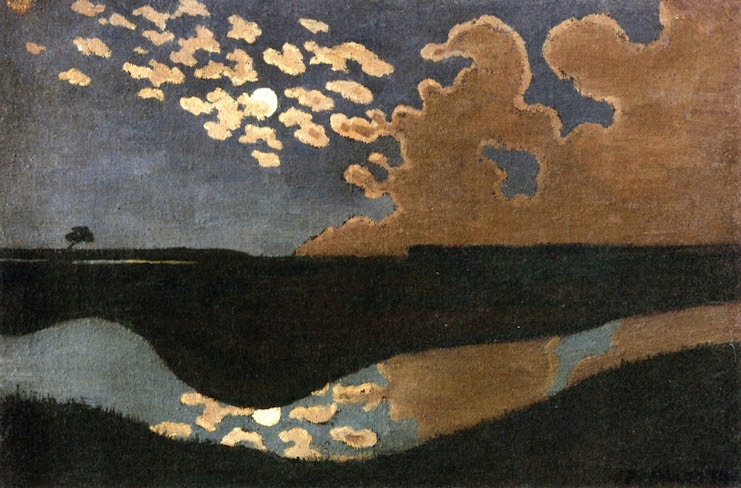

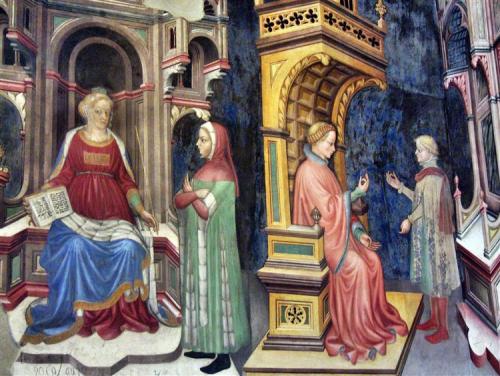
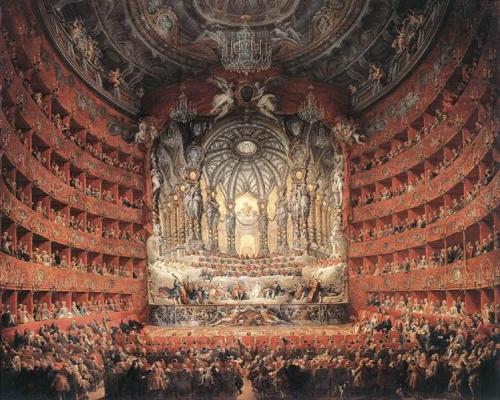
“Musical Fête“ (1747)
____________
though by now you must be assuming
that Beethoven had been defining the
entire early Romantic Period all by
himself, 1803, let’s say, to, say, 1810,
when Schubert, 13 by then, started
kicking in, however immaturely, with
his D1 – D1, note, not D960, over a
thousand compositions later, a work
imbued, so early, not unexpectedly,
with the irrepressible spirit of Mozart,
and therefore, by then, incidentally,
audibly outdated – but you would be,
we would be, overlooking the extraordinary
influence of a maverick, a relic of the
earlier Italian domination of the arts,
from the Renaissance, at least, on –
Paganini – the wizard of the
violin, who’d sold his soul, like Faust,
to the devil, it was susurrated, for his
extraordinary gift
Bach had not only changed the course
of musical history, in the early 18th
Century, but shanghaied the very
language of art as oracular expression,
and substituted music as the voice that
spoke for the people, music will define
henceforth, for a time, the period
there is the Italian Baroque, of course,
utterly masterful paintings, sublime
even, see above, but it has been
supplanted in our 21st-Century
popular imagination by the Baroque
of the German nations, their music,
Bach’s, transcendental then, though
ever so intricate, descriptions of his
particular epoch
this dominance will migrate to Paris,
eventually, and back to art, painting,
after over a hundred tumultuous,
and impermeable, years, with the
Impressionists, in the late 19th
Century
meanwhile, Paganini will get in the
way, 1780 – 1840, an exact, more or
less, contemporary of Beethoven,
1770 – 1827, and show off what
Romantics can do, unleashed,
before a newly enfranchised, and
thrilled, as you will surely be,
audience
R ! chard
psst: the “Caprices“ are essentially
cadenzas, the improvised solo
sections in concertos, where
instrumentalists get to show
off their stuff, and riff, however
exponentially, on their subject
Paganini, makes an art form
of that, as do others, whom
I’ll bring up, trust me, later
stay tuned

“St. George and the Dragon“ (c.1470)
________
it isn’t easy for me to leave Bach behind
whenever I start listening to him, I could
ride his musical train forever
but the middle of the 18th Century did, put
him aside, for about a hundred years, until
Mendelssohn rediscovered him
Bach’s Cello Suites were themselves only
reinstated in the 1930s by Pablo Casals,
the Classical 18th Century had considered
Bach too fussy, his pieces, they thought,
were technical exercises rather than
actual entertainments, form was
overtaking, for them, function
there’s a wonderful book about all this,
“The Cello Suites“, written by Eric Siblin,
a Canadian journalist, which is not only
amazingly informed and probing, but also
beautifully written, it holds a place of
honour on my bookshelf, along with other
inspired, and inspiring, texts
not only was Bach set asunder, dismissed,
during the Classical Era, but all of the
formative music also he had written, for
cello, violin, keyboard, in other words,
the entire curriculum
which, since Bach’s reinstatement, has
become, paradoxically, the very
foundation for learning these instruments
imagine playing a tune with the right
hand, then a few notes later, picking
it up in the left hand while the right
hand keeps on going, imagine what
that does to your fingers, never mind
to your mind, that’s what his Two-Part
Inventions are all about, fifteen of
them, eight in major keys, seven in
minor, consider the technical
difficulties, intricacies, imposed
both compositionally and upon
the harried performer
then Bach follows through with his
Three-Part Inventions to top it all
off, for the keyboard at least, and
only for the moment – there’ll still
be his transcendental “Goldberg
Variations” among other
incandescent masterpieces –
wherein one juggles three tunes at
a time, and all of them in the same
assortment of fifteen contrasting,
foundational, keys, the “Inventions“
– if you can do that, you’re on your
way, one would think, to knowing
entirely what you’re doing
but time marches on, the Classical
Era hits, Haydn takes over, not
unimpressively
the same thing happened in my
generation to Frank Sinatra via
the Beatles, not to mention, a little
later, to either, with Pink Floyd
listen to Haydn’s First Cello Concerto,
note the bravura inherent in the
composition, this is not Bach’s
meditative music, the very Romantic
Period is, through Classical reserve,
expressing already its imminence,
individual prowess is taking over
from community, which is to say
religious, affiliation, the same way
the Renaissance artists, Duccio,
Giotto, Fra Angelico, Filippo Lippi,
Uccello had stood out, incidentally,
from their brethren in the standard
communal art schools dedicated to
decorating the ever burgeoning
churches sprouting out in the still
fervent European environment
musical, though unaristocratic,
talents, this time, were beginning,
within a German context, to flex
their decidedly not unimpressive
muscles, and gaining some
significant purchase
and who wouldn’t when a Cello
Concerto would’ve sounded like
this, listen
R ! chard
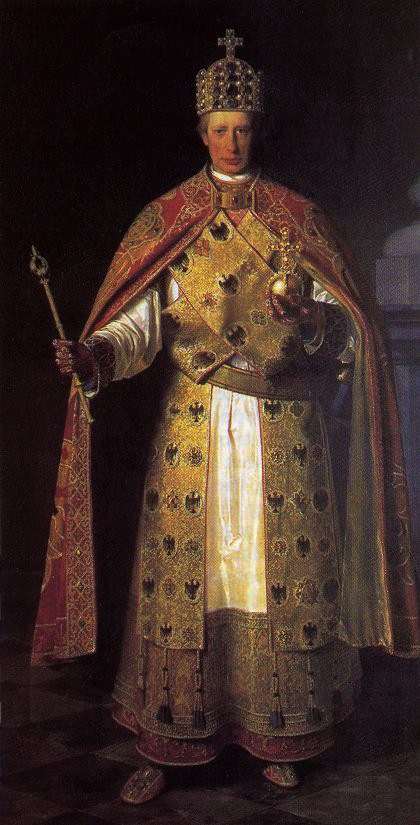
“Francis II as Holy Roman Emperor“ (1874)
_____________
Haydn’s String Quartet, opus 76, no 3,
is nicknamed the “Emperor“ cause the
second movement, the poco adagio;
cantabile, is a recapitulation of an
anthem Haydn had earlier written for
Francis ll, the Holy Roman Emperor
– not, incidentally, for Napoleon, the
Emperor of the moment, who was to
defeat Francis ll, eventually, at the
Battle of Austerlitz, December 2, 1805,
thereby dissolving that Holy Roman
Empire, which had been established
by Leo, the very Pope, lll when, on
December 25th, 800, which is to say
preceding Austerlitz by a thousand
years, he crowned Charlemagne its
Emperor
Haydn must’ve been a monarchist
you’ll recognize that second movement
as the present day anthem of Germany
but listen to how Haydn makes it glisten,
explicitly, with articulations and filigree
that render it utterly irresistible
the adagio is usually the moment that
remains immutable, if the composer
is doing hir stuff, it’s the one you walk
home singing, the faster movements,
however histrionic, are nearly a dime
a dozen, though ever nevertheless
often dazzling
this adagio is utterly Romantic, though
I’m sure Haydn didn’t know what he
was doing, cause despite their push
against the democratic surge, even
monarchists, princes, dukes, dutiful
composers, were finding, and voicing,
their personal, and individual, which
is to say, their democratic, opinions,
however aristocratic their pedigree
artists had done a similar thing when
their personalities began to single
themselves out as especially gifted
when the Renaissance was
happening, it was now music’s hour,
individual voices were staking their
claim, Haydn’s manifestly superior
based on talent and, after widespread
economic affluence, audience appeal,
Haydn’s commercial boots were made
for walking, and he filled them both
magnificently and incontrovertibly
the poco adagio; cantabile is not
courtly music, it reaches for not
merely elegance, but the heart,
we’ve entered another
transformational generation,
something like the revolution
that triggered change in the
cultural upheaval of the1960s
our first step then was the Beatles,
theirs was Haydn, or rather Elvis
Presley shoring up the Beatles,
Beethoven was more aptly John,
Paul, George and Ringo
but watch the rapture on the players’
faces, Francis ll would’ve been
appalled, much like parents in my
generation facing the pill, drugs,
unorthodox sexual couplings, and,
of course, raucous and unruly rock
music
today, under the spell of the
Romantic Period, and encouraged
by that very Sexual Revolution, the
Calidore String Quartet’s Elysium,
their evident bliss, emotionally
manifest, and utterly arresting, sells
tickets, for better or, hopefully not,
for worse
but you call the shots, to decorum or
not to decorum, that is the question
R ! chard

“Paradise”
__________
“Is Art Truth?“, a friend asks after speaking of
its benefits, “Art accepts and tells the truth-Is
that it ?“, she inquires, wonders
art, like truth itself and beauty, is in the eye
of the beholder, I submit, and therefore my
definition is, once again, entirely personal,
though I’ve rigorously plumbed it
it requires background
art died for a thousand years, it was
essentially unrecorded, dormant from
the fall of Rome to the Renaissance, nor
promoted but for Catholic purposes,
hence the majestic cathedrals and the
magisterial altarpieces, works produced
by, however, communities until eventually
certain artisans were recognized as more
inspired than others, and given autonomy
enter Duccio, for instance
in time these new, necessarily idiosyncratic
perspectives – see Hieronymus Bosch, Dante
Alighieri – dominated, veering in their search
for truth in their art and beauty – selling points,
incidentally – towards less strictly orthodox
utterances
see above
art, and its contemporary science, were
chipping away at ecclesiastical dogma
till God died, and artists continued their
prescient march forward, shaping our
zeitgeist, our spirit of the times, with
their pronouncements for lack of any
other guides
but the voices grew personal, see Mozart,
often profound and prophetic, see
Beethoven, till the confluence of disparate
realities gave us secularism, each soul for
itself as a tenet, a credo, a belief, a truth
what did they have in common
I believe it was their quest for beauty
through truth, their quest for truth
through beauty, with a nod here to
the salient Keats
art is prayer, a search for, as well as a
manifestation of, one’s personal
identification with the sacred
it is not truth, it is not beauty, it is the
fervent intention itself, linked with a
correspondent workmanship, craft,
which inspires
see for instance van Gogh for this, who,
remember, nevertheless shot himself,
artists are mortal, merely, messengers,
ever, therefore, fallible, unsure, fearful
even, often, of their, perhaps
Promethean, fire
for consolation, or even maybe
transcendence, see again,
pertinently here, Beethoven
Richard
psst: thanks, Joan
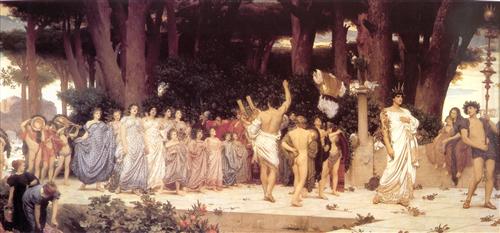
“The Daphnephoria“ (c. 1875)
________________
odes, with their suggestion of music
– despite a history of merely words
spoken in the intervening interim,
counting on meaning and rhythm
without music’s attendant tonality –
go back to the Greeks, the Seventh
Century, BCE, Sappho, for instance,
one of history’s most honoured
women poets, surely quite an
achievement for her in an age of
predominant, indeed
disenfranchising, masculinity
the ode was meant to accompany
tributes to people, events, things,
thereby acquiring an element of
acclamation and praise within its
dimensions, Pindar, ca 552 – 442
BCE, wrote odes for heroes of the
original Greek Olympics, for
instance
by the time of Horace, 65 – 8 BCE,
odes had become stylized,
independent of music, here’s one,
not inappropriately in this season’s
vernal context, to spring
odes remained spoken throughout
their resurrection in the wake of the
rediscovery of the Ancient World
during the Renaissance, onwards
through some famous Romantic
ones, Shelley, for instance, Keats,
up to even this one, by Stanislaw
Barańczak, which I found in the
New Yorker, April 20th, a gem, I
think, and in the very spirit of our
Age of Irony
O plywood, second best to the real stuff,
believe me, one day I will say “Enough”
to my stooping shoulders, my slouched spine;
my sloped shape and your stiff boards will align,
and you’ll see how my backbone will unbend
and I’ll be standing straight until the end
of my makeshift but rectilinear
prayer, one stiff-backed as a chest of drawers
when we shove heavy furniture around;
I will rise from the dead, though on what ground
and which I, I don’t know; I’ll stand erect,
though my vertebrae’s hierarchic sect
won’t outlive plywood, no, it just can’t win
against that vertical eternity, so thin
and yet so sturdy in its ersatz pride;
as if the moon had shown me its dark side,
I lean, my ear glued to a cupboard’s back,
and I can hear its hollow and exact
hymn to its own cheap immortality;
no, wait, I still can straighten, still can be
square with this upright world (you knew I could),
just as plumb as four planks of real wood.
(Translated, from the Polish,
by Clare Cavanagh and the author.)
__________
though you mightn’t’ve caught an “Ode”
in the title, the clue to its essence is in
the initial “O”, an acclamation
and yes, “O, Canada” is therefore also
an ode, as would be most anthems
incidentally Beethoven put the music
back into the form with his incendiary
use of Schiller’s poem for his vocal
triumph in his ninth Symphony, “An
die Freude“, the “Ode to Joy“,
incomparable in this rendering for
an improbable 10,000, yes 10,000, just
click
Richard
“If thou workest at that which is before thee, following right reason seriously, vigorously, calmly, without allowing anything else to distract thee, but keeping thy divine part pure, as if thou shouldst be bound to give it back immediately; if thou holdest to this, expecting nothing, fearing nothing, but satisfied with thy present activity according to nature, and with heroic truth in every word and sound which thou utterest, thou wilt live happy. And there is no man who is able to prevent this.”
“Meditations“, Book 3, 12
_________
the idea of the virtuous man, or the
interpretation of Marcus Aurelius of
such a person, goes back of course to
Socrates by way of Plato, 427 – 347
B.C., who’s ideal was primarily
political, what to achieve within a
political order, rather than a private
meditation, an advice rather than
a contemplation as in Marcus
Aurelius, 121 – 180 A.D., 550,
not inconsequential, years later
other moral perspectives meanwhile
applied, Epicureanism, for instance,
notably, after which the stranglehold
of Christianity produced not philosophy
but dogma, for a subservient and,
biblically labeled, fallen people,
nearly fifteen hundred years spent
trying to figure out how many angels
fit through the eye of a needle,
essentially, how many irrationalities
could prove the existence, and
authority, of a mandated God
René Descartes inadvertently in this
very quest, but not before 1637, put
an end to that, introduced a new, and
revolutionary, perspective, “I think,
therefore I am“, which put the individual
instead of the Church in the driver’s seat,
this, if it didn’t bring on the Renaissance,
at least gave it a significant push
but because of his famous scientific
method, studies afterwards in what
we now know as the humanities
became more empirical than
specifically moral, how do we
perceive rather than how do we live
according to what is right or wrong,
Nietzsche‘s “Beyond Good and Evil“,
1886, reoriented that investigation,
as it happened, ominously, in an age
where any kind of god had become
irrelevant, Beethoven would be
transformed into a Hitler, an
uncomfortably fateful Übermensch,
Superman
now philosophy is concerned with
language, what do we mean when
we say what do we mean, and can
anybody understand that
our closest moralist, our modern day
Marcus Aurelius, is at present Miss
Manners, whom I wholeheartedly
recommend
as well as, of course, Marcus Aurelius
Richard
psst: Miss Manners‘ question and answer
format, incidentally, is not at all unlike
what Plato does in his Socratic dialogues,
she just has a larger, more flip audience
Have you thought of writing or already written memoirs? I think I’d enjoy reading them.
Your second story reminded me of the Confessions by St. Augustine,
in which he grieved over the death of his beloved friend.
Descartes might say this about your “This is the census” moment: “I lisp, therefore I exist”.
But how would you interpret the “parable”?
What caused you to stop ministering at the palliative care unit after ten years?
 Richibi's Weblog