Richibi’s Weblog

Just another WordPress.com weblog

Tag: the punishment of Lycaon

“Metamorphoses” (The Giants’ War, V) – Ovid

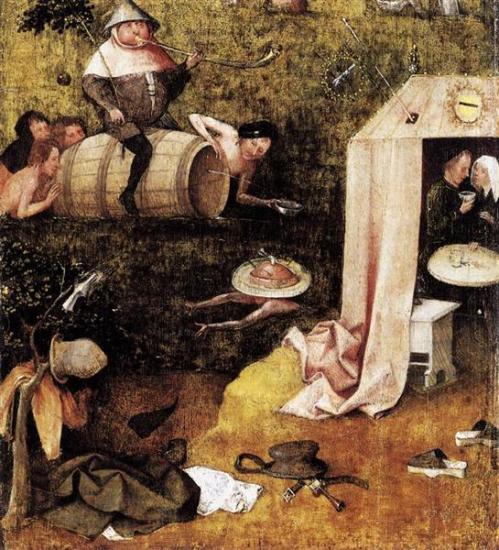
allegory-of-gluttony-and-lust-1500.jpg!Large

     Allegory of Gluttony and Lust (1490 – 1500) 


             Hieronymus Bosch


                _____________


             This was a single ruin, but not one
             Deserves so just a punishment alone


the punishment of Lycaon, Jove says,

was not an isolated incident, more 

miscreants need to be held 

accountable for deeds equally as 

blameworthy, equally as horrid


             Mankind’s a monster, and th’ ungodly times
             Confed’rate into guilt, are sworn to crimes. 


Jove doesn’t think much of the human 

race, nor of th’ ungodly times, for that

matter, that promise more crimes, are

sworn, he believes, consigned to them


confed’rate is an adjective here, 

meaning participating, in agreement,

party to the events


             All are alike involv’d in ill, and all
             Must by the same relentless fury fall. 


Jove here, much like the Christian God,

intends to subject the entire human race, 

not just Lycaon, to punishment for its 

pervasive monstrosities, its innate

aberrations


             Thus ended he; the greater Gods assent;
             By clamours urging his severe intent;
             The less fill up the cry for punishment. 


all Gods are in agreement, the greater, 

and [t]he less, by very clamours urging

Jove’s blanket, and severe, censure,

once he has ended, completed, his 

proclamation  


             Yet still with pity they remember Man;
             And mourn as much as heav’nly spirits can. 


there remains among the Gods, 

however, the memory of early Man, 

which is to say the people of the

Golden Age, but the trials and 

tribulations of earthlings generally 

would not be of much consequence  

to the deities, it is suggested, who 

as immortals, and as a function of 

their infinite longevity, wouldn’t be 

very likely, anyway, to mourn, 

would find it an unfamiliar concept


             They ask, when those were lost of humane birth,
             What he wou’d do with all this waste of Earth: 


if, the Gods ask, all humans were

obliterated from the Earth, what 

would he, Jove, do with what 

remained, bereft as it would be 

of human stewardship


             If his dispeopl’d world he would resign
             To beasts, a mute, and more ignoble line;
             Neglected altars must no longer smoke,
             If none were left to worship, and invoke. 


if Jove were to grant the dispeopl’d 

world, a world without humans, to 

beasts alone, the mute, and more

ignoble species, who would tend 

the altars, who would worship


             To whom the Father of the Gods reply’d,
             Lay that unnecessary fear aside:
             Mine be the care, new people to provide. 


leave it to me, Jove, Father of the

Gods, tells them, I will provide 

a new and improved model


             I will from wondrous principles ordain
             A race unlike the first, and try my skill again. 


from new and wondrous principles,

Jove promises, I will create from the 

scratch, as my German teacher used

to say, a better humanity


let’s see how that turns out


R ! chard 


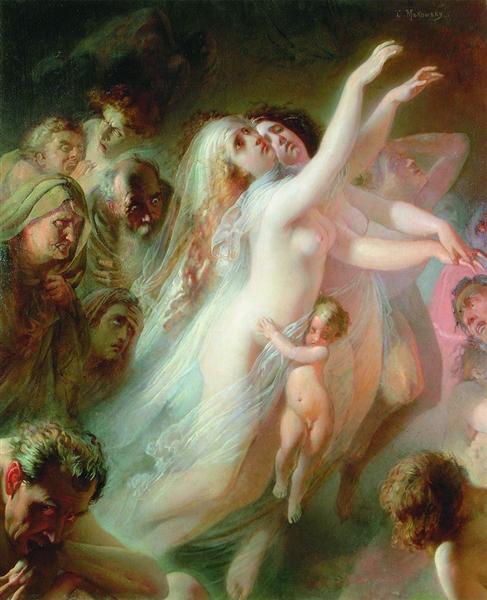
“Metamorphoses” (The Giants’ War, III) – Ovid

charon-carries-dead-souls-across-the-river-styx.jpg!Large

    “Charon Carries Dead Souls across the River Styx(1861)


           Konstantin Makovsky


                 ____________


Jove, god of Thunder, speaks


            I was not more concern’d in that debate
            Of empire, when our universal state
            Was put to hazard, and the giant race
            Our captive skies were ready to imbrace: 


I was not especially disturbed, Jove says,

when the state of our universe was 

challenged, or debate[d], when the giants 

tried to usurp our territory, were ready to 

imbrace, or embrace, take on, our  

vulnerable, [o]ur captive, skies


            For tho’ the foe was fierce, the seeds of all
            Rebellion, sprung from one original; 


because the enemy, then, the adversary, 

came from the one original source, its 

however manifold predations, its 

however myriad desecrations, would’ve

been identifiable to Jove, not foreign, not

unmanageable, he would’ve recognized

the black sheep of the Olympian family,

the giants  


            Now, wheresoever ambient waters glide,
            All are corrupt, and all must be destroy’d. 


ambient, nearby, related, infected, corrupt,

all has been corrupted


            Let me this holy protestation make,
            By Hell, and Hell’s inviolable lake, 


here’s another anachronism, for Hell wouldn’t’ve 

been even a concept in the era of Ovid, where

the Underworld, and Hades, entirely different

afterworlds, would’ve prevailed, areas of 

persistent gloom and shade, see Homer here,

for instance, or Virgil


the Underworld of the ancient world was 

surrounded by five rivers, Hell’s inviolable 

lake, the most famous of which was the 

river Styx


in the Divine Comedy, Dante updates this 

watery boundary for his own 14th Century

readers, and makes it the passageway to

the fifth circle of Hell, where Charon 

remains, after even over a thousand 

years, the very same ferryman


see above


nor was there either any of our present

conception of Heaven, Heaven would’ve 

been Olympus then, the exclusive domain 

of the Gods, either Greek or Roman 


            I try’d whatever in the godhead lay: 


Jove says, I tried everything a god 

could use


            But gangren’d members must be lopt away,
            Before the nobler parts are tainted to decay. 


you’ve got to lop[ ] away, cut off, the bad 

parts before they infect the more vital 

components of the body

 
            There dwells below, a race of demi-gods,
            Of nymphs in waters, and of fawns in woods:
            Who, tho’ not worthy yet, in Heav’n to live,
            Let ’em, at least, enjoy that Earth we give. 


not all beings are corrupt, but nymphs 

and fawns, innocents, Jove pleads, 

should be given consideration on 

Earth, if they be not yet worthy of the 

majesty of Heav’n, and granted earthly 

areas of enjoyment in the confines of 

their forsaken place 


            Can these be thought securely lodg’d below,
            When I my self, who no superior know,
            I, who have Heav’n and Earth at my command,
            Have been attempted by Lycaon’s hand? 


if Lycaon could attack me, Jove, god 

of Thunder, asks, how can these 

innocents, nymphs, fawns, ever be 

safe


             At this a murmur through the synod went,
             And with one voice they vote his punishment. 


the punishment of Lycaon, which we’ll 

soon encounter


             Thus, when conspiring traytors dar’d to doom
             The fall of Caesar, and in him of Rome,
             The nations trembled with a pious fear;
             All anxious for their earthly Thunderer: 


Thus, or in a similar manner, did the nations

of the earth tremble when Caesar, their 

earthly Thunderer, was assassinated 


nations, incidentally, is another anachronism,

nations didn’t appear on earth until the 

18th Century, with the French Revolution


             Nor was their care, o Caesar, less esteem’d
             By thee, than that of Heav’n for Jove was deem’d: 


Ovid addresses Caesar here, his contemporary,

and compares that emperor’s esteem for nations, 

his reliance on their allegiance, to the esteem 

Heav’n has for Jove


             Who with his hand, and voice, did first restrain
             Their murmurs, then resum’d his speech again. 


Jove calls for silence in the assembly

before speaking again


             The Gods to silence were compos’d, and sate
             With reverence, due to his superior state. 


The Gods … sate, or sat, then took heed,

bowing to Jove’s superior position


the tale of the punishment of Lycaon

will follow  


R ! chard