Richibi’s Weblog

Just another WordPress.com weblog

Tag: the Pleiades

The Story of Phaeton (V) – Ovid
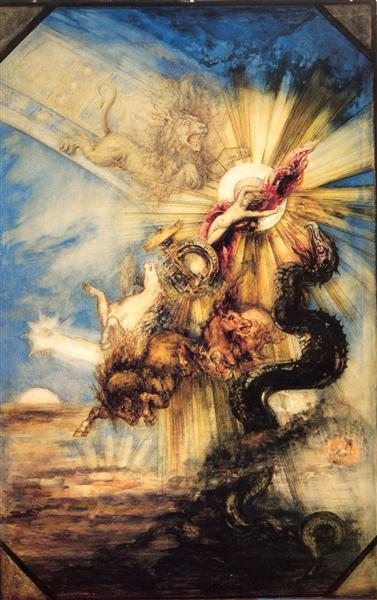
phaethon.jpg!Large

     Phaethon (1878) 


            Gustave Moreau


                       ________


              Mean-while the restless horses neigh’d aloud,
              Breathing out fire, and pawing where they stood.
              Tethys, not knowing what had past, gave way,
              And all the waste of Heav’n before ’em lay. 


Tethys, a Titaness, from the original 

race of gods, before the Olympians,

who seems to have some sort of 

controlling force in the heavens, 

and concern for the regularity of its

movements, though I haven’t yet 

figured out her specific purpose,

position, in the scheme of things 


              They spring together out, and swiftly bear
              The flying youth thro’ clouds and yielding air; 


They, the horses


The flying youth, Phaeton


              With wingy speed outstrip the eastern wind,
              And leave the breezes of the morn behind. “


the eastern wind, Eurus, which you

might remember from the Creation

of the World


              The youth was light, nor cou’d he fill the seat, 
              Or poise the chariot with its wonted weight: 


wonted, usual, the chariot is lighter 

now that only Phaeton’s lesser 

weight is in it rather than that of his 

heavier father


poise, superb word here suggestive 

of the delicacy, the precariousness, 

of the operation, not to mention its 

grace 


              But as at sea th’ unballass’d vessel rides, 


unballass’d, without ballast,

unstable, destabilized


              Cast to and fro, the sport of winds and tides;
              So in the bounding chariot toss’d on high,
              The youth is hurry’d headlong through the sky. 


see above


              Soon as the steeds perceive it, they forsake
              Their stated course, and leave the beaten track.
              The youth was in a maze, 


you can hear the etymology of amaze

here, was in a maze, caught up in a 

conundrum, completely disoriented


                                                    nor did he know
              Which way to turn the reins, or where to go;
              Nor wou’d the horses, had he known, obey. 


had he known, Phaeton didn’t know,

as his father would have, his horses


              Then the sev’n stars first felt Apollo’s ray,
              And wish’d to dip in the forbidden sea. 


the sev’n stars, the Pleiades, a star 

cluster, closest to the earth, would 

resort to the coolness of the sea, 

supposedly, upon being subjected 

to the heat of Apollo’s ray, or rays


forbidden, probably forbidding 


              The folded serpent next the frozen pole,
              Stiff and benum’d before, began to rowle, 


The folded serpent, the constellation

Serpens


              And raged with inward heat, and threaten’d war,
              And shot a redder light from ev’ry star; 


a redder light, the brightest star, 

indeed a double star, in the 

constellation Serpens, is called 

Alpha Serpentis, we now, with our 

greater understanding of the 

cosmos, call such stars red giant

because of a distinctive ring they 

present around their core for 

reasons of thermodynamics, Ovid 

is using this cosmic peculiarity 

here for his own poetic purposes


              Nay, and ’tis said Bootes too, that fain
              Thou woud’st have fled, tho’ cumber’d with thy wane. 


Bootes, or Boötes, is yet another 

constellation, like Serpens, in the 

northern sky

cumbered, encumbered

 wane, to lose its vigour 


              Th’ unhappy youth then, bending down his head,
              Saw Earth and Ocean far beneath him spread.
              His colour chang’d, he startled at the sight,
              And his eyes darken’d by too great a light. 


darken’d, blinded, by too great a light


              Now cou’d he wish the fiery steeds untry’d, 


untry’d, o, that he had not attempted to

take on the fiery steeds, Phaeton rues, 

nor to have ridden at all the Chariot of 

the Sun


              His birth obscure, and his request deny’d: 


had Phaeton only left [h]is birth obscure,

not demanded to know who his father 

was, and been denied, been deny’d, this 

horrifying proof of it would not be now

so threatening

              Now wou’d he Merops for his father own, 


Merops, Clymene‘s husband, Phaeton‘s 

stepfather, Phaeton would now willingly

accept, own, Merops as his father, and

give up his claim to being son of the

Sun god


              And quit his boasted kindred to the sun. 


kindred, originating from the same family,

spirit


              So fares the pilot, when his ship is tost
              In troubled seas, and all its steerage lost,
              He gives her to the winds, and in despair
              Seeks his last refuge in the Gods and pray’r. 


after a lifetime’s consideration, I’ve

determined there are only two things

one can do when confronted with a 

dire situation, pray for grace, and 

make sure your tie’s on right’s stepfather


Phaeton, one extrapolates, is doing 

at least one of these two things, the 

rest being up to the Gods, his last

refuge


stay tuned


R ! chard


“The Transformation of Io into a Heyfer” (V) – Ovid

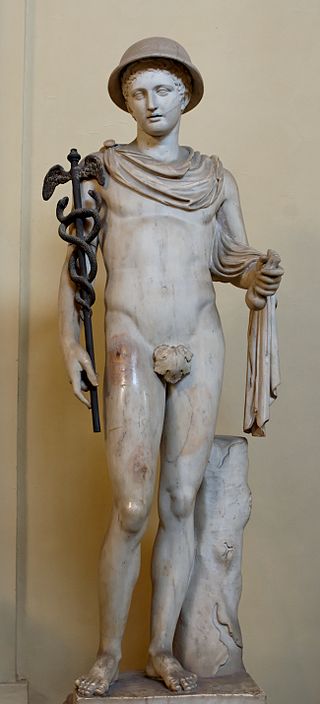
320px-Statue_Hermes_Chiaramonti

     Statue of Hermes (Vatican Museums)

                     ___________________

though Io might still have been “not

out of the woods”, when last we saw 

her, there remained nevertheless 

her original suitor, Jove, god of gods


                 Now Jove no longer cou’d her suff’rings bear;
                 But call’d in haste his airy messenger,
                 The son of Maia, with severe decree
                 To kill the keeper, and to set her free.  
 

The son of Maia, Hermes, messenger

of the gods


Maia, one of the Pleiadesplaymates

of Artemisgoddess of the Hunt,

daughters, also, of Atlasfamously 

condemned, he, to hold up the

heavens for eternity


                 With all his harness soon the God was sped, 
 

Hermes, no sooner equipped,

[w]ith all his harness, livery,

attire, was sped, got under

way


                 His flying hat was fastned on his head,
                 Wings on his heels were hung, and in his hand
                 He holds the vertue of the snaky wand. 
 

vertue, virtue, but having retained, 

still in 1717, its root, vertu, French 

for virtue, benefit 


Hermes is usually shown wearing

[h]is flying hat, [w]ings on his heels,

a snaky wand, identifying accessories


snaky wand, his caduceus


see above


                 The liquid air his moving pinions wound, 


pinions, the feathers of a bird’s wing


wound, to injure, but also to wrap 

around, according to its two 

differing pronunciations


                 And, in the moment, shoot him on the ground.


to rhyme with wound, note


Hermes has landed, but apparently

uncomfortably


                 Before he came in sight, the crafty God
                 His wings dismiss’d, but still retain’d his rod: 


dismiss’d, put aside, made invisible,

[h]is wings


                 That sleep-procuring wand wise Hermes took,
                 But made it seem to sight a sherpherd’s hook. 


though Hermes kept his rod, he made

it look, seem to sight, like a shepherd’s 

staff, hook


                 With this, he did a herd of goats controul;  


controul, control


                 Which by the way he met, and slily stole. 


by the way, as he walked along


slily stole, deities make up their

own rules


                 Clad like a country swain, he pip’d, and sung;
                 And playing, drove his jolly troop along. 


swain, young man


                 With pleasure, Argus the musician heeds; 


Argus heeds the musician, again

an inverted sentence, in order to 

rhyme with


                 But wonders much at those new vocal reeds. 


vocal reeds suggests Pan pipes

here, a wind instrument consisting 

of several tubes of increasing length 

placed side by side, where the piper 

creates the melody by moving his 

lips, her lips, from embouchure to 

embouchure, the openings through 

which to blow


               And whosoe’er thou art, my friend, said he,
               Up hither drive thy goats, and play by me: 


Argus asks Hermes to stay, drive thy 

goats away, [u]p hither, he directs, 

and play thy instrument, keep him 

company


                 This hill has browz for them, and shade for thee. 


browz, browse, matter, twigs, shoots,

upon which goats might graze


                 The God, who was with ease induc’d to climb,  


to climb, [u]p hither, in order to drive

the goats 

                Began discourse to pass away the time;
                 And still betwixt, his tuneful pipe he plies;   


betwixt, meanwhile


plies, continues


                 And watch’d his hour, to close the keeper’s eyes.


his hour, his opportune moment  


the keeper, Argus, over Io


                 With much ado, he partly kept awake; 


the calming effect of the Pan pipes

was making it hard, much ado, for

Argus to stay awake 


                 Not suff’ring all his eyes repose to take: 


never allowing, suff’ring, all his eyes 

to close, repose to take, at the same

time


                 And ask’d the stranger, who did reeds invent,
                 And whence began so rare an instrument? 


how do you do that, Argus asks,

which leads to an interpolated story,

wherein Hermes, before we learn

much more about Io, answers the 

questions 


stay tuned


R ! chard