Richibi’s Weblog

Just another WordPress.com weblog

Tag: the pianoforte

Beethoven – piano sonata no 7, in D major, opus 10, no 3‏

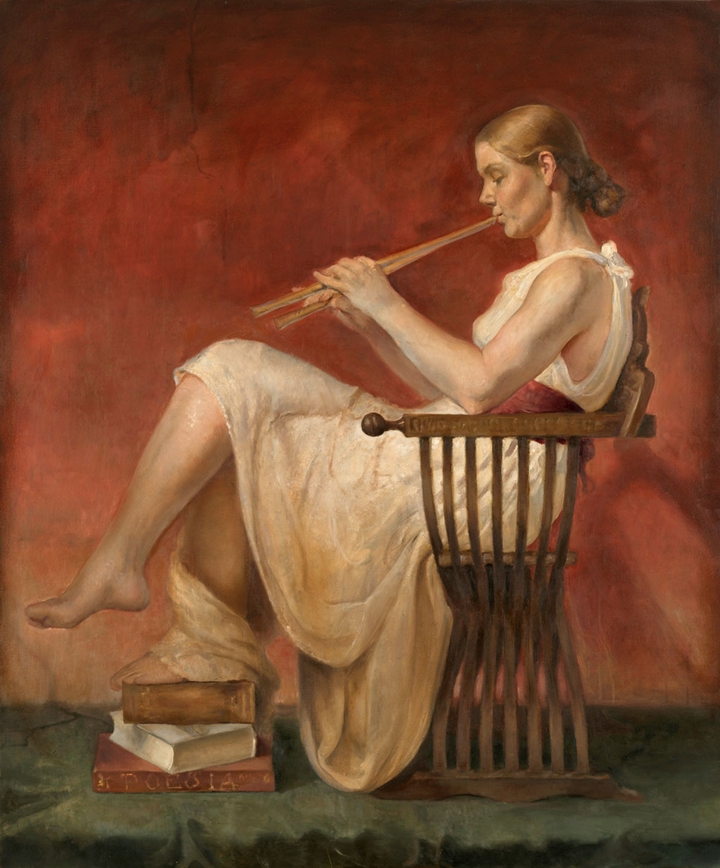
Euterpe - Apollo and the Muses - Helene Knoop 1979 - Norwegian Figurative painter - Tutt'Art@

EuterpeApollo and the Muses (2008 – 9)

Helene Knoop

________

if the piano sonata no 4 of Beethoven,
in E flat, opus 7, was academic, an
exercise, a display of technical
dexterity and some, admittedly,
even mighty, compositional verve,
it lacked, in my estimation, a centre,
a convincing motivating factor, a muse,
though ever ardent, ever entertaining,
it is ultimately arid, I think, trite, I’m
not, one is not, keen on returning to it

but in the piano sonata no 7, in D major,
opus 10, no 3
, Beethoven hits, I submit,
his stride, this sonata is enchanting

note the similarities of structure
between the two, the order of the
movements with identical, essentially,
tempo patterns, notably the middle
slow movement, in the first a largo,
con gran expressione,
slow with
great expression, in the latter, a
largo e mesta, slow with sadness,
where Beethoven plumbs, evidently,
the limits of pacing, the time lapse
between two notes, the capacity for
silence of this new instrument, the
pianoforte, of which he’ll look into
also, and even vigorously, its
capacity for volume, the crashing
introduction to his celebrated 8th,
for instance, to establish the
instrument’s new perimeters

you’ll note you can listen to the later
largo, the opus 10, no 3, forever, you
can get lost in its aural world, I can’t
think of anywhere else right now a
more profound largo

the other movements are dazzling
in their thrilling prestidigitation, all
organically sound, and, crucially,
motivationally centred, I think, this
is indeed music, magisterial music,
Beethoven’s not just kidding
anymore, he’s hitched onto his
proper inspirational deity, his own
private Euterpe, music’s muse, and
we’re in for something, from here
on, of a ride

note the cool riff closing off the last
movement, Beethoven in the guise
of Gene Kelly stepping in for a
breezy good-bye, prefiguring, of
course, XXth-Century music, and
the serendipitous extrapolations
of jazz

Richard

psst: incidentally, the headings, largo,
con gran expressione, largo e
mesta,
are entirely Romantic
musical notions, notations,
Classical composers would’ve
been too sedate, formal, courtly,
for such flagrant sentiment

Tchaikowsky piano concerto no 1 in B flat minor, opus 23‏

the piano concerto no 3 of Rachmaninoff was written in 1909,
a hundred years after Beethoven’s piano concerto no 5, the
“Emperor”
, 1811, to the attentive ear the intervening years
are present in the evolution of the music

the most evident structural alteration, sensed now rather
than consciously heard, though this change would’ve been
glaring during that period, is the often elastic rhythm, the
hesitation, the reserve, the recapitulation of forces before
a surging onslaught, before a turbulent apotheosis, as a
movement returns to its fundamental tempo

the beat ever essentially reigns

this will change

let me point out here that this rallentando wouldn’t’ve been
even conceivable before the invention of the piano, which
happened around the time of Mozart, the harpsichord before
that couldn’t do that, it was confined, you might say, to
only rallentandon’ts, the harpsichord didn’t provide the
possibility of resounding a note, neither of moderating of
course its volume, which the piano, by very definition, did,
“piano” means “soft”, “pianoforte” “soft loud”, the very
foundational elements of the instrument, the elaboration
of beat would thus perforce henceforward play a major role

between Rachmaninoff and Beethoven, these two pillars of
our musical Trinity, there is the mighty, the third supreme
immortal, Tchaikowsky, a Late Romantic, of all composers
perhaps to us the most familiar, his piano concerto no 1 in
B flat minor, opus 23, written in 1875, is the concerto most
associated with my generation, Van Cliburn was a rock star
then, after winning the Tchaikowsky Piano Competition in
Moscow, 1958, an achievement of the very highest order
for an American in that historical context

and his performance of it was spectacular

the most salient aspect of Tchaikowsky‘s music to my mind
is the charged dramatics, which is not surprising when you
consider that he wrote the music for “The Nutcracker”,
“Swan Lake”, musical story-telling, you’ll note he evokes
this dramatic tension by sustaining, withholding, then
unleashing the beat before a storm of prestidigitatori

Tchaikowsky tells grandiose stories, Rachmaninoff opens
an anguished heart, Beethoven speaks with God, they are
our foundational musical poets, our sonic oracles

the formidable Emil Gilels, 1916 – 1985, plays Tchaikowsky,
he is electric, he is epic, he is extraordinary

Alfred Wallenstein conducts

Richard