Richibi’s Weblog

Just another WordPress.com weblog

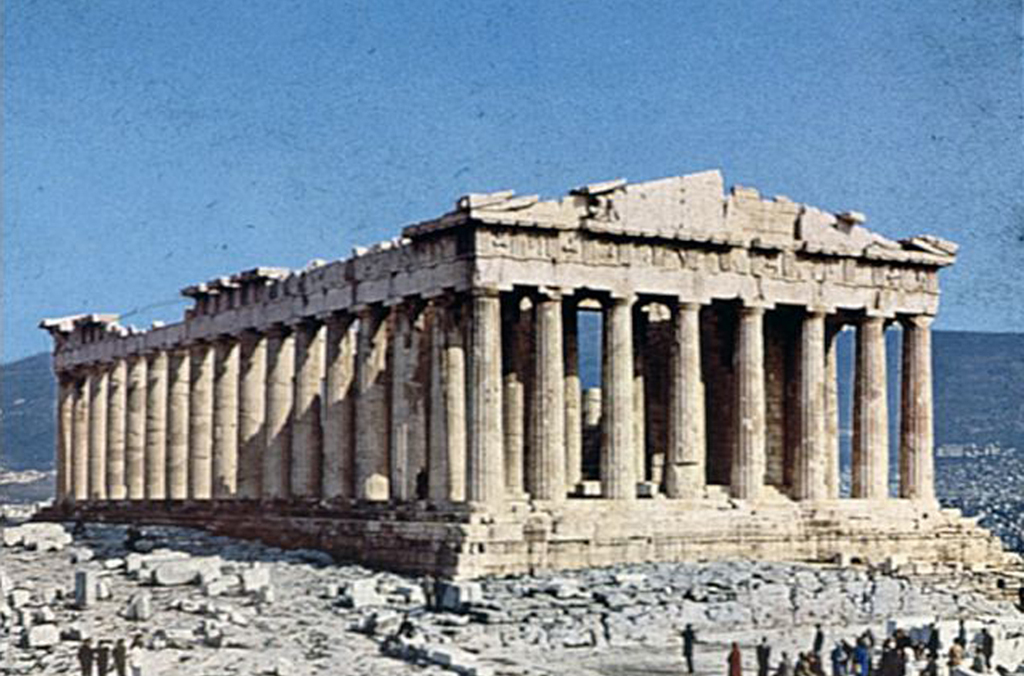
Tag: the Parthenon
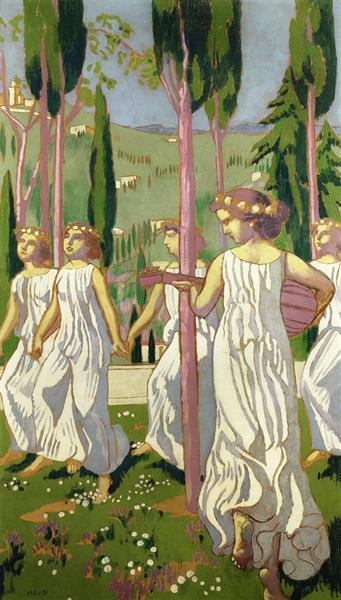
“The Story of Aglauros, transform’d into a Statue” – Ovid

the-dancers-also-known-as-eternal-summer-wiesbaden.jpg!Large


      The Dancers” (c.1905)


               Maurice Denis


                          ________


            This done, the God flew up on high,


This done, Hermes, the God, had just

turned Battus to a Touch stone


                                                          and pass’d

            O’er lofty Athens, by Minerva grac’d,


Minerva, the Latin version of Athena,

was patroness of Athens, grac’d,

indeed, by the very Parthenon, then,

and still now, her temple


            And wide Munichia, whilst his eyes survey

            All the vast region that beneath him lay.


Munichia, the ancient name for a steep

hill, now called Kastella, in Piraeus, the

port of Athens


            ‘Twas now the feast, when each Athenian maid

            Her yearly homage to Minerva paid;


let me point out that during the period

when pantheism prevailed, which is to

say anything earlier than the Emperor

Constantine, 272 – 337 AD, who

established Christianity as the official

religion of the Roman Empire, and going

back to the very beginnings of recorded

history, but at the very least to the epics

of Homer, his Iliad, his Odysseythe 8th

Century BC, which tell of the Trojan War

and its aftermath, from the even more

distant 12th Century BC, homage was

paid, around the Mediterranean, to gods

and goddesses of Olympus, temples

were built, rituals performed in their

honour, much as in the Christian Era,

believers attend church, build cathedrals

to their preferred deity, feasts to Minerva

were as fervent then, in other words, as,

later, were those of devotees to their own

Christmas and Easter, say, celebrations


            In canisters, with garlands cover’d o’er,

            High on their heads, their mystick gifts they bore:

            And now, returning in a solemn train,

            The troop of shining virgins fill’d the plain.


see above


            The God well pleas’d beheld the pompous show,


The God, Hermes still


            And saw the bright procession pass below;

            Then veer’d about, and took a wheeling flight,

            And hover’d o’er them: as the spreading kite,


kitea bird of prey


            That smells the slaughter’d victim from on high,

            Flies at a distance, if the priests are nigh,

            And sails around, and keeps it in her eye:


her eye, the kite is given the feminine

gender here, perhaps following upon

the original Latin word’s grammar


            So kept the God the virgin quire in view,

            And in slow winding circles round them flew.


quire, archaic spelling of choir, a

group of instrumentalists or singers


            As Lucifer excells the meanest star,

            Or, as the full-orb’d Phoebe, Lucifer;


Lucifer, the Morning Star, the planet

Venus, as it appears in the East

before sunrise


Phoebe, pre-Olympian goddess

representative of the moon, thus

in the verse above the very moon


            So much did Herse all the rest outvy,

            And gave a grace to the solemnity.


Herse, a Greek princess


outvy, outvie, to surpass


            Hermes was fir’d, as in the clouds he hung:


fir’d, inflamed, aroused, thus

flung as would be a missile,

the word fir’d here shimmers

with both meanings


            So the cold bullet, that with fury slung

            From Balearick engines mounts on high,

            Glows in the whirl, and burns along the sky.


Balearick engines, slingshots,

the people of the Balearic Islands,

off the coast of Spain, were famous

in ancient times for their use of the

slingshot, or sling, especially as a

weapon


            At length he pitch’d upon the ground, and show’d

            The form divine, the features of a God.

            He knew their vertue o’er a female heart,


their vertue, the virtues of both [t]he

form divine and the features of a

God, however be these identical,

allow grammatically for the

possessive adjective their to be

used here


            And yet he strives to better them by art.


Hermes would rather seduce with

art, which is to say with charm 

and artistry, than by his august

credentials merely


            He hangs his mantle loose, and sets to show

            The golden edging on the seam below;

            Adjusts his flowing curls, and in his hand

            Waves, with an air, the sleep-procuring wand;

            The glitt’ring sandals to his feet applies,

            And to each heel the well-trim’d pinion ties.


pinion, the outer part of a bird’s wing,

including the flight feathers, which

Hermes applies to his sandals


            His ornaments with nicest art display’d,

            He seeks th’ apartment of the royal maid.


to be continued


R ! chard

Seong-jin Cho‏

parthenon

the Parthenon

______


in the last phase of the Arthur Rubinstein
Piano Master Competition
, wherein
contestants play with the Israel
Philharmonic Orchestra
, of course
resounding works abound, among those
Tchaikovsky’s First Piano Concerto holds
a revered place, in our culture it stands
right up there with the Parthenon, the
Roman Coliseum, the Cathedral at
Chartres, as an icon, an emblem, of
our civilization

here Seong-jin Cho gives it an impeccable,
an irreproachable, rendering, lights it up,
sets it on very fire

don’t not watch

Richard

Beethoven piano sonata no 29, the “Hammerklavier”

take a few minutes, well, nearly an hour,
to watch, imbibe, incorporate, integrate,
this video, to smell this miraculous
flower, Beethoven’s piano sonata no 29,
the monumental Hammerklavier“, the
equivalent, to my mind, of the Eiffel
Tower, the Coliseum, the Parthenon,
Homer’s Iliad“, I promise it will
transform you

I’ll talk about it later, I also promise

Richard

psst: you might need some Kleenex