Richibi’s Weblog

Just another WordPress.com weblog

Tag: the Olympians

The Story of Phaeton (V) – Ovid
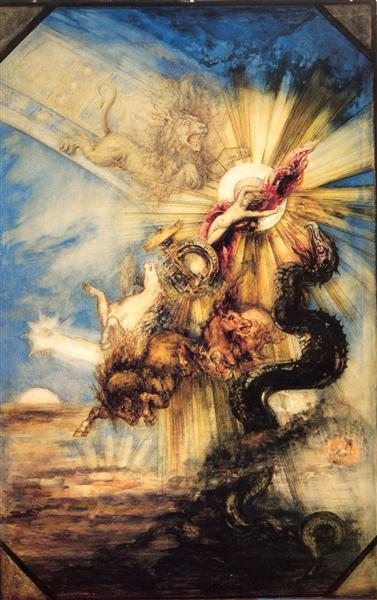
phaethon.jpg!Large

     Phaethon (1878) 


            Gustave Moreau


                       ________


              Mean-while the restless horses neigh’d aloud,
              Breathing out fire, and pawing where they stood.
              Tethys, not knowing what had past, gave way,
              And all the waste of Heav’n before ’em lay. 


Tethys, a Titaness, from the original 

race of gods, before the Olympians,

who seems to have some sort of 

controlling force in the heavens, 

and concern for the regularity of its

movements, though I haven’t yet 

figured out her specific purpose,

position, in the scheme of things 


              They spring together out, and swiftly bear
              The flying youth thro’ clouds and yielding air; 


They, the horses


The flying youth, Phaeton


              With wingy speed outstrip the eastern wind,
              And leave the breezes of the morn behind. “


the eastern wind, Eurus, which you

might remember from the Creation

of the World


              The youth was light, nor cou’d he fill the seat, 
              Or poise the chariot with its wonted weight: 


wonted, usual, the chariot is lighter 

now that only Phaeton’s lesser 

weight is in it rather than that of his 

heavier father


poise, superb word here suggestive 

of the delicacy, the precariousness, 

of the operation, not to mention its 

grace 


              But as at sea th’ unballass’d vessel rides, 


unballass’d, without ballast,

unstable, destabilized


              Cast to and fro, the sport of winds and tides;
              So in the bounding chariot toss’d on high,
              The youth is hurry’d headlong through the sky. 


see above


              Soon as the steeds perceive it, they forsake
              Their stated course, and leave the beaten track.
              The youth was in a maze, 


you can hear the etymology of amaze

here, was in a maze, caught up in a 

conundrum, completely disoriented


                                                    nor did he know
              Which way to turn the reins, or where to go;
              Nor wou’d the horses, had he known, obey. 


had he known, Phaeton didn’t know,

as his father would have, his horses


              Then the sev’n stars first felt Apollo’s ray,
              And wish’d to dip in the forbidden sea. 


the sev’n stars, the Pleiades, a star 

cluster, closest to the earth, would 

resort to the coolness of the sea, 

supposedly, upon being subjected 

to the heat of Apollo’s ray, or rays


forbidden, probably forbidding 


              The folded serpent next the frozen pole,
              Stiff and benum’d before, began to rowle, 


The folded serpent, the constellation

Serpens


              And raged with inward heat, and threaten’d war,
              And shot a redder light from ev’ry star; 


a redder light, the brightest star, 

indeed a double star, in the 

constellation Serpens, is called 

Alpha Serpentis, we now, with our 

greater understanding of the 

cosmos, call such stars red giant

because of a distinctive ring they 

present around their core for 

reasons of thermodynamics, Ovid 

is using this cosmic peculiarity 

here for his own poetic purposes


              Nay, and ’tis said Bootes too, that fain
              Thou woud’st have fled, tho’ cumber’d with thy wane. 


Bootes, or Boötes, is yet another 

constellation, like Serpens, in the 

northern sky

cumbered, encumbered

 wane, to lose its vigour 


              Th’ unhappy youth then, bending down his head,
              Saw Earth and Ocean far beneath him spread.
              His colour chang’d, he startled at the sight,
              And his eyes darken’d by too great a light. 


darken’d, blinded, by too great a light


              Now cou’d he wish the fiery steeds untry’d, 


untry’d, o, that he had not attempted to

take on the fiery steeds, Phaeton rues, 

nor to have ridden at all the Chariot of 

the Sun


              His birth obscure, and his request deny’d: 


had Phaeton only left [h]is birth obscure,

not demanded to know who his father 

was, and been denied, been deny’d, this 

horrifying proof of it would not be now

so threatening

              Now wou’d he Merops for his father own, 


Merops, Clymene‘s husband, Phaeton‘s 

stepfather, Phaeton would now willingly

accept, own, Merops as his father, and

give up his claim to being son of the

Sun god


              And quit his boasted kindred to the sun. 


kindred, originating from the same family,

spirit


              So fares the pilot, when his ship is tost
              In troubled seas, and all its steerage lost,
              He gives her to the winds, and in despair
              Seeks his last refuge in the Gods and pray’r. 


after a lifetime’s consideration, I’ve

determined there are only two things

one can do when confronted with a 

dire situation, pray for grace, and 

make sure your tie’s on right’s stepfather


Phaeton, one extrapolates, is doing 

at least one of these two things, the 

rest being up to the Gods, his last

refuge


stay tuned


R ! chard


The Story of Phaeton (III) – Ovid

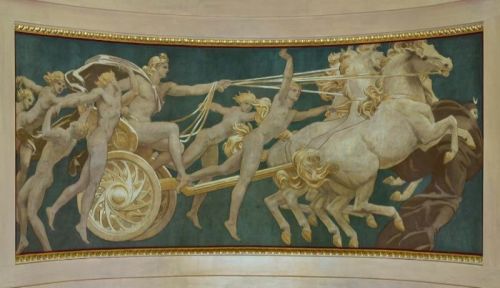
Apollo_in_His_Chariot_with_the_Hours

   Apollo in His Chariot with the Hours (1922–25) 


               John Singer Sargent


                     __________


                 The God repented of the oath he took, 


the God, Helios / Phoebus / Apollo,

father of Phaeton, with Clymene,

Phaeton’s mother


the oath, to grant Phaeton his wish

in order to prove his paternity


                 For anguish thrice his radiant head he shook;
                 “My son,” says he, “some other proof require,
                 Rash was my promise, rash is thy desire.
                 I’d fain deny this wish, which thou hast made,
                 Or, what I can’t deny, wou’d fain disswade. 


fain, willingly, gladly


what I can’t deny, his oath


disswade, dissuade


                Too vast and hazardous the task appears,
                 Nor suited to thy strength, nor to thy years.
                 Thy lot is mortal, but thy wishes fly
                 Beyond the province of mortality:


Beyond the province of mortality,

into immortality, for which Phaeton

is not equipped, being human, his

lot is mortal


                There is not one of all the Gods that dares
                 (However skill’d in other great affairs)
                 To mount the burning axle-tree, but I; 


the axle-tree, the bar that joins the 

wheels of the chariot, is burning 

because it transports the sun


                Not Jove himself, the ruler of the sky,
                 That hurles the three-fork’d thunder from above,
                 Dares try his strength: yet who so strong as Jove? 


not even Jove / Jupiter / Zeus, god of 

gods, and of Thunder, will attempt to  

mount the burning axle-tree, despite 

his immense strength, superior to

anyone’s


                The steeds climb up the first ascent with pain,
                 And when the middle firmament they gain, 


the middle firmament, noon, the

middle of the day, where the sun

reaches its zenith


                If downward from the Heav’ns my head I bow,
                 And see the Earth and Ocean hang below, 


hang, suspended in the heavens


                Ev’n I am seiz’d with horror and affright,
                 And my own heart misgives me at the sight. 


Helios / Phoebus / Apollo admits 

to fear of vertigo


                A mighty downfal steeps the ev’ning stage,
                 And steddy reins must curb the horses’ rage.
                 Tethys herself has fear’d to see me driv’n
                 Down headlong from the precipice of Heav’n. 


Tethys, a Titaness, of the race of 

Giants, who were defeated during 

the Giants’ War


what I’ve learned in the meantime 

is that the Giants, the Titans, had 

actually ruled the cosmos before 

being defeated by the Olympians

something Ovid had misrepresented

in his retelling, where he suggests 

that they were upstarts, rather, 

mortal, however gigantic, who were 

trying from the Earth, Hills pil’d on

hills, on mountains mountains … /

To make their mad approaches to

the skie, in order to unseat the 

gods of Olympus


the Titans, as it turns out, were 

immortals, who ruled the cosmos 

before being ousted by the

Olympians, Jove / Jupiter / Zeus

and his cohorts, and relegated, 

most of them, to the Underworld

though Tethys herself seems to 

have made it out, and been 

reconciled with, at least, the 

Sun god


should I point out that to try to set 

out in one, however comprehensive,

manuscript, a mythology that had 

endured for going on a thousand 

years was likely to reflect some 

inconsistencies, some inaccuracies,

not to mention the dictates of not 

only cultural, but also political 

considerations, we’ll have to 

forgive Ovid, or not, it appears,

his  transgressions 


                Besides, consider what impetuous force
                 Turns stars and planets in a diff’rent course. 


Helios / Phoebus / Apollo continues

to speak, warning his son Phaeton

of the strong, impetuous, and 

unpredictable, currents that [t]urn,

jostle, stars and planets


                I steer against their motions; 


that’s what I have to deal with,

Helios / Phoebus / Apollo

cautions, these motions,

these irascible, interplanetary,

interstellar, streams 


                                                              nor am I
                 Born back by all the current of the sky. 


neither am I born back, which is 

to say borne back, carried back, 

guided back, by any regular,

orderly, current of the sky, by any 

rhythm, of the days, for instance, 

or of the, however intransigent,

hours, that could, potentially,

redirect his path 


                But how cou’d you resist the orbs that roul
                 In adverse whirls, and stem the rapid pole? 


roul, roll, swirl


adverse whirls, of the winds, like 

ocean currents, that stem, are 

created by, are the source of, as 

in the stem of plants, the rapid 

pole, or pull, to rhyme with roul,

a bit, I think, of a poetic stretch


                But you perhaps may hope for pleasing woods,
                 And stately dooms, and cities fill’d with Gods;
                 While through a thousand snares your progress lies,
                 Where forms of starry monsters stock the skies: 


dooms, eventualities, a wonderful 

conjunction here of stately, or 

exalted, expectations, with the 

more dire threat of a thousand

snares, or starry monsters, that

the word doom would usually

suggest


                For, shou’d you hit the doubtful way aright, 


even if you stay on the right track,

even if you hit the … way aright


                The bull with stooping horns stands opposite; 


you’ll have to confront [t]he bull, 

Taurus


                Next him the bright Haemonian bow is strung, 


Haemonian, of Thessaly, a region 

still of Greece  


the Haemonian bow, representative

of Sagittarius


                And next, the lion’s grinning visage hung: 


the lion, Leo


                 The scorpion’s claws, here clasp a wide extent; 


The scorpion, Scorpio


                And here the crab’s in lesser clasps are bent. 


the crab, Cancer


an array of astrological configurations 

obstruct the sky


                Nor wou’d you find it easie to compose
                 The mettled steeds, when from their nostrils flows
                 The scorching fire, that in their entrails glows. 


mettled, spirited 


                Ev’n I their head-strong fury scarce restrain,
                 When they grow warm and restif to the rein. 


Ev’n I, Helios / Phoebus / Apollo, can 

barely, scarce, hold them back, restrain

them, when they grow … restif, restive,

unable to keep still 


                Let not my son a fatal gift require, 


don’t require of me a fatal gift, 

Phaeton’s father pleads, a gift 

that will destroy you 


                But, O! in time, recall your rash desire;
                 You ask a gift that may your parent tell, 


a gift that may your parent tell,

that is meant to determine, to 

prove, your descent


                Let these my fears your parentage reveal;
                 And learn a father from a father’s care:
                 Look on my face; or if my heart lay bare,
                 Cou’d you but look, you’d read the father there. 


were you to just look at my face, 

see my concern, you should be 

able to make out that I’m your 

father, Helios / Phoebus / Apollo

says


                Chuse out a gift from seas, or Earth, or skies, 


[c]huse, choose


                For open to your wish all Nature lies,
                 Only decline this one unequal task,
                 For ’tis a mischief, not a gift, you ask. 


unequal task, a challenge that 

is too great for Phaeton


                You ask a real mischief, Phaeton:
                 Nay hang not thus about my neck, my son: 


don’t hang about my neck, Helios

/ Phoebus / Apollo tells his son, 

you don’t need to try to cajole me


                I grant your wish, and Styx has heard my voice, 


Helios / Phoebus / Apollo has 

sworn an oath on Styx, the 

goddess, the river, an 

unshakable promise, which 

he intends to deliver


                Chuse what you will, but make a wiser choice.” 


now it’s up to you, Phaeton, for 

better or for worse, to decide


R ! chard