Richibi’s Weblog

Just another WordPress.com weblog

Tag: “The Giants’ War” – Ovid

The Story of Phaeton (VII) – Ovid
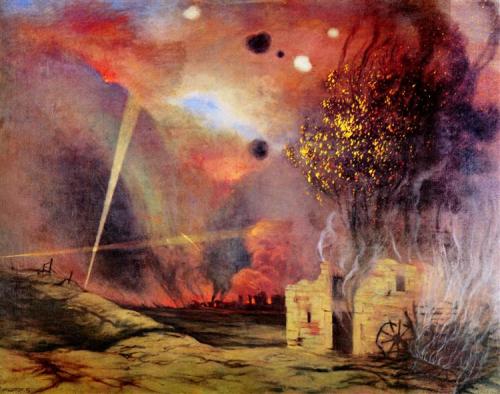
landscape-off-ruins-and-fires-1914.jpg!Large

   Landscape of Ruins and Fires (1914)


               Félix Vallotton


                   _______


                ‘Twas then, they say, the swarthy Moor begun
                To change his hue, and blacken in the sun. 


Moor, a flagrant anachronism here, 

as Moors, Muslim inhabitants of

North Africa, didn’t exist before the 

advent of Islam, which began in the 

Seventh Century CE, Ovid, in Latin,

uses Ethiopian, which would entirely 

throw off, note, Dryden‘s poetic 

metre, thus Moor


                Then Libya first, of all her moisture drain’d,
                Became a barren waste, a wild of sand. 


Libya, Ancient Libya, a much larger 

country of North Africa than the 

Libya we know of today


                The water-nymphs lament their empty urns,
                Boeotia, robb’s of silve Dirce, mourns, 


empty urns, the water has evaporated


Boeotia, a region still of Greece


Dirce, upon her gruesome death, which 

I won’t get into here, was transformed 

by Dionysus, god of revelry and fertility,  

into a fountain, which became revered


silve, sylvan, of the forest, the 

countryside


robb’s, I’ll guess robbers, because 

Boeotia is where Dirce, abducted,

became a fountain 


                Corinth Pyrene’s wasted spring bewails,
                And Argos grieves whilst Amymone fails. 


Corinth, a city still in Greece


Pyrene, a princess, who was, another 

distressing story, transformed into the 

Pyreneesby Heracles, her seducer,

as well as being a god renowned for 

his extraordinary exploits


Argos, a city still in Greece


Amymone, another unfortunate maiden,

who was granted by Poseidon, god of 

Water, for, throughout her tribulations, 

her probity, springs, sources of water, 

for her community, which, in the 

instance, all fail[ ] 


                The floods are drain’d from ev’ry distant coast,
                Ev’n Tanais, tho’ fix’d in ice, was lost. 


Tanais, the river today known as the 

Don in Russia, thus fix’d in ice


                Enrag’d Caicus and Lycormas roar, 


Caicus, a river in Asia Minor, now

given a different name in a different

script, Bakırçay, which I’ll let you 

try to pronounce 


Lycormas, a river in Ancient Greece, 

now called Evinos


                And Xanthus, fated to be burnt once more. 


Xanthus, or Xanthos, a river in Ancient

Asia Minor, which was yellowish already

due to its surrounding tainted soil, thus 

burnt once more    


                The fam’d Maeander, that unweary’d strays 


Maeander, a river in Ancient Asia

Minor


                Through mazy windings, smoaks in ev’ry maze. 


smoaks, smokes


mazy, maze, cute


                From his lov’d Babylon Euphrates flies;
                The big-swoln Ganges and the Danube rise
                In thick’ning fumes, and darken half the skies. 


the Euphrates, the Ganges, and the

Danube, rivers which still go by their

ancient names


                In flames Ismenos and the Phasis roul’d, 


Ismenos, or Ismenus, a river in 

Boeotia, Greece


Phasis, ancient name for the 

Rioni River in Georgia, Eurasia


roul’d, rolled


                And Tagus floating in his melted gold. 


Tagus, a river in the Iberian 

Peninsula


                The swans, that on Cayster often try’d
                Their tuneful songs, now sung their last and dy’d. 


Cayster, a river in Turkey


                The frighted Nile ran off, and under ground
                Conceal’d his head, nor can it yet be found:
                His sev’n divided currents all are dry,
                And where they row’ld, sev’n gaping trenches lye: 


it is being suggested that the Nile

had at one point seven tributaries,

some of which dried up, never

recovered


rowl’d, rolled


                No more the Rhine or Rhone their course maintain,
                Nor Tiber, of his promis’d empire vain. 


the Rhine, the Rhone, and the Tiber

are all European rivers


vain, deprived


                The ground, deep-cleft, admits the dazling ray,
                And startles Pluto with the flash of day. 


dazling, dazzling


Pluto, god of the Underworld, who 

would be understandably startle[d] 

by a flash of day


                The seas shrink in, and to the sight disclose
                Wide naked plains, where once their billows rose; 


billows, of [t]he seas


                Their rocks are all discover’d, and increase
                The number of the scatter’d Cyclades.

 discover’d, uncovered


Cyclades, a group of islands in the 

Aegean Sea, between present-day

Greece and Turkey


                The fish in sholes about the bottom creep, 


sholes, shoals


                Nor longer dares the crooked dolphin leap
                Gasping for breath, th’ unshapen Phocae die, 


Phocae, plural of Phoca, is the 

generic name, and therefore, 

interestingly, capitalized, for 

seals, walruses, sea lions


                And on the boiling wave extended lye. 


lye, lie


                Nereus, and Doris with her virgin train,
                Seek out the last recesses of the main; 


Nereus, and Doris, Sea god and 

goddess, parents, notably, of the 

Nereids, sea nymphs, the virgin 

train


the main, the ocean


                Beneath unfathomable depths they faint,
                And secret in their gloomy caverns pant. 


secret, unseen, alone, untended


                Stern Neptune thrice above the waves upheld
                His face, and thrice was by the flames repell’d. 


Neptune, principal god of the Sea


it is interesting to note that where 

earlier the earth had been 

submerged in water, during the 

Giants’ War, now the earth is

engulfed in flames, a primordial

global warming, as it were, the 

result, consider, of a human, 

Phaeton, trying to take on the 

duties of a god, a warning the 

Ancients were already delivering,

so many years, so many centuries, 

so many millennia, ago


I suspect, worldwide, indigenous 

people would be telling a similar 

tale were we able to access their 

own, unfortunately unwritten, 

though undoubtedly comparable, 

ancestral wisdom, going back,

perhaps, even as far 


R ! chard


The Story of Phaeton (III) – Ovid

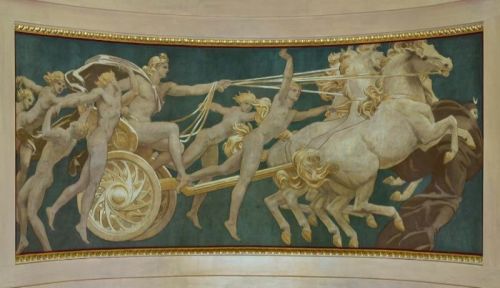
Apollo_in_His_Chariot_with_the_Hours

   Apollo in His Chariot with the Hours (1922–25) 


               John Singer Sargent


                     __________


                 The God repented of the oath he took, 


the God, Helios / Phoebus / Apollo,

father of Phaeton, with Clymene,

Phaeton’s mother


the oath, to grant Phaeton his wish

in order to prove his paternity


                 For anguish thrice his radiant head he shook;
                 “My son,” says he, “some other proof require,
                 Rash was my promise, rash is thy desire.
                 I’d fain deny this wish, which thou hast made,
                 Or, what I can’t deny, wou’d fain disswade. 


fain, willingly, gladly


what I can’t deny, his oath


disswade, dissuade


                Too vast and hazardous the task appears,
                 Nor suited to thy strength, nor to thy years.
                 Thy lot is mortal, but thy wishes fly
                 Beyond the province of mortality:


Beyond the province of mortality,

into immortality, for which Phaeton

is not equipped, being human, his

lot is mortal


                There is not one of all the Gods that dares
                 (However skill’d in other great affairs)
                 To mount the burning axle-tree, but I; 


the axle-tree, the bar that joins the 

wheels of the chariot, is burning 

because it transports the sun


                Not Jove himself, the ruler of the sky,
                 That hurles the three-fork’d thunder from above,
                 Dares try his strength: yet who so strong as Jove? 


not even Jove / Jupiter / Zeus, god of 

gods, and of Thunder, will attempt to  

mount the burning axle-tree, despite 

his immense strength, superior to

anyone’s


                The steeds climb up the first ascent with pain,
                 And when the middle firmament they gain, 


the middle firmament, noon, the

middle of the day, where the sun

reaches its zenith


                If downward from the Heav’ns my head I bow,
                 And see the Earth and Ocean hang below, 


hang, suspended in the heavens


                Ev’n I am seiz’d with horror and affright,
                 And my own heart misgives me at the sight. 


Helios / Phoebus / Apollo admits 

to fear of vertigo


                A mighty downfal steeps the ev’ning stage,
                 And steddy reins must curb the horses’ rage.
                 Tethys herself has fear’d to see me driv’n
                 Down headlong from the precipice of Heav’n. 


Tethys, a Titaness, of the race of 

Giants, who were defeated during 

the Giants’ War


what I’ve learned in the meantime 

is that the Giants, the Titans, had 

actually ruled the cosmos before 

being defeated by the Olympians

something Ovid had misrepresented

in his retelling, where he suggests 

that they were upstarts, rather, 

mortal, however gigantic, who were 

trying from the Earth, Hills pil’d on

hills, on mountains mountains … /

To make their mad approaches to

the skie, in order to unseat the 

gods of Olympus


the Titans, as it turns out, were 

immortals, who ruled the cosmos 

before being ousted by the

Olympians, Jove / Jupiter / Zeus

and his cohorts, and relegated, 

most of them, to the Underworld

though Tethys herself seems to 

have made it out, and been 

reconciled with, at least, the 

Sun god


should I point out that to try to set 

out in one, however comprehensive,

manuscript, a mythology that had 

endured for going on a thousand 

years was likely to reflect some 

inconsistencies, some inaccuracies,

not to mention the dictates of not 

only cultural, but also political 

considerations, we’ll have to 

forgive Ovid, or not, it appears,

his  transgressions 


                Besides, consider what impetuous force
                 Turns stars and planets in a diff’rent course. 


Helios / Phoebus / Apollo continues

to speak, warning his son Phaeton

of the strong, impetuous, and 

unpredictable, currents that [t]urn,

jostle, stars and planets


                I steer against their motions; 


that’s what I have to deal with,

Helios / Phoebus / Apollo

cautions, these motions,

these irascible, interplanetary,

interstellar, streams 


                                                              nor am I
                 Born back by all the current of the sky. 


neither am I born back, which is 

to say borne back, carried back, 

guided back, by any regular,

orderly, current of the sky, by any 

rhythm, of the days, for instance, 

or of the, however intransigent,

hours, that could, potentially,

redirect his path 


                But how cou’d you resist the orbs that roul
                 In adverse whirls, and stem the rapid pole? 


roul, roll, swirl


adverse whirls, of the winds, like 

ocean currents, that stem, are 

created by, are the source of, as 

in the stem of plants, the rapid 

pole, or pull, to rhyme with roul,

a bit, I think, of a poetic stretch


                But you perhaps may hope for pleasing woods,
                 And stately dooms, and cities fill’d with Gods;
                 While through a thousand snares your progress lies,
                 Where forms of starry monsters stock the skies: 


dooms, eventualities, a wonderful 

conjunction here of stately, or 

exalted, expectations, with the 

more dire threat of a thousand

snares, or starry monsters, that

the word doom would usually

suggest


                For, shou’d you hit the doubtful way aright, 


even if you stay on the right track,

even if you hit the … way aright


                The bull with stooping horns stands opposite; 


you’ll have to confront [t]he bull, 

Taurus


                Next him the bright Haemonian bow is strung, 


Haemonian, of Thessaly, a region 

still of Greece  


the Haemonian bow, representative

of Sagittarius


                And next, the lion’s grinning visage hung: 


the lion, Leo


                 The scorpion’s claws, here clasp a wide extent; 


The scorpion, Scorpio


                And here the crab’s in lesser clasps are bent. 


the crab, Cancer


an array of astrological configurations 

obstruct the sky


                Nor wou’d you find it easie to compose
                 The mettled steeds, when from their nostrils flows
                 The scorching fire, that in their entrails glows. 


mettled, spirited 


                Ev’n I their head-strong fury scarce restrain,
                 When they grow warm and restif to the rein. 


Ev’n I, Helios / Phoebus / Apollo, can 

barely, scarce, hold them back, restrain

them, when they grow … restif, restive,

unable to keep still 


                Let not my son a fatal gift require, 


don’t require of me a fatal gift, 

Phaeton’s father pleads, a gift 

that will destroy you 


                But, O! in time, recall your rash desire;
                 You ask a gift that may your parent tell, 


a gift that may your parent tell,

that is meant to determine, to 

prove, your descent


                Let these my fears your parentage reveal;
                 And learn a father from a father’s care:
                 Look on my face; or if my heart lay bare,
                 Cou’d you but look, you’d read the father there. 


were you to just look at my face, 

see my concern, you should be 

able to make out that I’m your 

father, Helios / Phoebus / Apollo

says


                Chuse out a gift from seas, or Earth, or skies, 


[c]huse, choose


                For open to your wish all Nature lies,
                 Only decline this one unequal task,
                 For ’tis a mischief, not a gift, you ask. 


unequal task, a challenge that 

is too great for Phaeton


                You ask a real mischief, Phaeton:
                 Nay hang not thus about my neck, my son: 


don’t hang about my neck, Helios

/ Phoebus / Apollo tells his son, 

you don’t need to try to cajole me


                I grant your wish, and Styx has heard my voice, 


Helios / Phoebus / Apollo has 

sworn an oath on Styx, the 

goddess, the river, an 

unshakable promise, which 

he intends to deliver


                Chuse what you will, but make a wiser choice.” 


now it’s up to you, Phaeton, for 

better or for worse, to decide


R ! chard


“Metamorphoses” (The Giants’ War) – Ovid

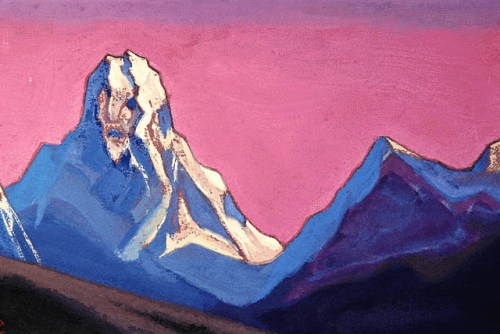
the-giant-1943

    The Giant (1943) 


      Nicholas Roerich


          _________


The Giants’ War

            Nor were the Gods themselves more safe above;  

“justice” might have returned to Heaven

but that didn’t mean the Gods there 

were not affected by strife, nor immune 


            Against beleaguer’d Heav’n the giants move. 


where do the giants come from, who 

knows, I suspect there might be a

vestigial recollection here of larger 

entities, dinosaurs, for instance, 

lurking in our prehistoric memory, 

our primeval consciousness, finding 

expression and acknowledgment 

in our myths


            Hills pil’d on hills, on mountains mountains lie,
            To make their mad approaches to the skie. 


the giants were piling hills on hills, 

mountains on mountains, building 

pathways, however “mad”

notion, to the “skie”, or sky


see above


            ‘Till Jove, no longer patient, took his time
            T’ avenge with thunder their audacious crime: 


Jove, god of thunder


            Red light’ning plaid along the firmament,
            And their demolish’d works to pieces rent. 


lightning “plaid”, or played, at the edge 

of the heavens, destroying there the 

“works” the giants had erected, the 

high hills, the expanded, the extended, 

mountains


rent, past participle of the verb to rend,

to tear asunder


            Sing’d with the flames, and with the bolts transfixt,
            With native Earth, their blood the monsters mixt; 


the blood of these giants, “[s]ing’d with 

flames”, and “transfixt”, or pierced, 

riven, by thunderbolts, mixes with earth


            The blood, indu’d with animating heat, 


hot, propulsive, generating blood


indu’d, or endued, which is to say,

supplied with


            Did in th’ impregnant Earth new sons beget: 


the blood of the giants impregnates 

the Earth, begetting sons, there, and 

daughters 


            They, like the seed from which they sprung, accurst, 

            Against the Gods immortal hatred nurst,


the sins of the father are carried on to  

their sons, and daughters, who maintain, 

have maintained, “nurst”, or nursed, the 

primitive rancour


            An impious, arrogant, and cruel brood;
            Expressing their original from blood. 


the children of the giants were recognizably 

the children of these “original[s]”, these

preliminary giants, an impious, arrogant, 

and cruel brood”


            Which when the king of Gods beheld from high 


the king of Gods, Jove


            (Withal revolving in his memory, 

            What he himself had found on Earth of late,
            Lycaon’s guilt, and his inhumane treat), 


“withal revolving”, or having revolved,

considered,“in his memory”, what he’d 

recently seen on Earth, the reprehensible 

behaviour of a certain Lycaon, Lycaon’s

monstrous discourtesies, his “inhumane

treat[ment]”, of which we’ll hear later


            He sigh’d; nor longer with his pity strove;
            But kindled to a wrath becoming Jove: 

an ire, a fury, worthy of the king of Gods 


stay tuned


R ! chard