Richibi’s Weblog

Just another WordPress.com weblog

Tag: The Garden of Earthly Delights” – Hieronymus Bosch

“Metamorphoses” (The Giants’ War, VII) – Ovid
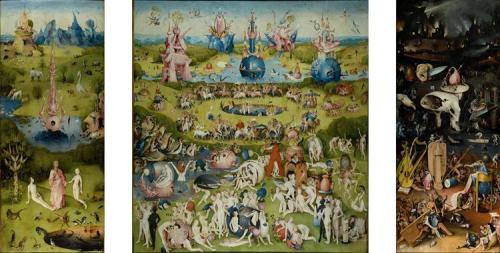
the-garden-of-earthly-delights-1515-7.jpg!Large

    The Garden of Earthly Delights (1510 – 1515) 


             Hieronymus Bosch


                  __________


              Nor from his patrimonial Heaven alone
              Is Jove content to pour his vengeance down; 


let me say something about Heaven 

here, a concept that is quite different 

from the earlier Ancient Greek and 

Roman understanding of the term, 

was it, for that matter, even a term

then, of the Ancients, that would’ve 

meant nothing other to them than 

the blue sky above, not at all an 

area reached by extraterrestrial 

transcendence


the abode of the gods and goddesses 

at the time of Ovid was Mount Olympus

and had been for centuries, much closer 

to the earth than the more ethereal home 

we imagine of the gods today, every one

of them, however professedly uniquely  

supreme, otherworldly


all gods, note, no goddesses, what’s up  

with that, I’ve long wondered


the Underworld was for the Ancients 

the dwelling place of the departed, 

somewhere deep beneath the earth, 

or at the very ends of all the seas, 

never totally beyond the very 

cosmos, as our prevailing faiths 

now uniformly preach 


the image of Heaven, Hell, and 

Purgatory for that matter, that last

a completely Catholic invention – to 

account for the salvation, however 

partial, of innocent souls deprived 

of Heaven for not having been 

christened, though not able yet, at 

so early an age, to have sinned – 

was pretty well codified by Dante

in the 14th Century in his 

masterpiece, The Divine Comedy,​ 

a daunting, but profoundly

illuminating read, which has 

shaped our impression of these 

several possible afterlives ever 

since


see above


this particular translation, however 

magisterial, but crafted after over a

thousand years of Catholic cultural 

domination, cannot avoid the impact 

of the Catholic understanding of 

Heaven


neither, now, can we, for that matter, 

intimately imbued as we are with

the binding faiths of our relatively

more recent forebears


be therefore perspicacious


              Aid from his brother of the seas he craves,
              To help him with auxiliary waves. 


later, we’ll learn that Jove’s brother 

of the seas is Neptune, god of all

aqueous things


            The watry tyrant calls his brooks and floods,
            Who rowl from mossie caves (their moist abodes); 


rowl, or roil, upset 


mossie, mossy


            And with perpetual urns his palace fill:
            To whom in brief, he thus imparts his will.


Neptune is stockpiling water, with

the help of his conforming waterways


            Small exhortation needs


no time, in other words, no need, 

to do much coaxing, much 

exhortation


                                          your pow’rs employ: 


use, put into action, or employ, 

your pow’rs


            And this bad world, so Jove requires, destroy. 


Jove, god of gods, is here commanding, 

authorizing, orchestrating    


            Let loose the reins to all your watry store:
            Bear down the damms, and open ev’ry door.


             The floods

 will inexorably follow


stay tuned


R ! chard


String Quartet no 15 in A minor, opus 132 – Beethoven

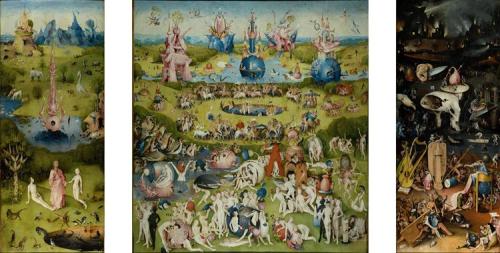
the-garden-of-earthly-delights-1515-7.jpg!Large

   “The Garden of Earthly Delights (1510 – 1515) 

          Hieronymus Bosch

               ____________

if I’ve been spending a lot of time on
Beethoven, it’s that, apart from 
besides him Napoleon, no one else 
dominates in the public imagination 
the early 19th Century, there is no 
one else of such comparable 
importance 

let me also point out that when 
Nietzsche identified his model for  
the Übermensch, Superman, it was  
not the French General, the French 
Emperor, however formidable, 
however illustrious, he named, but 
Beethoven 

Nietzsche had already understood 
that in the future, a future where the
idea of God had been put into question,
an issue which had begun irreversibly 
with the splintering of the Catholic 
supremacy, when the several 
Protestantisms, Lutheran, Calvinist
Anglican then, presented differing 
opinions of each their vehemently
defended deity, the eventual 
resolution would be inescapably up 
for metaphysical grabs, which set 
philosophers, scientists, poets in 
search of answers, which by 
definition must be as varied as 
there are voices

the outcome was the eventual 
declaration of human rights before
the court of international opinion 
as the ruling moral consideration
above the demands of any one 
faith

Nietzsche‘s pronouncement was that
a powerful opinion could therefore 
sway very populations towards its 
vision, however ultimately 
sometimes dire, Nietzsche was 
therefore blamed for predicting, 
for instance, Hitler, as though 
Nietzsche were himself responsible, 
rather than prescient 

one of his books, indeed, entitled 
Beyond Good and Evil“, illustrates
the breakdown of the traditional, 
which is to say Christian, moral
order, powerful people will take us 
where they want to, for better or 
for worse, he prophesied

therefore, note, the very present

but there is also Beethoven, the 
incandescent prophet, Charles 
Darwin, the biologist, who 
changed the way we understand 
ourselves, Sigmund Freud, who 
pushed that understanding even 
further, Albert Einstein, who gave 
us an alternate picture of the 
universe, John Lennon, who 
called upon us all to Imagine“, 
Princess Diana, who demonstrated 
what it was to be good in a world 
that was losing its compass, each 
shaping by force of personality 
our present age, their future
 
all was not, by their examples, 
lost, in other words, some of our 
leaders would be benevolent, 
verily even inspiring, despite the 
prevalence in their midst, the 
existential threat of, nefarious, 
indeed ruthless, and, too often, 
appalling, despots, a category 
too long to even begin to list

here’s, however, Beethoven doing 
again his stuff to inform the tenor
of his time, his 15th String Quartet
another forceful and foundational 
step towards the world that lay,
before him, ahead, our world, for 
better or for worse


R ! chard