Richibi’s Weblog

Just another WordPress.com weblog

Tag: the First World War

November / Month of the Sonata – 20

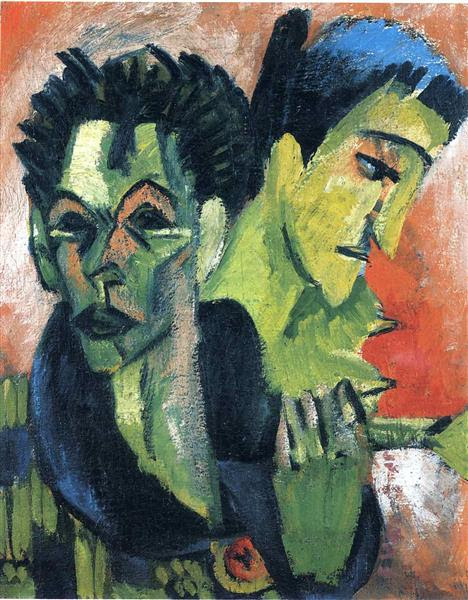
Double Self-Portrait - Ernst Ludwig Kirchner


        “Double Self-Portrait 


               Ernst Ludwig Kirchner


                           ________


Ravel’s Violin Sonata no 2, of 1927, is a 

long way from the Romantics, though I

usually settle Ravel among the 

Impressionists, this piece seems rather

to reflect the later Expressionists in art,

see above, for its virulence and eccentric 

tonalities and performance techniques 

in both the violin and the piano, the age 

had given us the First World War, and 

would soon lead to the Second


the three Classical imperatives of tonality, 

tempo, and repetition are maintained still, 

but their descendants are unruly, willful, 

bold and impervious, there are no holds 

barred here, they take no prisoners


listen


R ! chard

how to listen to music if you don’t know your Beethoven from your Bach, cont.

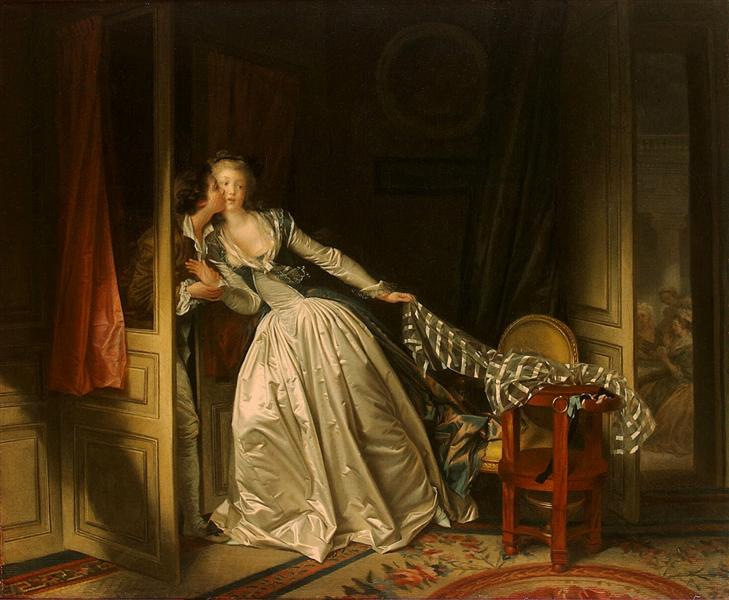
The Stolen Kiss, 1788 - Jean-Honore Fragonard


        The Stolen Kiss (1788)


       Jean-Honoré Fragonard


               _____________


if you listened to the couple of pieces I

recommended in my last commentary,

you would’ve indeed recognized, if

even only subconsciously, that the

first work wasn’t composed by the

composer of the other, that different

spirits infused either


a visual representation of the same

thing might be to juxtapose a

contemporary painting of the one

epoch with a corresponding painting

of the other


over a hundred years had passed

between Mozart and Prokofiev,

Mozart’s Piano Sonata no 18, K576

– his last piano sonata, incidentally,

he died a short two years later –

was written in 1789, the year of the

French Revolution, a still safe

distance from Vienna, where

Mozart could still cater to an,

however endangered, species


Jean-Honoré Fragonard, a contemporary

painter, 1732 – 1806, had been doing the

same thing, The Stolen Kiss, 1788, for

instance, a mere year earlier, see above


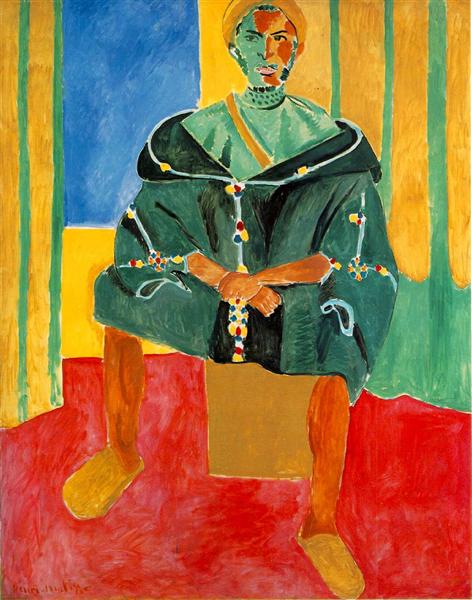
meanwhile, over a hundred years later,

inches only away from the First World

War, Matisse is doing in art what

Prokofiev is doing in music, taking the

temperature of his own time, Seated

Riffian (1911 –1912) – a Riffian, a Berber,

a North African tribesman – see below,

to corroborate Prokofiev’s equally

emblematic vision of their shared era


you can hear this in the music


mostly through the difference in the use

of volume, languorous softs, thunderous

louds, but also in the more expansive use

of pace, fast, slow, the rapidity of some

notes, the embrace, the extended caress,

of others, in the later composition


which, in a word, follows the development

of the piano from harpsichord to the

instrument we’re used to today


Mozart still had the harpsichord in his ear,

he was writing for the fortepiano, which

evolved, through the pianoforte, to the

piano we know of today, no flexibility of

pace, no flexibility of volume then, listen,

hearyou can hear it in the juxtaposition


we hear a lot more than we think we

hear


R ! chard


                  __________


Seated Riffian, 1912 - 1913 - Henri Matisse


        Seated Riffian (1911 – 1912)


                Henri Matisse


                  __________

Debussy’s “Études”

 Man with a Guitar - Georges Braque
 
                    Man with a Guitar (1914)
 
                               Georges Braque 
 
                                       ______
 
 
while we’re on the subject of études, listening to 
hundred years later, 1830s to 1915, would prove
instructive, I deemed 
 
picture me deeming, August 3, 2012, my brow
just slightly pensively constricting 
 
 
if the basis of music as defined by the Classical
period depended on beat, tonality, and the repetition
of the tune, usually of both musical statements, these
apparently essential components of course would be
the first places to bear the scrutiny of probing musical
minds, seeking to find, seeking to set more expansive,
more profound dimensions to the areas of their quest,
that’s what artists do 
 
and this of course is exactly what happened starting
with Beethoven, by the time of Chopin music had
relaxed its stricter Classical rhythmic precision,
allowing great expansive gestures in the more
malleable tempi, tempos, producing the effect of
more compassion and soulful examination than
the earlier less indulgent, more disciplined code
 
the fact of having musical tapestries, sound patches,
take the place of melody, narrative, in the musical
presentation of Chopin also suggests a more
diversified, dare I say prismatic, telling, than the 
linear account of for instance Mozart‘s solitary
tuneful wanderer
 
it also evokes incidentally the vagaries of the
inconstant heart rather than its unflinching
condemnation, a repudiation of atavistic
Christian ecclesiastical intolerance 
 
 
by the time the old order was about to be extinguished,
in 1915, at the onset of the First World War, Debussy’s
Études, like Chopin 12 of them per set, had seen
social injustice – see Charles Dickens, see Émile Zola,
see Karl Marx – the improbable discoveries of science –
Darwin, Freud, Einstein – the car, the airplane,
photography were changing everything, the old
paradigms no longer applied, were irrelevant, even
harmful, in this new context, the First World War 
would prove all that 
 
in the language of music, tempo, melody, repetition
would be inevitably subverted
 
Debussy produces erratic tempi, foregoes melody for
harmonic exploration, combining incidentally the
musical patches of Chopin with the intellectually
driven investigations of Beethoven for a more
cerebral understanding of music, a music for the
head, with expert displays of pianistic skill, indeed
prestidigitation, for, along with the intellectual
rigour, spectacle  
 
is this then still music 
 
is Post-Impressionist painting still art  
 
what would 1915 have said
 
 
above is Georges Braque‘s nearly contemporary, 1914,  
 
man with a guitar, who’d a thunk it
 
 
Richard