Richibi’s Weblog

Just another WordPress.com weblog

Tag: the Enlightenment

Piano Concertos 2, 3, 4 – Beethoven
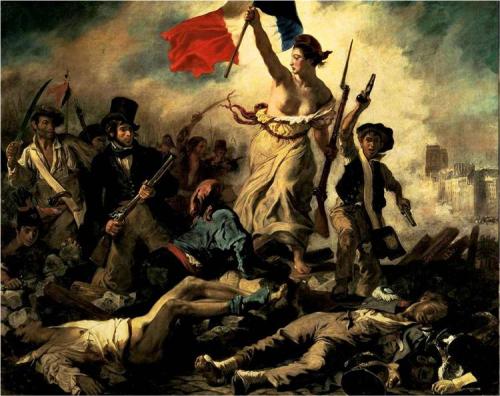
the-liberty-leading-the-people-1830.jpg!Large

     “Liberty Leading the People (1830) 

             Eugène Delacroix

                    _________

                               for everyone, with great gratitude, 
                                  who reads me, I mean only to 
                                     bring poetry, which is to say,
                                        light

though I’d considered leaving the 
Romantic Piano Concertos behind
to explore other areas of the period
in this survey, it seemed unfair,  
indeed remiss of me, not to include 
the three among my top ten that I 
haven’t yet highlighted, Beethoven’s 
2nd, 3rdand 4th Piano Concertos
Opuses 1937and 58 respectively,
after all, these are where the spirit 
of the age, the Zeitgeist, was 
constructed, like a building, with 
walls, windows, a hearth, all of 
which would become church, 
then a Church, and by the time of 
Brahms, a very Romantic Cathedral 

the foundation had already been laid 
by Mozart with his 27, but music had 
not yet become anything other than 
an entertainment by then, or 
alternatively, an accessory to 
ceremonial pomp and circumstance, 
see Handel and England for this, or 
liturgical stuffsee, among many 
others here, Bach

but with the turn towards 
independence of thought as the 
Enlightenment progressed, cultural 
power devolved from the prelates, 
and their reverent representations, 
to the nobles, who wanted their own 
art, music, which is to say, something 
secular, therefore the Classical 
Period, 1750 – 1800, in round figures

then in the middle of all that, 1789, 
the French Revolution happened, 
and the field was ripe for prophets, 
anyone with a message of hope, 
and a metaphysical direction, midst 
all the existential disarray – the Age
of Reason had set the way, 
theoretically, for the possibility of a 
world without God, something, or 
Something, was needed to replace 
the The Trinity, the Father, the Son, 
and the Holy Ghost, Who had been 
seeing Their supremacy contested 
since already the Reformation 

Beethoven turned out to be just
our man, don’t take my, but history‘s 
authentification of it, see the very
Romantic Period for corroboration

in a word, Beethoven established 
Faith, a Vision, not to mention the 
appropriate tools to instal this new 
perspective, a sound, however
inherited, musical structure – his 
Piano Concertos TwoThreeand 
Four, for instance, are paramount 
amongst a host of others of his  
transcendental revelations

briefly, the initial voice, I am here, in 
the first movement, is declamatory, 
even imperious, but ever 
compositionally solid, and proven, 
tempo, tonality, recapitulation, the 
materials haven’t changed from the 
earlier Classical epoch, just the 
design, the interior, the 
metaphysical conception

his construction is masterfully
direct, the line of music is 
throughout ever clear and concise, 
despite flights ofoften, ethereal, 
even magical, speculation, you 
don’t feel the music in your body 
as you would in a dance, as in the 
earlier eraof minuets, but follow 
it, rather, with your intellect, you,
nearly irresistibly, read it

but the adagio, the slow movement, 
the middle one Classically, is always, 
for me, the clincher, the movement 
that delivers the incontrovertible 
humanity that gave power to the 
Romantic poet, who touched you 
where you live 

Beethoven says life is difficult, and
eventually, at the end of his Early, 
Middle and Late Periods, life may 
even have no meaning
 
but should there be someone, he 
says, who is listening, Someone – 
though implicit is that one may be 
speaking to merely the wind – this 
is what I can do, this is who I am
 
and while I am here, however 
briefly, am not insignificant, I 
can be worthy, even glorious, 
even beautiful, I am no less 
consequential, thus, nor  
precious, than a flower

for better, of course, or for worse


R ! chard
off my top – from Bach to Beethoven

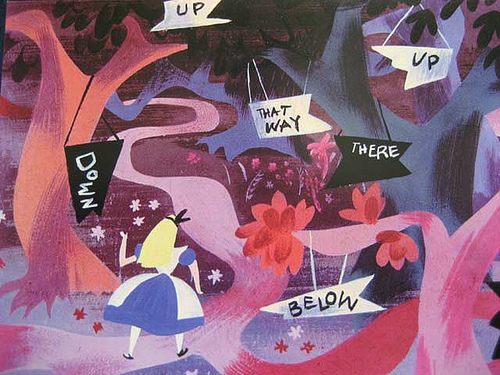
6.jpg

    “Alice in Wonderland” 

             Mary Blair

               _______

when I listen to Bach, I feel like I’m 
on a train – from Leipzig to Dresden, 
say, his territory – the constancy of
his rhythms, modified only by 
accidentals along the way, the 
particular condition of the rails, that 
indeed decorate an otherwise 
monotonous clockwork progression, 
beat upon beat, there is neither an 
increase in volume, which hadn’t been 
formally invented yet as a principal 
musical implement – and I’m only 
partially joking here – the music is 
horizontal, not focused on reiteration, 
but on getting there, accomplishing 
mission, upon which the outcome is
even spiritual – it’s Dresden, I get off 
at the Neustadt Station, am not only 
refreshed but utterly inspired, 
reminded of my position in the world, 
and my place in this novel, but
ordered, and pious, environment 

listen to Bach, his Sonata for Violin
and Piano, B minor, BWV 10141717 
to 1723 approximately, for instance

with Mozart, I get on a merry-go-round,
at a carnival, the clockwork has become 
circular, you can sing the tune, and sing 
it again without a problem, the wooden
horses fly by, one after the other, entirely 
recognizable, though ever magical and
entertaining, but you get off at exactly 
the same untransformed station, 
however delightedly

Mozart’s Sonata for Violin and Piano,
no 18 in G major, K301, 1778, say

with Beethoven, though, it’s like going 
through the looking glass, if you’ve ever 
been through one, the direction is 
horizontal again, you might try singing 
along, but get only so far, until you’re 
utterly confounded, what happened, 
where am I, you wonder, when 
suddenly a Mad Hatter comes along, 
or a Queen of Heartsand speechless, 
you hold onto your seat, it’s 
Disneyland, but without the usual 
safeguards

later, after however many movements,
you’re returned to, if you’ll permit in 
its American transliteration, Kansas, 
from Oz, and Dorothy’s tornado, her 
equally transformational journey, 
safe and wondrously sound, but with 
extraordinary benefits, mystical, 
even transcendental 

but, o my goodness, you think, it’s 
late, I’ve got to get the supper on, 
and, did that really just happen, a 
blip in the order of consciousness, 
a very illumination, a transcendence, 
however secular, however 
non-denominational a take on the 
question of our shared fate, our 
shared humanity, our manifest 
and sublime glories, our profound 
and wrenching tragedies, as 
probing, and indeed as oracular 
as the words of any of the other 
propounding pastors, indeed 
philosophers, then, in a world 
coming to grips with the debate 
around God, and by extension,  
I might extrapolate, my own 
God/dess

for by this time, that had become
a concern, Science, which is to say, 
the Enlightenment, the Age of 
Reasonhad provided a convincing 
counterpoint to the various takes on 
an, even just Christian, Supreme 
Deity, Who’s very viability was up,
in the 18th Century, for grabs

Beethoven provides the first 
personal option, his version of the 
Ten Commandments, for the later
non-denominational ages, our 
souls, our individual agonies, he 
demonstrates, are enough of an 
argument for our unconditional 
salvation, our personal, and 
resplendent souls are not not to
be discounted, their poetry, their 
truth and beauty, are the heaven 
towards which we can existentially 
all aspire, for better, of course, or  
for worse

Beethoven, his Sonata for Violin 
and Piano in G major, no 10
Opus 96, 1812, listen 


R ! chard

String Quartet, opus 77, no 1 – Joseph Haydn

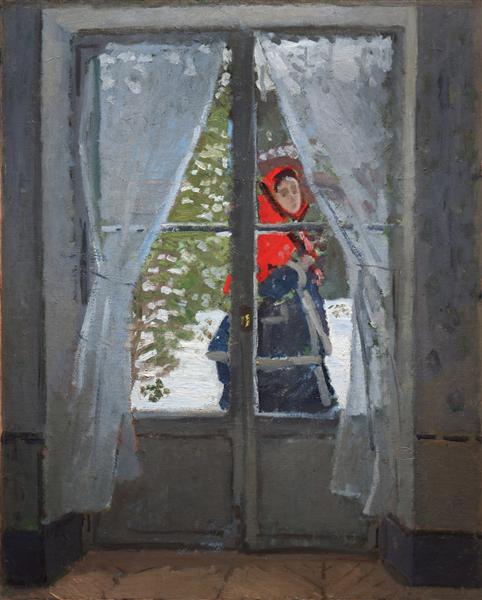
the-red-cape-madame-monet.jpg!Large.jpg

      The Red Cape (Madame Monet) (c.1870) 

              Claude Monet

                    _______

                                              for my mom

that’s a lot of Haydn, I said to my mom, 
when I saw the list of my transmittals in
her hotmail, hm, I wondered, maybe it’s 
too much

then I said, but it’s like when we’ve 
toured, for instance, our European 
art galleries, me propounding on 
the paintings, as I am wont, however 
incorrigibly, to do, but now, note, you 
can tell the difference between your 
Monets and your Klimts, however 
similar their perspectives

or like your tour guide taking you
recently through Argentina, 
highlighting spots, in the space of 
a month only, the same amount of 
time I’ve spent for the music of 
Haydn

pronounced, incidentally, I specified, 
like “hidin'” in English, not “maiden”, 
just sayin’

I gathered that she’d ‘ve sensed by 
now, if she’d been listening, which she 
said she had, mornings over her 
coffee, what a string quartet is, four
movements, different tempos, fast
at first, a joyful introduction, 
followed by a lament, then a spirited 
third movement, for countereffect, 
then a big fourth movement finish

also, the internal structure of each 
movement would’ve been internalized,
theme, a counter theme, a 
recapitulation of both, or either, all of 
it, probably unconsciously, which is 
how art fundamentally works till you
meticulously deconstruct it

the string quartet is the work of Haydn, 
the house that Haydn built, from 
peripheral aristocratic entertainment, 
like modern day artists sporting their 
wares in noisy restaurants, to the 
glamour of taking on, in concert halls, 
Europe, Brunelleschi did a similar, 
sleight-of-hand thing with his dome 
in Florence for its oracular Cathedral

remember that the string quartet lives 
on as a form, where no longer does 
the minuet, for instance, nor the 
polonaise, nor even the waltz, not to 
mention that concertos, and  
symphonies have become now  
significantly subservient to movies, 
secondary players


watch the instrumentalists here live 
out, in Haydn’s Opus 77, no 1, their 
appropriately Romantic ardour,
something not at all promoted in 
Haydn’s earlier Esterházy phase, to 
raise their bow in triumph, as they 
do at the end of most movements
is already an indicationnot at all 
appropriate for the earlier princely 
salons, that times have changed

Haydn was a prophet, but also an
elder, with an instrument to connect 
the oncoming, and turbulent, century 
to the impregnable bond of his 
period’s systems, the legitimacy of 
the autocratic, clockwork, world, 
Classicism, the Age of Reason, the 
Enlightenment, for better or for 
worse

we are left with its, however ever 
ebullient, consequences

enjoy


R ! chard

String Quartet no 1, “From My Life” – Bedřich Smetana‏

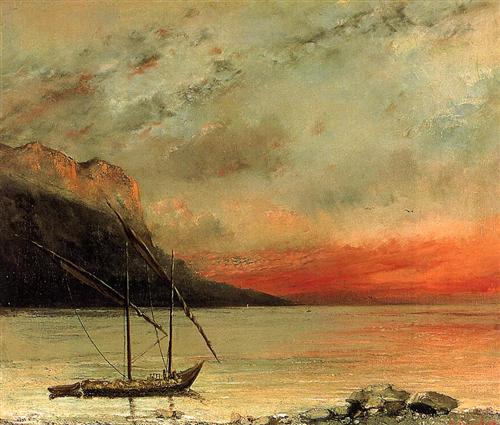
"Coucher de soleil sur le lac Léman" - Gustave Courbet

Coucher de soleil sur le lac Léman (1874)

Gustave Courbet

_________

paying attention to tenuti is not as
easy as all that, you’ll have found
probably that the music’s kept on
going and you’re not so sure if
what just went by indeed was a
tenuto, so brief, however stressed,
might’ve been the impression

rubati are easier, it’s hard to miss
them when they come round, for
being spread out through the
musical passage as a
consequence of being at the very
least three notes, usually
considerably more

tenuti happen on one note only,
one fleet fish in an ebullient river
rather than a more noticeable and
synchronous school

interestingly, not many of either,
rubati, tenuti, show up in music
history until the late Romantic
Era, the mid- to late 1800s, they’d
been only theoretically, and here
and there, part of the musical
vocabulary for having had no
purchase in music written for the
harpsichord, an instrument that
had allowed only minimal
resonance, though it laid the
foundations for composition,
and therefore dictated taste
into the very mid-nineteenth
century, a whole hundred years
after the invention of the piano,
by having entrenched the ideal
of strict tempo, the reflection,
note, of an ideal, and belief
then in a scientifically cogent
world

that was the Enlightenment

Romanticism came along to
express the ineffable reality of
the truths of the human heart,
in contrast to merely reason –
“Le coeur a ses raisons que la
raison ne connaît point”,
says
Pascal, “The heart has its own
logic which allows it to
understand what the rational
mind cannot”,
though he in a
somewhat other, much more
theological, context

but the shoe snugly fits, so I’ll
wear it, though with the same
consideration I’d render the
shoes, understand, of my
father

you can tell we’ve reached the
late 1800s when you start
hearing tenuti, ritardandi,
atonality, for that matter, and
also obscure and eccentric
repetitions

this pattern is probably more
evidenced in pictorial art,
where precision gives way to
individualized expression,
and the blurred lines of Early
Impressionism, see above

at the same time, the German
grip on the history of Western
music which it had held for a
hundred and fifty years, from
Bach to Brahms, began to loosen,
along with the idea, incidentally,
of a rationally, even irrationally,
conceived world, you can hear
it in the evolution of the tenuti,
the rubati, like canaries sense
altered conditions in a coal
mine

note however that music itself
is as indifferent to bald facts
as mathematics, it merely
describes, doesn’t comment

listen to Bedřich Smetana, a
Czech composer, his String
Quartet no 1, “From My Life”

follows in the footsteps of
the Germans, but with a
distinctively folkloric air,
there’s even a polka

tend the tenuti, relish the
rubati, if you can identify
them, they’re milestones
to the modern

but, more than anything,
enjoy

Richard