Richibi’s Weblog

Just another WordPress.com weblog

Tag: the Elbe

mass appeal, or “Missa Solemnis”, opus 123 – Beethoven
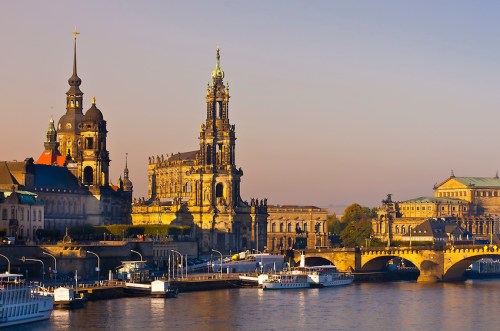
Hofkirche (Dresden Cathedral) and the Elbe River, Dresden, Saxony, Germany

    from the centre, the Hofkirche, the Dresden Cathedral, across from the 
    Augustusbrückeor Augustus Bridge, extends into the Zwinger, one  
    of three only palaces in Europe, along with Versailles and Vienna’s 
    Schönbrunndistinctly horizontally to the right, not to be confused 
  with a crook in the Cathedralan intolerable, were it so, ecclesiastical  
   gaffe, it ‘s now become one of the most significant art galleries in  
   Europe, the green rooves, to the right still, are the Semperoper‘s, the   
  black roof, nestling before it, an unforgettable Italian
  restaurant 

  before it all, majestically, the Elbe

        _______

from the very Semperoper in Dresden,
where I’ll ever remember seeing the 
worst “Barber of Seville” I’ve ever seen,
first balcony, left of centre, Figaro came 
out on a motorcycle, I ask you, it was 
downhill after that, my mom, beside 
me, was falling even asleep, we left at 
intermission, soldiered on to a 
restaurant overlooking the Elbe, Italian
if I remember, but utterly more enjoyable 
than the disappointing operatic option, 
there might even ‘ve been a moon at our 
tableside window, picturesquely 
shimmering on the river

but, hey, we both would‘ve stayed,
incontrovertibly, for this performance
Beethoven’s Missa Solemnis“, a late, 
and towering, entry, 1823, in his opus 
– second definition of that word, which 
is to sayhis entire output, all 135 
opuses, first definition there, discrete 
compositions – plus all his works 
without opus – first definition again – 
numbers, WoO

the plural of opusincidentally, can 
also be, both meanings, opera, just 
to confuse things, I use either
interchangeably, according to my 
narrative rhythm

 
missae solemnes, plural of missa 
solemnis, are a particularly Catholic
form of music, going back to the 
very Middle Ages, at which point 
religious art was all that really 
mattered, anything else was entirely
peripheral, of no consequence 

but Catholicism, and its Protestant
offshoots, which is to say, their 
common Christianity, remained 
culturally entrenched during the 
process of their slow disintegration

Nietzsche would, later, take care 
of that, but that’s another story

Beethoven, Mozart, Catholics, if, 
either, only by name, delivered 
missae solemneswhile Bach, 
Handel, both Protestant, 
delivered oratorios, with some 
intermingling

about which, later

Catholic, Protestant expression still
find, even strong, exponents at 
present, though the form is, 
essentially, outdated, our anthems 
are national, now, mostly, if even 
somewhat, that, halfheartedly, when 
notparadoxically, searchingly, 
hopefully, and maybe even
revolutionarily, again, ideological

imagine Imagine for instance, as 
suchjust click


R ! chard

C*r*s*mas greetings from Dresden, December 24, 2006

Bellotto Bernardo - Dresden Elbufer

    View of Dresden from the Right Bank of the Elbe with  Augustus Bridge

                                                        (1748)                      

                                                 Bernardo Bellotto

                                                      1720 – 1780

                          _________________________________

                                                                                                                                                                                                                                           these earlier “back tracks“, of which the following is one example, are pieces I consider still to be worth your while

please enjoy

                        _______________________

                                                                                                                                                                                                                                       December 24, 2006

through the good graces of a dear friend, a lady I met last year, my teacher in German at the Goethe-Institut, I´ve been afforded the wonderful opportunity of spending the next several weeks, while she is away with her family in their hideaway in rural Belgium, here in shimmering Dresden, the jewel, I´m sure, of central Europe, I´d already rendered her the use of my own apartment in Vancouver when in September she came to visit and I could use my mom´s place while she was away touring for most of the month the Iberian peninsula, Spain, Portugal, as well as, across the strait, Morrocco

Dresden celebrated its eight hundredth anniversary this year and, though its buildings don´t date back that far, much of it has worn its architectural robes several centuries, the Zwinger, Dresden´s answer to Versailles, was built from 1609 to 1611, I was yesterday informed as I marvelled at the Bernardo Bellottos, Canaletto the Younger, the Elder´s nephew, who was court painter there, I believe I understood through a charming attendant´s perhaps too rapid German, and whose views of the city then were as detailed and precise as his uncle’s famous masterpieces of Venice, their styles are indeed so similar that until recently I´d believed, to my great embarrassment when I found out they were not, that they were one and the same, that the uncle had spent time in both Dresden and Warsaw, which he had not, the nephew rather had, I inadvertently discovered in a book I read on Dresden that cleared everything up, the one had superseded the other, channelled him there, more darkly perhaps due to those cities’ darker tones, but not at all less brilliantly 

not only the Canalettos of course but many other masters adorn the Zwinger, the city´s most sumptuous art museum, the Madonna of the Sistine Chapel of Raphael (which you’ll find below) with its couple of attendant cherubs for instance holds a place of the highest honour, and during the past couple of days I took in a wonderful exhibition of Cranachs there, both the Elder and the Younger, was mightily impressed by the latter´s “Adam” and “Eve”, which tall, naked, and still innocent beneath their modest leafy branches, graced either side of a doorway that led onward through a row of precisely positioned doors partitioning a long narrow corridor into a series of smaller rooms that seemed infinite, like a mirror reflecting itself in a mirror, in a rich burgundy throughout

but on the opposite side in the next room behind the “Eve”, a demure and elegant St Catherine stood large as life leaning upon her eponymous wheel while before her she held upright a heraldic sword whose blade rested on the pebbled ground, a work of the Elder Cranach

her medieval robes were golden, as was her headdress and hair, a prim plaited bodice attested to both her youth and modesty, her eyes shy and discreet gazed softly on the beholder and upon, as in all timeless art, I´m sure, infinity

I would´ve taken her with me but am caught up in the fleeting here and now

Dresden itself is of course much reconstructed after the scandal of its destruction, quite equal I would think to the ravages of Hiroshima and Nagasaki, its center lies across the Elbe, the river that runs through the town, from the Neustadt, the New City, so called already several centuries ago

in the Altstadt, the Old City, there along the river´s opposite bank beyond the several bridges, are the exquisite Baroque structures, churches and palaces and stately buildings, that make up her glory

in the evening as the city lights are reflected in the meandering river the shimmering city achieves the quality of high art, a tribute through the ages to the very best in culture and civilization

it hasn´t snowed here yet, already on December the 24th, Christmas won´t, it appears, be white, it´ll nevertheless be for me quite special as is evident I´m sure in my attitude of awestruck reverence

may it be as well for you, may it be happy, healthy and thoroughly blessed

                                                                                                                                                                                                                                                     with all my heart

Richard


                            _______________________________________