Richibi’s Weblog

Just another WordPress.com weblog

Tag: “The Divine Comedy” – Dante

“The Story of Aglauros, transform’d into a Statue” (lll) – Ovid
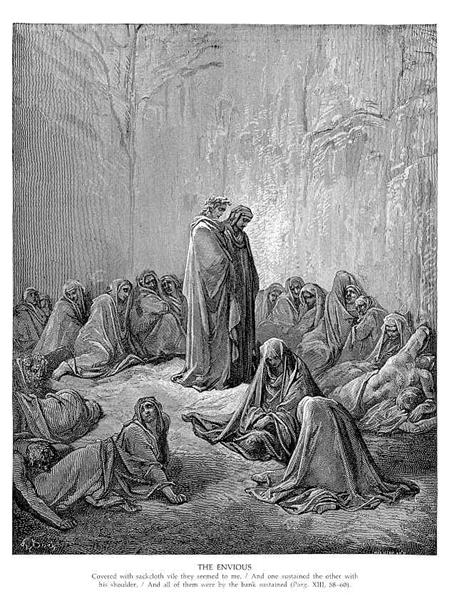
the-envious.jpg!Large

          The Envious


                  Gustave Doré


                             _______


all mythologies have their picture, their

rendition, their evocation of an afterlife,

states of either resignation, in earlier

traditions, perdition or bliss in the later

Christian view, manifest, these latter,

in Dante, his depictions of Hell,

Purgatory, and Heaven in his

Commediaare probably its most

explicit evocations


the Greek and Roman pictures of

their own representative Underworld,

available in Homer, Horace, Virgil,

notably, is less compartmentalized,

less extreme in its divisions, a gloom

pervades, but nowhere fire and

brimstone, nor the diametrically

opposed consolation of archangels

and trumpets, only an unending

sense of desolation, be one worthy

of it or not


limbo comes to mind


but Envy’s realm is actual, not

belated, in the Ancient Greek and

Roman traditions, it is of this world,

present, however horrid, a place

that lurks in the hearts of men, of

people, always, ever, accessible


Dante situates his nexus of Envy in

Purgatory, the afterlife, the nether

world, its Second Circle, of seven,

Wrath, Envy, Pride, Lust, Gluttony,

Greed, Sloth


for Ovid, you can reach Envy’s

dominion, in the nearby mountainous

areas, if only you’ll follow Minerva


the one course is transcendental,

the other, organic, note, physical,

carnate


            Directly to the cave her course she steer’d;

            Against the gates her martial lance she rear’d;

            The gates flew open, and the fiend appear’d.


the fiend, Envy herself


            A pois’nous morsel in her teeth she chew’d,

            And gorg’d the flesh of vipers for her food.


yech


             Minerva loathing turn’d away her eye;


as, incontrovertibly, would I


            The hideous monster, rising heavily,

            Came stalking forward with a sullen pace,

            And left her mangled offals on the place.

            Soon as she saw the goddess gay and bright,

            She fetch’d a groan at such a chearful sight.

            Livid and meagre were her looks, her eye

            In foul distorted glances turn’d awry;

            A hoard of gall her inward parts possess’d,

            And spread a greenness o’er her canker’d breast;

            Her teeth were brown with rust, and from her tongue,

            In dangling drops, the stringy poison hung.

            She never smiles but when the wretched weep,

            Nor lulls her malice with a moment’s sleep,

            Restless in spite: while watchful to destroy,

            She pines and sickens at another’s joy;

            Foe to her self, distressing and distrest,

            She bears her own tormentor in her breast.


the passage, without explication,

speaks for itself, I cede to its

manifest erudition


            The Goddess gave (for she abhorr’d her sight)


her sight, what she was looking

upon

 
            A short command: “To Athens speed thy flight;

            On curst Aglauros try thy utmost art,

            And fix thy rankest venoms in her heart.”


Minerva condemns, curs[es], 

Aglauros


            This said, her spear she push’d against the ground,

            And mounting from it with an active bound,

            Flew off to Heav’n:


Minerva reminds me of my own

generation’s Wonder Woman


meanwhile, the hag, Envy, with

eyes askew


            Look’d up, and mutter’d curses as she flew;

            For sore she fretted, and began to grieve

            At the success which she her self must give.


success, the humiliation of

Aglauros


            Then takes her staff, hung round with wreaths ofthorn,

            And sails along, in a black whirlwind born,


the picture of a witch on a

broomstick shouldn’t

here be unanticipated 


            O’er fields and flow’ry meadows: where she steers

            Her baneful course, a mighty blast appears,

            Mildews and blights; the meadows are defac’d,

            The fields, the flow’rs, and the whole years laidwaste:


the whole years, the yearly crops


            On mortals next, and peopled towns she falls,

            And breathes a burning plague among their walls.


the, not unfamiliar to us, season,

now, of the witch


R ! chard

“Metamorphoses” (The Giants’ War, VII) – Ovid

the-garden-of-earthly-delights-1515-7.jpg!Large

    The Garden of Earthly Delights (1510 – 1515) 


             Hieronymus Bosch


                  __________


              Nor from his patrimonial Heaven alone
              Is Jove content to pour his vengeance down; 


let me say something about Heaven 

here, a concept that is quite different 

from the earlier Ancient Greek and 

Roman understanding of the term, 

was it, for that matter, even a term

then, of the Ancients, that would’ve 

meant nothing other to them than 

the blue sky above, not at all an 

area reached by extraterrestrial 

transcendence


the abode of the gods and goddesses 

at the time of Ovid was Mount Olympus

and had been for centuries, much closer 

to the earth than the more ethereal home 

we imagine of the gods today, every one

of them, however professedly uniquely  

supreme, otherworldly


all gods, note, no goddesses, what’s up  

with that, I’ve long wondered


the Underworld was for the Ancients 

the dwelling place of the departed, 

somewhere deep beneath the earth, 

or at the very ends of all the seas, 

never totally beyond the very 

cosmos, as our prevailing faiths 

now uniformly preach 


the image of Heaven, Hell, and 

Purgatory for that matter, that last

a completely Catholic invention – to 

account for the salvation, however 

partial, of innocent souls deprived 

of Heaven for not having been 

christened, though not able yet, at 

so early an age, to have sinned – 

was pretty well codified by Dante

in the 14th Century in his 

masterpiece, The Divine Comedy,​ 

a daunting, but profoundly

illuminating read, which has 

shaped our impression of these 

several possible afterlives ever 

since


see above


this particular translation, however 

magisterial, but crafted after over a

thousand years of Catholic cultural 

domination, cannot avoid the impact 

of the Catholic understanding of 

Heaven


neither, now, can we, for that matter, 

intimately imbued as we are with

the binding faiths of our relatively

more recent forebears


be therefore perspicacious


              Aid from his brother of the seas he craves,
              To help him with auxiliary waves. 


later, we’ll learn that Jove’s brother 

of the seas is Neptune, god of all

aqueous things


            The watry tyrant calls his brooks and floods,
            Who rowl from mossie caves (their moist abodes); 


rowl, or roil, upset 


mossie, mossy


            And with perpetual urns his palace fill:
            To whom in brief, he thus imparts his will.


Neptune is stockpiling water, with

the help of his conforming waterways


            Small exhortation needs


no time, in other words, no need, 

to do much coaxing, much 

exhortation


                                          your pow’rs employ: 


use, put into action, or employ, 

your pow’rs


            And this bad world, so Jove requires, destroy. 


Jove, god of gods, is here commanding, 

authorizing, orchestrating    


            Let loose the reins to all your watry store:
            Bear down the damms, and open ev’ry door.


             The floods

 will inexorably follow


stay tuned


R ! chard


“When You Come” – Daniel Goodwin

800px-Accolade_by_Edmund_Blair_Leighton.jpg

            “The Accolade (1901) 

           Edmund Blair Leighton

                     ___________

When You Come

When you come to greet me, shyly, 
wearing nothing but your love for me
I will come to meet you halfway
like a falcon returning to your wrist.

And when you raise your arm,
trembling ever so slightly,
I will alight and let you pull
the velvet shroud over my eyes. 

 Daniel Goodwin

                  —————–

courtly love, an idea of love that took 
shape in the 12th Century in what would
become France eventually, though its 
development soon touched all the 
countries, or kingdoms then, of Europe,
became the primary subject of poetry
and literature especially through the 
influence  of Eleanor of Acquitaine
without a doubt the most powerful
woman in Europe during her reign as 
Queen of France after her marriage to 
Louis Vll, which was annulled after a 
time for her having not borne Louis  
any sons, then with Henry, Duke of 
Normandy, who then became Henry ll
of England, with whom she had 
Richard l, the Lionheart, as well as the 
later King John – the wonderful film, 
The Lion in Winter” with Katherine
Hepburn as Eleanor is a brilliant 
account of her later life with Henry 
and their fractious sons, featuring 
as well Peter O’Toole as Henry, and a
young Anthony Hopkins as Richard

her patronage of the arts in general 
then, from her position of power, 
allowed, much as it would today any
potentate, the dissemination of 
courtly love as a cultural ideal that
ultimately led to some of the greatest 
works of our Western cultures, notably
Dante‘s The Divine Comedy“, where 
Dante courts chastely the married 
Beatrice, who becomes indeed even 
an intermediary for him during his 
passage through Paradise

the idea, through the interpolation of
the Catholic Church, was that courtly 
love should be pure, unconsummated,
a noble admiration and reverence of 
an object of adulation within the strict 
constraints of an impossible physical 
conjunction, the model being, of course, 
the emulation of the worship of the 
Virgin Mary

Cervantes‘ Don Quixote is a later 
example of this same disposition,
though by this time, 1605 to 1615,
the practice of courtly love had 
been sullied by too many evidently 
corrupt practitioners, and a more 
cynical therefore culture, so that 
Don Quixote despite his blameless
pursuit of Dulcinea, his unwitting
muse, is made out to be a fool 
given the context of his more 
contentious times, albeit a benign, 
and somewhat heroic, fool

but my very favourite such story is
that of Edmond Rostand‘s “Cyrano
de Bergerac“, whose long nose 
makes him disparage his own 
chances of ever achieving the love 
of his beloved, Roxane

José Ferrer got an Oscar for his 
superb performance of Cyrano in 
1950, but my ideal remains that of
Gérard Dépardieu, a complete 
wonder, in 1990, both very much, 
however, worth your time

all this as a preface to the poem 
above, When You Come, which 
seems to me of that tradition,
despite having been written in 
2014 according to its inclusion 
then in the Literary Review of 
Canada, perhaps because of the 
introduction of the falcon, not at 
all a contemporary image, but 
fraught with the impression of a
love that is all devotion instead 
of conquest, a kind of love that
in my particular circumstances 
I’ve come to reach for rather 
than anything less refined

true love, in other words, can  
never not love, as I’ve said earlier 

Richard