Richibi’s Weblog

Just another WordPress.com weblog

Tag: the Delphic Oracle

Divertimento in G major, Hob.II:1 – Joseph Haydn
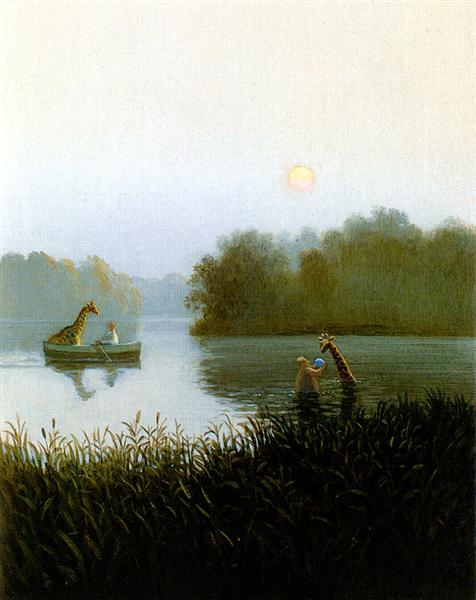
giraffe.jpg!Large

        “Giraffe” 

               Michael Sowa

                        ________

after looking everywhere on the Internet 
for how many divertimenti Haydn had 
written – since I’d given up counting them 
individually from the only list I could find
there, confounding one – I asked Siri
the 21st Century’s Delphic Oracle, whom 
I’d never yet consulted, apart from once 
during a friendly demonstration of her 
prowess

her reply about “divinity minty”, however, 
didn’t lead me anywhere, though 
“divertimento” eventually got me, 
however unsatisfactory, somewhat more 
pertinent answers

regardless, here is Haydn’s very first  
divertimento

a divertimento is quite simply an 
entertainment, an after dinner mint for
the aristocratic set, a place to digest 
one’s fine culinary offerings in the 
same, usually stratified, company
 

nowadays we have supper clubs

when Haydn called his early string 
quartets “divertimenti a quatro”, he
wasn’t kidding, a divertimento could 
be comprised of indeed even a small 
orchestra, or, quite simply, one only
performer, the string quartet as a 
form hadn’t yet been established as 
such, Haydn pulled it, as it were, out 
from under his hat, and gave it status

here’s the short, terse, Divertimento 
in G major, for instance, for, originally, 
harpsichord only, which is to say, just 
one person, but this homemade piano
version will point out already Haydn’s 
musical brilliance – you’ll love the 
giraffe, I loved the coffee cup at the 
bottom of the keyboard

incidentally, Haydn could’ve called 
his Divertimento a piano sonata, 
like Hoboken did, his bibliographer, 
eventually, for the list he compiled 
of the works of Haydn, we know it 
now, therefore, as well, as Haydn’s
First Piano Sonata in G major, 
Hob. XVl:8, same number as for  
the corresponding Divertimento

new terms were popping up, and 
being tested, then just as now, 
like our app, interface, Siriand 
who says compact disc anymore, 
or record

tempus, as we say in Latin, fugit,
time ever is on the wing


R ! chard

XXVlll. My letters! all dead paper, mute and white – Elizabeth Barrett Browning‏

from Sonnets from the Portuguese

XXVlll. My letters! all dead paper, mute and white

My letters! all dead paper, mute and white!
And yet they seem alive and quivering
Against my tremulous hands which loose the string
And let them drop down on my knee to-night,
This said, — he wished to have me in his sight
Once, as a friend: this fixed a day in spring
To come and touch my hand . . . a simple thing,
Yet I wept for it! — this, . . . the paper’s light. . .
Said, Dear, I love thee; and I sank and quailed
As if God’s future thundered on my past.
This said, I am thine — and so its ink has paled
With lying at my heart that beat too fast.
And this . . . O Love, thy words have ill availed
If, what this said, I dared repeat at last!

Elizabeth Barrett Browning

______________________

after a meticulous search of my archive, I
finally found the last place I’d been wrong,
if you remember well I’d written the date so
it could be found at any moment, just like
this one, March 28, 2012, check it out

if I’ve chosen to preface my comment on
Barrett Browning‘s 28th sonnet from
the Portuguese
with a personal
exculpation it’s because here I so easily
could be incorrect, Elizabeth is to my mind
here too abstruse, obtuse, too cute, I think,
for her own convoluted words

who is doing what to whom in this flurry
of what was “said”, we wonder

she is speaking to the paper – “dead”,
“mute and white”, note – which says what
had been said by her then improbable lover,
that he wished to see her, “to have me in his
sight “,
that he loves her, “Dear, I love thee”,
that he’s hers, “I am thine”, but what is this
insuperable “thy words have ill availed / If,
what this said, I dared repeat at last

an analysis that will not cede the secrets
of a text after a certain moment by a
reasonably informed and probing
analyst is no longer a shortcoming of the
analyst but of the poem, I submit, and
such, I feel, is here the case, though that
position is entirely assailable, I might be
merely, in this instance, stupid, but I
doubt it

the Metaphysical Poets were good at that,
establishing confounding parallels, Donne,
Herbert, Marvell, revered poets Elizabeth
surely would have aspired to mimic

“Love”, I’ll propose, in line 14, is a
composite of Love itself – Amor, a Platonic,
anthropomorphized conception – and
Robert Browning, who had become by this
time her spouse, to whom these recollections
are indirectly directed – remember she’s still
speaking to the paper – who utters this Delphic,
which is to say, inscrutable, pronouncement

then again it could be herself, Elizabeth,
hypothesizing, for she hasn’t italicized this
statement as she has earlier the others

therefore she could be – instead of he, they,
invoking her – invoking them, though “And
this”
in the second last line suggests that
he, Robert Browning, is speaking again,
and yet the “L” is capitalized this time
where it hadn’t been for Robert anywhere
before

help

I will venture, for the sake of conclusion,
that she means that had these been the
last expressions of his devotion, or he,
does she mean, of hers, these letters
would indeed be also dead

but I could be entirely wrong

November 14, 2012

Richard