Richibi’s Weblog

Just another WordPress.com weblog

Tag: “The Company of Strangers”

String Quintet in C major, D. 956 – Franz Schubert
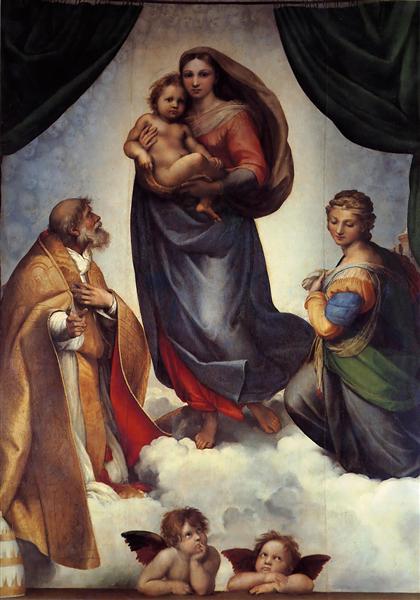
the-sistine-madonna-1513.jpg!Large

   “The Sistine Madonna (1513)
 
          Raphael


          __________ 


if you listen to only one piece of music  
this week, make it this one, Schubert’s 
a monument of Western culture, it’d be
like missing the Venus de Milo when 
you’re at the Louvre, or the Sistine 
Madonna of Dresden’s Zwinger 
the church of Saint Agnes Outside the 
Walls, transformative experiences

quartets, I couldn’t not next introduce
their very gold standard 
 
written in 1828, it was composed at 
the very height of the Romantic 
Period, just a little ahead of Chopin,
1810 – 1849, his other significant 
counterpart, apart from the ageing
Beethoven, 1770 – 1827, who still 
towered above all, despite his 
demise, and was universally 
admired 
 
but had Schubert lived longer than 
his 31 years, I suspect he might’ve 
been Beethoven’s equal, Schubert 
died even earlier than Mozart did, 
at 35, but of something that wasn’t
spoken of until much later, which 
is why we haven’t heard about the 
loss of this other musical giant
quite as grievously as we have 
about his somewhat more senior 
counterpart
 
but listen
 
it’s even hard to tell him apart from 
Beethoven, the passion, the urgency, 
the drama, even composing against 
the beat, a signature trait in 
Beethoven, like Alfred Hitchcock 
showing up in his own movies, or
Woody Allen, always introducing a 
work of art
 
a few things
 
though the frame is immaculately 
Classical, tonality, tempo, and 
recapitulation are not at all 
unobserved, the mood has changed 
from courteous, deferential, and 
respectful, to urgent, confessional, 
and private, the walls are there, but 
the furniture has changed, thanks 
of course here to Beethoven
 
and to the times
 
was writing her Sonnets from the 
Let me count the ways. – right about 
thenunfettered love poems to her 
beloved husband, Robertthe equally 
famous poet, who was remaining 
nevertheless, in his own work, more 
emotionally punctilious
 
I noted as well that the tempo in the 
second movement, one of the most 
beautiful adagios eversurely, 
lurches into an intemperate rebellion,
a second rhythm, up against the earlier 
mournful resignation of the poignant 
lament – note, in passing, that its 
stress of the dominant note is on the 
last beat not the first, like a weight 
that becomes, at every inching 
forward, intolerable, very path to a 
personal Calvary – before returning 
to that very fateful, though luminous, 
initial, stricken dirge

the next movement, the scherzo, does 
the reverse, fast, then slow, then fast 
again, to give the work in its entirety
eight rather than the four traditional 
tempi
 
the piece now has episodes, rather 
than merely a clockwork display,
drama has replaced the dance
entirely as the subtext for music
 
Schubert died two weeks after its
publication, for your info, I think 
his soul had been talking
 
 
R ! chard

psst: there’s a magical film I associate 
          with this music, The Company 
          of Strangers“, a Canadian 
          production, about several elderly
          ladies who get stuck in the 
          wilderness after their tour bus  
          breaks down in the middle of 
          nowhere
 
          you’ll never forget it


Schubert – Piano Sonata D959‏

to my utter surprise when I checked I’d never
but only once in the many months I haven’t
been able to shut up since I started spouting
my bristling endorsements, like a very rushing
river gushing with the overflowing bounty of
an inveterate spring, mentioned Schubert, an
incandescent voice from surely heaven

it was about his String Quartet in C major, the
D956, not surprisingly, it is utterly enchanting,
D for Otto Erich Deutsch still, incidentally

here’s an alternate version of it, an utterly
inspired one

but if I’ve reintroduced Schubert it’s specifically
this time to compare him with Beethoven, they’re
easily confounded, I even did it once myself, to
my crushing embarrassment, in erudite and
unflinching company, oof, I cringe to even
remember it

the D959, moments only after the 956 of course,
has all the idioms of a Beethoven, and exercises
them as expertly, the beat, however, is always
on, unlike Beethoven, whose beat is always off,
contrary, rebellious, against the prevailing
order

though this variance might seem slight, one
senses already in the younger and later
Schubert a return to form, elegance, and civility,
the First Empire had indeed taken hold during
the transformation of Napoleon from hero of
the Revolution to a different incarnation of
Emperor, Chopin as well would be beholden
to later similarly reinstated French courts

so seemingly trivial an alteration speaks
volumes when one attentively listens, one
must do this with one’s heart

such a return to aristocratic principles is not
uncommon, incidentally, we seem, indeed, to
thirst for dynasties, if you’ll note the return of
late, of the Bushes, the Clintons, and most
recently the Canadian Trudeaux

Putin is another, though arguably somewhat
less democratic, version of that principle

Beethoven is off the beat then, Schubert on, you
won’t find much else that’s different upon first
listening, you’ll note only that their music is very
much the same, rigorous beat, tonal, essentially,
harmonics, and the return eventually of the
melodies, Classical imperatives, but with the
distinction of the new Romantic,
transformational however, sensibilities

Schubert might’ve even outpaced Beethoven
had he survived, I think, but he didn’t, he died
much too young, at the most tender age of
only 31, younger even than the more
celebrated Mozart, famous for succumbing
prematurely at the still early age of 36

may they rest, may they all rest, Schubert,
Mozart, and the somewhat longer-lived
Beethoven, still early deceased at 56, in
eternal peace, for they have brought us
but wonders

Richard

psst: here’s a movie to go with the earlier
Schubert
, The Company of Strangers“,
the very best film Canada has ever had
to offer, bar none, a gaggle of old women
are stranded in the Laurentians after their
tour bus breaks down, Schubert would’ve
loved it

and been honoured