Richibi’s Weblog

Just another WordPress.com weblog

Tag: The Classical Period

String Quartet no 8 in E Major, op 2, no 2 – Joseph Haydn
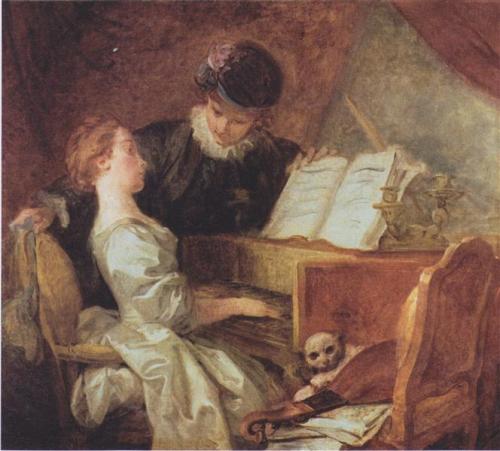
the-music-lesson.jpg!Large.jpg

      “The Music Lesson (c.1769) 

           Jean-Honoré Fragonard

                ________________

Haydn’s String Quartet no 8 in E Major, 
op 2, no 2 is not an iconic work, but 
representative of what the period had 
on offer, which wasn’t at all shabby, 
however more entertaining than in 
any way inspirational, seismic, that’ll 
come later, Haydn was nevertheless 
not only composing delightful pieces, 
but setting the stage for an era, the 
Classical Period, along, of course, 
with Mozart 

the form is not quite settled yet for
the string quartet, with again five 
movements here mirroring each 
other across again a central adagio,
twice the length, incidentally, of the 
other sections, againthough not at 
all unpleasantly, which ought to tell 
you something

the call and response aspect of the 
music, like a verse and refrain, are 
manifest, and grounding, everywhere,
you know where you stand, or sit, be
it the allegros, the minuets, or the 
adagios, the tunes return and 
reassure like clockwork 

dance forms, you’ll note, still remain
in the titles, a vestige of the earlier
period’s suites, this will alter, with
headings turning to tempo markings
exclusively, a move towards the 
transcendental rather than the 
frivolities of gavottes, or minuets


transposition, meanwhile, of the
Opus 2, no 2 has beguiled me, the 
first violin has been replaced here 
with a guitar, same string quartet, 
but with an exquisite alteration

the guitar can only pluck, not glide
across a note, something akin to the 
harpsichord before the fortepiano, 
it makes for a completely different, 
though profoundly remembered, 
original

and delivered a particular zing to  
the strings of my heart

listen


R ! chard

Paganini’s First Violin Concerto – Akiko Suwanai‏

Jean Auguste Dominique Ingres - "Niccolo Paganini" (c.1819)

Niccolo Paganini (c.1819)

Jean Auguste Dominique Ingres

_____________

for Apollo, who alerted me to my error

having egregiously misspelled “Akiko”
in my recent commentaries about Ms
Suwanai, since, however, corrected, I
can only heap upon her greater praise
now for again an immaculate
performance of, this time, Paganini’s
First Violin Concerto
, itself an event,
as atonement

not only does she play this thrilling
masterpiece
with precision and
consummate artistry, this is the
performance with which she wins
the Tchaikovsky Competition, the
one Van Cliburn had secured so
illustriously back in the late Fifties,
at the height of Soviet Communism,
she in 1990, moments only after its
fall, a full, now, 25 years ago

it astounds me that such a talent
would’ve taken so long to reach my
ears, which have been attuned to
Classical music and its
peregrinations for as long as I can
remember

then again there was no ticker tape
parade for Ms Suwanai when she
triumphed
, the world has changed,
it seems such excellence is no longer
so universally paraded, not even
much advertised

the Paganini Violin Concerto was
composed around 1818, late
Beethoven, early Chopin, Paganini
defines for the violin the Romantic
Period, what Chopin did for the piano,
Beethoven had given them the push

if you can get past your astonishment
you’ll note that the foundation of the
piece
is Classical, tight tempi, tonality,
no discordant notes, and repetition
always of the themes, still the triple
pillars of our understanding of music,
its Trinity, despite some strong forays
into their deconstructions, see, for
instance, the haunting George Crumb

what Paganini adds to Classicism is
personality, Romanticism, same as
Beethoven did, and at about the
same time

aristocratic formality was giving way
to the voices of the crowd, some highly
articulate, representative, formidable,
as the shackles of servitude fell with
the French Revolution and human
rights became central, and
indomitable

Richard