November / Month of the Sonata – 24
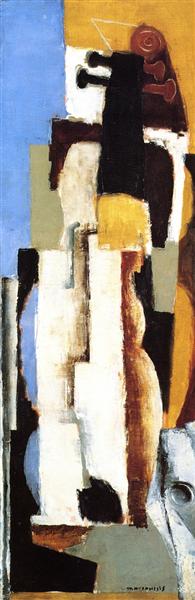
“A Cello“ (1921)
___________
between Bach’s transcendent Suites for
Cello and Beethoven’s reinvention of that
instrument, two only cello works occupy
the last half of that century, both by
Haydn
his Second, however, Concerto, written
several years later than his First, 1783,
indeed nearly twenty years later, seems
to me less accomplished, though ever,
nevertheless, unimpeachably, and
impressively, Haydn
the first movement is long, long works
only until you start thinking it’s long
the initial melody in the adagio, the
second movement, struck me as artificial,
saccharine, though Haydn weaves magic,
not unexpectedly, still, and
continuously, around it in its
development, his elaboration of it
and the pace of the third movement,
following the second, is disconcerting
rather than surprising, rather than,
were it effective, delightful
Mozart wrote a Cello Concerto too,
apparently, but, if so, it is lost
otherwise we’re on to the next historical
epoch, Beethoven’s, after this inauspicious
turn at this generation for the cello, lost
for a while among the more assertive
instruments of that prim, and proper,
Classical Era
R ! chard

“St. George and the Dragon“ (c.1470)
________
it isn’t easy for me to leave Bach behind
whenever I start listening to him, I could
ride his musical train forever
but the middle of the 18th Century did, put
him aside, for about a hundred years, until
Mendelssohn rediscovered him
Bach’s Cello Suites were themselves only
reinstated in the 1930s by Pablo Casals,
the Classical 18th Century had considered
Bach too fussy, his pieces, they thought,
were technical exercises rather than
actual entertainments, form was
overtaking, for them, function
there’s a wonderful book about all this,
“The Cello Suites“, written by Eric Siblin,
a Canadian journalist, which is not only
amazingly informed and probing, but also
beautifully written, it holds a place of
honour on my bookshelf, along with other
inspired, and inspiring, texts
not only was Bach set asunder, dismissed,
during the Classical Era, but all of the
formative music also he had written, for
cello, violin, keyboard, in other words,
the entire curriculum
which, since Bach’s reinstatement, has
become, paradoxically, the very
foundation for learning these instruments
imagine playing a tune with the right
hand, then a few notes later, picking
it up in the left hand while the right
hand keeps on going, imagine what
that does to your fingers, never mind
to your mind, that’s what his Two-Part
Inventions are all about, fifteen of
them, eight in major keys, seven in
minor, consider the technical
difficulties, intricacies, imposed
both compositionally and upon
the harried performer
then Bach follows through with his
Three-Part Inventions to top it all
off, for the keyboard at least, and
only for the moment – there’ll still
be his transcendental “Goldberg
Variations” among other
incandescent masterpieces –
wherein one juggles three tunes at
a time, and all of them in the same
assortment of fifteen contrasting,
foundational, keys, the “Inventions“
– if you can do that, you’re on your
way, one would think, to knowing
entirely what you’re doing
but time marches on, the Classical
Era hits, Haydn takes over, not
unimpressively
the same thing happened in my
generation to Frank Sinatra via
the Beatles, not to mention, a little
later, to either, with Pink Floyd
listen to Haydn’s First Cello Concerto,
note the bravura inherent in the
composition, this is not Bach’s
meditative music, the very Romantic
Period is, through Classical reserve,
expressing already its imminence,
individual prowess is taking over
from community, which is to say
religious, affiliation, the same way
the Renaissance artists, Duccio,
Giotto, Fra Angelico, Filippo Lippi,
Uccello had stood out, incidentally,
from their brethren in the standard
communal art schools dedicated to
decorating the ever burgeoning
churches sprouting out in the still
fervent European environment
musical, though unaristocratic,
talents, this time, were beginning,
within a German context, to flex
their decidedly not unimpressive
muscles, and gaining some
significant purchase
and who wouldn’t when a Cello
Concerto would’ve sounded like
this, listen
R ! chard
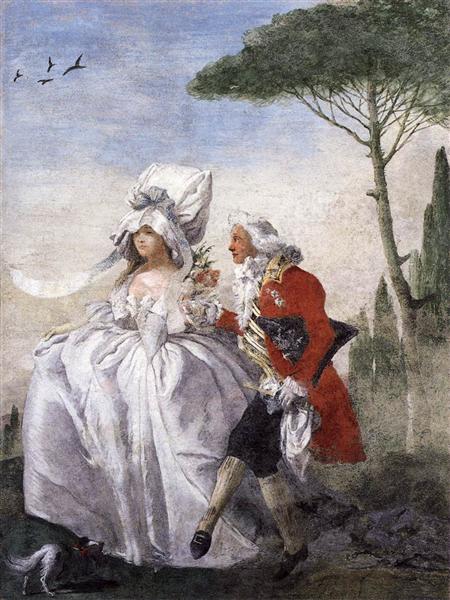
“Minuet in Villa“ (c.1791)
_____________
for my father
the Opus 74, along with the Opus 71, were
written as a unit, to deliver to the English
public for presentation, if the opus numbers
differ, it’s probably to do with publication
dates, the 74‘s being later than the earlier,
but they fit the bill together, batches of six
string quartets for Haydn’s opuses up until
now being the standard, each opus here
comprising only half the normal number,
just three
Haydn’s sponsor, Prince Nicholas Esterházy,
had died, leaving his son, Anton, to preside,
but being tone deaf, the descendant fired
the orchestra, however until then illustrious
the fact that these works were no longer,
therefore, court pieces but intended for
larger, paying, audiences, changed the
dynamics, Haydn is not only peripheral
music at an aristocratic court any longer,
he’s the host, and you can hear it
fermatas, where the note, or the pause,
are accentuated, deliver drama, so does
volume, and sudden tempo changes
therefore the Romantic Period
but, interestingly, the Classical
foundation remains, the established
structure – a musical statement, an
elaboration, a second musical,
related, statement, in usually a
complementary key, it’s own
elaboration, then a recapitulation
of either, or both
the minuet, incidentally, stalwart
still, holding on to the very end of
the 18th Century, still applies, a
sure enough, though residual
sign of the earlier Classical
supremacy, even as that era was
inexorably disintegrating
music is an entertainment, it
inspires, however so incidentally,
though it ever, perhaps even
intentionally, makes you often,
indeed, cry, it’s needed, even in
the direst circumstances, for
courage, however ironically,
however contrapuntally, in any
particular moment, it might even
seem cynical so to arouse spirit,
inspiration, I mean the French had
just turned the world upside down,
and here was sparkling creativity
Haydn was doing his stuff, keeping
us musically integrated, speaking
music instead of politics, turning a
bad situation into pearls, keeping
the world going, the very stuff of
oracles
listen
R ! chard
 Richibi's Weblog