Richibi’s Weblog

Just another WordPress.com weblog

Tag: the Baroque Period

November / Month of the Sonata – 13
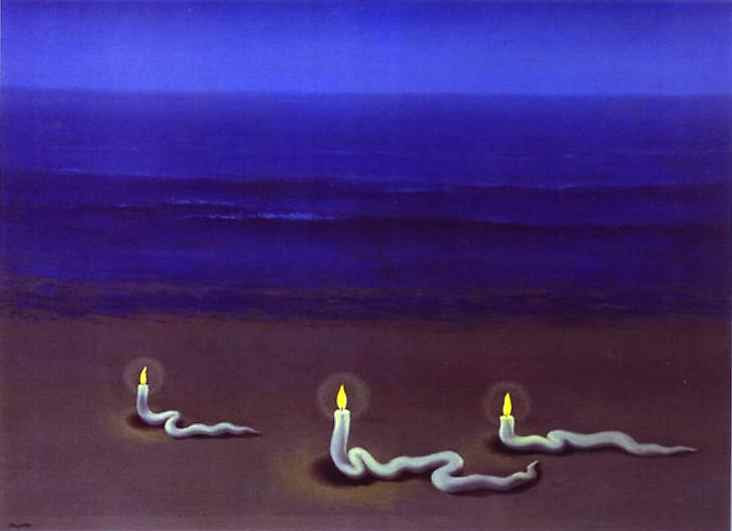
Meditation, 1936 - Rene Magritte

       Meditation  (1936) 


            René Magritte


                  _______


a story


while I volunteered at the palliative care

unit of our downtown hospital, a family 

asked if I could monitor their mother

while they took time off for lunch


of course, I agreed


their mother lay unsettled on her hospital

bed, jittery, shaking, distressed, incoherent,

out of touch, in her own nether, dissociated 

world, while the family, about ten of them, 

had been chatting, seemingly oblivious to, 

or unconcerned with, their mother’s flailing


they left


I sat by her side, placed a palm tenderly on 

her quivering arm, to impart what calm I

could, to bring her warmth, care, attention, 

and began to sing a mantra I’d learned at 

an ashram I had been attending, weekly, 

for months, after the death of my beloved, 

in order to find solace, consolation, Om 

Namah Shivaya, I chanted, gently, quietly,

over and over again


little by little, she settled, was becoming 

calm


then, in a whisper, she began to join in, 

Row, row, row your boat, she sang, 

over and over again, along with my 

own mantra, a duet of communication, 

despite even the incongruity of the 

tunes, we were meeting at an even 

deeper, primordial level


something stirred behind me, I turned,

the family was standing in the doorway, 

all held their breath, watching, as though 

they were witnessing grace


I think they were


a mantra is a distillation of the three

pillars of Western music, tempo, 

tonality, and repetition, what we sing 

to children to lull them to sleep, that’s 

what a mantra is


Row, row, row your boat indeed


the history of music in the West is 

the disintegration of those norms,

for better or for worse


here’s a solo, note, violin sonata of

Bach, no accompaniment, no piano,

his Sonata No. 2 in A minor, BWV 1003


Bach is of the late Baroque Period, the 

tail end of the Renaissance, when art 

was directed by the Christian Church,

Bach was in fact cantor, music director, 

of several churches in Leipzig


it took Mozart to kickstart the Classical

Era in the West, the purview, now, of 

the aristocracy, a process that started 

with Louis XIV, the Sun King, the art 

that he commissioned for Versailles

leaving the Church behind in a 

secularizing world


with Bach, tempo, tonality and repetition,

set the uncorrupted standard for the

ensuing ages, Bach is the next best 

thing, to my mind, to meditation


R ! chard

November / Month of the Sonata – 10

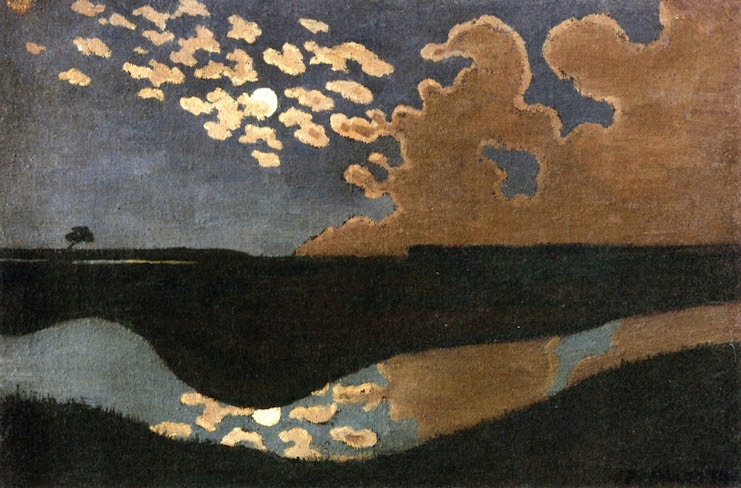
Moonlight, c.1895 - Felix Vallotton

    “Moonlight” or “Clair de lune” (c.1895) 


             Félix Vallotton


                  _______


at the end of the Nineteenth Century, a 

a seismic shift occurred in our Western 

culture’s sensitivity to art


much as visual representation during

the Renaissance and up until the late

Baroque Period had dominated, to 

be replaced by music during the 

Classical Age as the sensory 

temperature of the times, visual 

representation once again took over 

as arbiter of Western sensibility 

during Impressionism


you’ll remember the artists of the 

Renaissance, but not many of the 

composers, you’ll be able to name 

the composers of the Classical Age

and the Romantic, but not many, if

any, of the painters, you’ll then 

immediately toss off a list of artists 

of the Impressionist Era, but not 

many of its composers


this lasts till, I’d say, Andy Warhol,

when the visual arts still held sway,

but the present is, it seems, up for 

grabs


here’s meanwhile, an Impressionist,

Claude Debussy – his Clair de lune,

an obvious Impressionist statement, 

to be compared, incidentally, with 

its Romantic counterpart, Beethoven’s 

Moonlight Sonata – delivering his 

Sonata for Violin of 1917


enjoy


R ! chard

French Suite no 3 in B minor – Bach

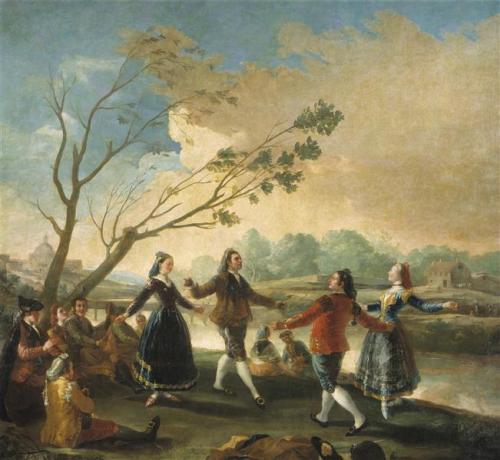
dance-of-the-majos-at-the-banks-of-manzanares-1777.jpg!Large.jpg

   “Dance of the Majos at the Banks of Manzanares (1777)

           Francisco Goya

                _________

upon reading up somewhat on the different
Bach Suites, I’ve provisionally concluded
that the earlier English Suites, 1715 to 1720,
were a modification of the established form 
of the suite, which would not have included 
a prelude, which isn’t, indeed, a dance

the Cello Suites follow, ahem, suit

but by the French Suites, 1722 to 1725, Bach 
is eschewing – Gesundheit – the prelude, but 
inserting, however, an air in his Fourth – an  
air is not either a dance – and mixing up  
their order in the later Suites, a minuet, for 
instance, in the last one of them, his Sixth,  
coming up after the gigue, which sports even
also a polonaise, where in his Fifth, Bach adds  
a loure, I ask you, a slow French gigue, to his  
bristling concoction

the terms French and English, incidentally, 
were added only after Bach’s demise, for 
diverse and uncorroborated reasons, so 
that these titles probably don’t mean much 
to a contemporary audience, who can’t tell, 
anyway, our gavottes from our bourrées

the music of Bach is like that of no other 
composer, he owns essentially the Baroque
Period, having, in fact, wrenched the Era 
from the painters, who’d established it in 
art to such a degree that it defined its
earlier historical phase

with Bach, the torch is handed over to 
music, from then on until the 
Impressionists, the period is defined 
by composers, both Classical, then 
Romantic, with some poets holding 
some sway 

the technique that dominates the music 
of Bach is that of counterpoint, where 
a tune is repeated in the harmonization
a few beats from its first iteration, 
vocally, we call that singing in canon

his music is introspective, as though 
the player were privately meditating,
it has the playfulness of Mozart, but
Mozart is expressive, not interior,
therefore nowhere near as spiritual,
Beethoven will return with a 
profundity that matches Bach’s, but 
with much more Sturm und Drang, 
tempestuous moral struggle, much  
less resignation, ouch, watch

listening to Bach for me is like getting 
on a train, and just letting the rhythm
of the wheels sustain me, as I watch,
indeed introspectively, the surrounding 
countryside, stopping at the musical 
journey’s several halts, its intervals, 
until its final destination, which 
despite, or even because of, taking 
sometimes hours, is nevertheless  
endlessly satisfying, and never  
ever less than, however improbably, 
inspiring

here’s Bach’s Third French Suite
you’ll note it includes an idiosyncratic 
“trio”, not strictly a recognized dance
either – leave it to the saucy French, I   
say, to consider interpolating a trio


R ! chard