Richibi’s Weblog

Just another WordPress.com weblog

Tag: the American Revolution

November / Month of the Sonata – 22
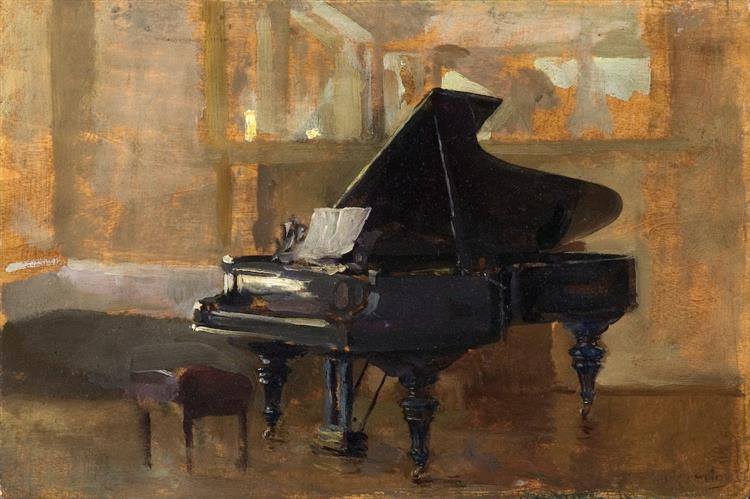
Piano - José Garnelo

       Piano 


             José Garnelo


                      _____


having heard Stravinsky’s Concerto for

Two Pianos already, if you’ve taken in 

my last instalment, you’ll find it perhaps 

the most instructive of any of my 

suggested comparisons to hear beside 

it Mozart’s Sonata for Two Pianos, the 

first, written in 1935, the second, 1781, 

you’ll hear the passage of time fly by  


both here are played by the same two

performers, brothers, incidentally, an 

extraordinary couple, making your 

aesthetic decision that much more

contained, straightforward


though Stravinsky might be here 

utterly unexpected, even disarming,

he’s evidently much more in tune 

with the Twentieth Century, even 

the 21st, than the more bucolic 

music of, energetic as it is, Mozart,

who is not of our era, however still 

entirely relevant


with Stravinsky, you hear the traffic, 

the hustle and bustle of modern life, 

the pulse and frenzy of a more 

frenetic century, though it must be 

remembered that Mozart wrote his 

piece between the American, 1776,

and the French, 1789, Revolutions,

a couple of historically seismic 

events, not at all not turbulent 


if you listen, you can hear it all in 

the music, art is like that


enjoy


R ! chard

how to listen to music if you don’t know your Beethoven from your Bach, Vll

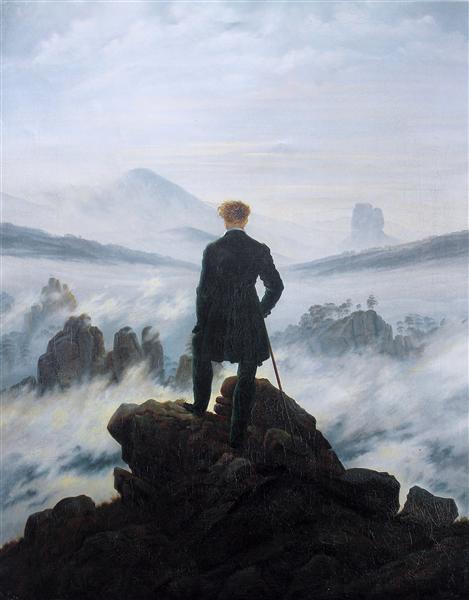
The Wanderer Above the Sea of Fog, 1818 - Caspar David Friedrich


        The Wanderer Above the Sea of Fog” (1818)


                 Caspar David Friedrich


                       _____________


by now, if you’ve been listening,

you’ll probably easily tell your

Chopin from your Mozart, even

without looking


if not, the one who isn’t Mozart

is Chopin, the one who isn’t

Chopin is Mozart, cause you’re

likely to recognize the one if not

the other


here’s Mozart’s Piano Sonata

no 16 in C major, K. 545from

1788, which even Mozart

deemed “for beginners”, but

its very elementary qualities

suit, here, my purposes


here’s Chopin’s Piano Sonata

no 3 in B minor, Op. 581844,

some sixty years later, the

epitome of the Romantic Era


Mozart is Classical, the foundation

of the shape and sound of music

in the West, think of Oriental music,

Chinese, for instance, opera, as an

alternative inspirational direction


he sets, along with Haydn, incidentally,

the parameters of Western music, I

call it its grammar, tempo, tonality,

and repetition, its hallmarks, its sine

qua non, as we say in Latin, its trinity

of imperatives, its without which there

would be no Western music as we

know it


Romanticism, after two revolutions,

the French and the American, comes

along to turn all of that into literature,

prompted by the spirit of democracy,

the first expressions of it since Caesar,

Ancient Rome, where earlier,

everywhere, kings had ruled, and by

extension, even more autocratically,

the Church, for monarchs had

received, morally, and consequently

politically, from it, their mandates

from God


one man, one vote, even theoretically,

upended that entire metaphysical

construct, therefore Romanticism


everyone had a voice, everyone had

a story, the birth of the individual,

and of, by extension, human rights,

for better or for worse, see above


therefore Chopin


listen, Chopin is the new Jesus,

prophet, but for a new age 


stay tuned


R ! chard

Piano Concerto no 1 in D minor, opus 15 – Brahms

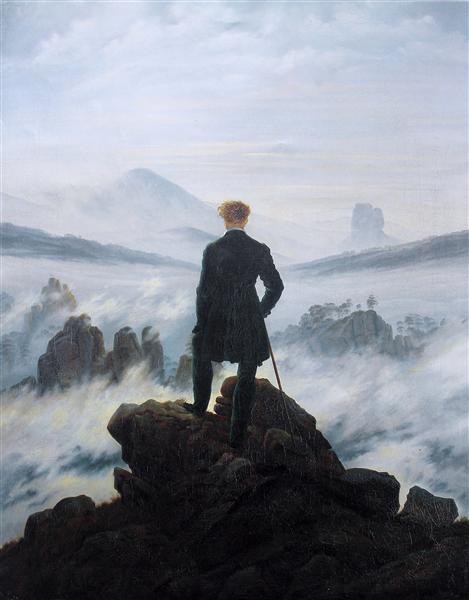
the-wanderer-above-the-sea-of-fog.jpg!Large

    “The Wanderer above the Sea of Fog (1818)

         Caspar David Friedrich

                  _____________

if Beethoven built the Church, along 
with Goethe maybe, of Romanticism, 
and be assured Romanticism is an 
ideology, a moral outlook, a 
motivational perspective, much like 
the economy is nowadays, 
supplanting any more humanistic 
imperatives, Brahms put up one of its 
Cathedrals, just listen, the First Piano
Concerto is a monument, as mighty 
as the Cologne Cathedral musically,
right next to Bonn, incidentally,  
Brahms‘ birthplace

with the disintegration of the 
supremacy of the Catholic deity 
at the onset of the Protestant 
Reformation, Luther, Calvin
Henry Vlll and all that, bolstered
by new discoveries in scientific
speculation, that the earth wasn’t 
flat, for instance, that it revolved 
around the sun rather than the 
other way around, contradictory, 
though convincing, voices began 
to abound, excite question  

in the 18th Century, the Age of 
Reason, the Christian Deity fell,
never effectively to be put back 
together again, see for Its final
sundering, Nietzsche

in France, after the Revolution
the Church was officially removed 
from political consideration, 
countermanding its centuries of 
morally heinous depredations, 
the United States had already at 
its own Revolution separated it 
from State  

Romanticism was an answer to 
a world wherein there might not 
be a God, a world with, however,  
a spiritual dimension, to respond 
to the clockwork universe 
envisioned by the earlier epoch,
the Enlightenmenta world where 
everything could be categorized,
analyzed, predicted

Romanticism called for the 
inclusion of inspiration in the mix,
there are more things in heaven 
and earth, Horatio, than are 
dreamt of in your philosophy, 
as Shakespeare would, for 
instance, have it – “Hamlet”,
1.5.167-8 
 
poets became prophets thereby, 
if they could manage it, very 
oracles, the world was blessed 
with, at that very moment, 
Beethoven, far outstripping the 
likes of, later, for example, Billy
Graham, or other such, however
galvanizing, proselytizers, 
whose messages would’ve been 
too, to my mind,  literal

for music cannot lie, obfuscate, 
prevaricate, music cannot be 
fake  

and then there was Schubert
and Chopin, TolstoyDickens
Elizabeth Barrett Browning
Roberther husband, 
TchaikovskyCaspar David
Friedrich, the Johann Strausses,  
ByronShelley, Keats, whose 
artworks, all, are as profoundly 
in our blood, our cultural system,
as, if not more so than, our 
present information about the 
details of our Christian myths, 
despite superfluity of them 
even, throughout the long 
indeed Middle Ages, and right 
up to, and including, the still 
fervent then Renaissancefor 
better or for worse still, for us

what Romanticism did, and 
specifically through the work 
of these seminal artists, was 
give each of us a chance, 
show us how to come 
through trial and tribulation,
what a faith does, any faith

it said, here, this is my dilemma, 
and this is how I deal with it

for me, Beethoven’s 32nd
Piano Sonata is, soundly, the 
epitome of that, but listen to 
Brahms put a stamp on it
with undaunted authority

we might be ultimately of no 
consequence in an indifferent 
universe, they say, but, hey, 
this is what we can do, and 
do gloriously, while we are 
at it

Woody Allen picks up the 
purpose in our own recent 
20th Century, following in 
the earnest footsteps of his 
Existential mentor, the much 
too dour, think, Ingmar 
Bergman  

but that’s another story
entirely 


meanwhile, listen

also watch, the conductor here
complete delight, is right out 
of Alice in Wonderland“, 
promise you’ll love it


R ! chard