Just another WordPress.com weblog
Tag: Tethys / Titaness
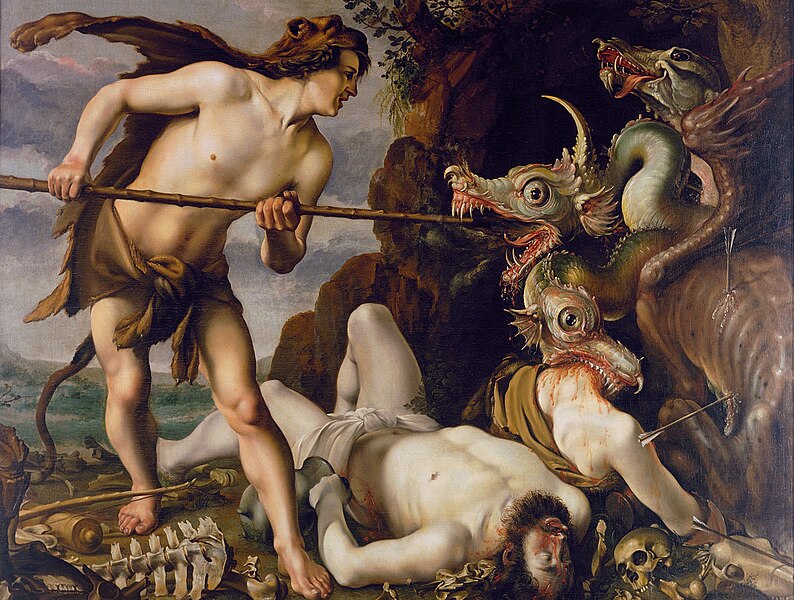
__________ And now the scorching sun was mounted high, In all its lustre, to the noon-day sky; When, anxious for his friends, and fill’d with cares, To search the woods th’ impatient chief prepares. th’ impatient chief, Cadmus , prince ofTyre , had sen[t] his servants to a neighb’ring grove / F or l iving streams, to thank that god for these new A lion’s hide around his loins he wore, The well poiz’d javelin to the field he bore, Inur’d to blood; the far-destroying dart; And, the best weapon, an undaunted heart. Cadmus here is a precursor of the mythologically later Heracles , orHerakles, or Hercules in Latin, a hero , which is to say descended from the gods, in that latter’s case, very deity who’d just abducted of all Europeans, divine or human Soon as the youth approach’d the fatal place, He saw his servants breathless on the grass; breathless, not breathing,deceased The scaly foe amid their corps he view’d, Basking at ease, and feasting in their blood. The scaly foe, the dragon corps, corpses “Such friends,” he cries, “deserv’d a longer date; a longer date, a longer life, a more extended period of existence But Cadmus will revenge or share their fate.” either [t]he scaly foe will die, the dragon, or Cadmus attempt to avenge his friends, his servants breathless on the grass, he promises Then heav’d a stone, and rising to the throw, He sent it in a whirlwind at the foe: in a whirlwind, taking advantage of a meteorological condition, as one would a kite A tow’r, assaulted by so rude a stroke, With all its lofty battlements had shook; a tower would’ve swayed at so powerful a strike, I rememberan earthquake once rocking my own high rise apartment building for an unnerving moment before settling, returning the ground, my ground, to its, otherwise imperturbable, placidity But nothing here th’ unwieldy rock avails, Rebounding harmless from the plaited scales, That, firmly join’d, preserv’d him from a wound, With native armour crusted all around. native, integral, a constituentpart of With more success, the dart unerring flew, the dart, the javelin Which at his back the raging warriour threw; the raging warriour, Cadmus Amid the plaited scales it took its course, And in the spinal marrow spent its force. The monster hiss’d aloud, and rag’d in vain, And writh’d his body to and fro with pain; He bit the dart, and wrench’d the wood away; The point still buried in the marrow lay. And now his rage, increasing with his pain, Reddens his eyes, and beats in ev’ry vein; Churn’d in his teeth the foamy venom rose, Whilst from his mouth a blast of vapours flows, Such as th’ infernal Stygian waters cast. forms the boundary between the river also, which encircled the entire world The plants around him wither in the blast. Now in a maze of rings he lies enrowl’d, enrowl’d, encircled, surrounded Now all unravel’d, and without a fold; without a fold, an intervening obstacle Now, like a torrent, with a mighty force Bears down the forest in his boist’rous course. Bears down the forest, like a torrent, against the wall oftrees Cadmus gave back, and on the lion’s spoil Sustain’d the shock, then forc’d him to recoil; gave back, drew back, backed away, forc’d … to recoil the lion’s spoil, the dragon’s venom and its gore The pointed jav’lin warded off his rage: the dragon readies for the onslaught, overcoming his, otherwise consuming rage, at the sight of [ t]he pointed jav’lin Mad with his pains, and furious to engage, The serpent champs the steel, and bites the spear, Till blood and venom all the point besmear. But still the hurt he yet receiv’d was slight; For, whilst the champion with redoubled might Strikes home the jav’lin, his retiring foe Shrinks from the wound, and disappoints the blow. the jav’lin is still no match for the, however wounded, dragon The dauntless heroe still pursues his stroke, And presses forward, ’till a knotty oak Retards his foe, and stops him in the rear; retards, stops, inhibits Full in his throat he plung’d the fatal spear, That in th’ extended neck a passage found, And pierc’d the solid timber through the wound. the fatal spear has pierc’d not only th’ extended neck, but alsothe knotty oak behind it, which had prevented the dragon from moving onward toward his escape Fix’d to the reeling trunk, with many a stroke Of his huge tail he lash’d the sturdy oak; ‘ Till spent with toil, and lab’ring hard for breath, He now lay twisting in the pangs of death. ding dong, the dragon is, if not dead, dying stay tuned R ! chard
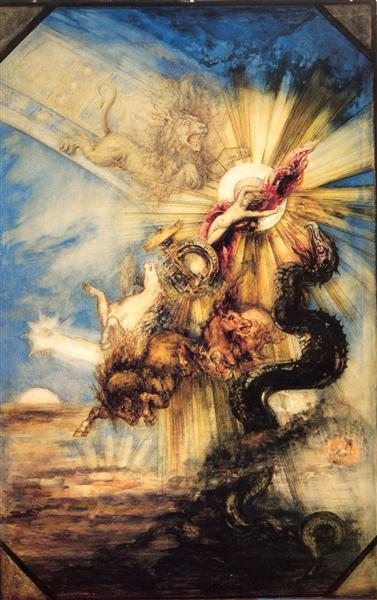
________ Mean-while the restless horses neigh’d aloud, Breathing out fire, and pawing where they stood. Tethys, not knowing what had past, gave way, And all the waste of Heav’n before ’em lay. who seems to have some sort of controlling force in the heavens, and concern for the regularity of its movements, though I haven’t yet figured out her specific purpose, position, in the scheme of things They spring together out, and swiftly bear The flying youth thro’ clouds and yielding air; They, the horses The flying youth, Phaeton With wingy speed outstrip the eastern wind, And leave the breezes of the morn behind. “ the eastern wind, Eurus , which you The youth was light, nor cou’d he fill the seat, Or poise the chariot with its wonted weight: wonted, usual, the chariot is lighter now that only Phaeton’s lesser weight is in it rather than that of his heavier father poise, superb word here suggestive of the delicacy, the precariousness, of the operation, not to mention its grace But as at sea th’ unballass’d vessel rides, unballass’d, without ballast,unstable, destabilized Cast to and fro, the sport of winds and tides; So in the bounding chariot toss’d on high, The youth is hurry’d headlong through the sky. Soon as the steeds perceive it, they forsake Their stated course, and leave the beaten track. The youth was in a maze, you can hear the etymology of amaze here, was in a maze, caught up in a conundrum, completely disoriented nor did he know Which way to turn the reins, or where to go; Nor wou’d the horses, had he known, obey. had he known, Phaeton didn’t know,as his father would have, his horses Then the sev’n stars first felt Apollo’s ray, And wish’d to dip in the forbidden sea. the sev’n stars, the Pleiades , a star cluster , closest to the earth, would resort to the coolness of the sea, supposedly, upon being subjected to the heat of Apollo’s ray, or rays forbidden, probably forbidding The folded serpent next the frozen pole, Stiff and benum’d before, began to rowle, The folded serpent, the constellation And raged with inward heat, and threaten’d war, And shot a redder light from ev’ry star; a redder light, the brightest star, constellation Serpens , is called greater understanding of the cosmos, call such stars red giant s because of a distinctive ring they present around their core for reasons of thermodynamics, Ovid is using this cosmic peculiarity here for his own poetic purposes Nay, and ’tis said Bootes too, that fain Thou woud’st have fled, tho’ cumber’d with thy wane. constellation, like Serpens , in the northern sky
cumbered, encumbered
wane, to lose its vigour Th’ unhappy youth then, bending down his head, Saw Earth and Ocean far beneath him spread. His colour chang’d, he startled at the sight, And his eyes darken’d by too great a light. darken’d, blinded, by too great a light Now cou’d he wish the fiery steeds untry’d, untry’d, o, that he had not attempted totake on the fiery steeds, Phaeton rues, nor to have ridden at all the Chariot of the Sun His birth obscure, and his request deny’d: had Phaeton only left [h]is birth obscure, not demanded to know who his father was, and been denied, been deny’d , this horrifying proof of it would not be now so threatening Now wou’d he Merops for his father own, stepfather, Phaeton would now willingly accept, own, Merops as his father, and give up his claim to being son of the Sun god And quit his boasted kindred to the sun. kindred, originating from the same family,spirit So fares the pilot, when his ship is tost In troubled seas, and all its steerage lost, He gives her to the winds, and in despair Seeks his last refuge in the Gods and pray’r.
after a lifetime’s consideration, I’ve determined there are only two things one can do when confronted with a dire situation, pray for grace, and
make sure your tie’s on right’s stepfather Phaeton , one extrapolates, is doing at least one of these two things, the rest being up to the Gods, his last refuge stay tuned R ! chard
 Richibi's Weblog