Richibi’s Weblog

Just another WordPress.com weblog

Tag: synesthesia

“The Story of Narcissus” (lll) – Ovid

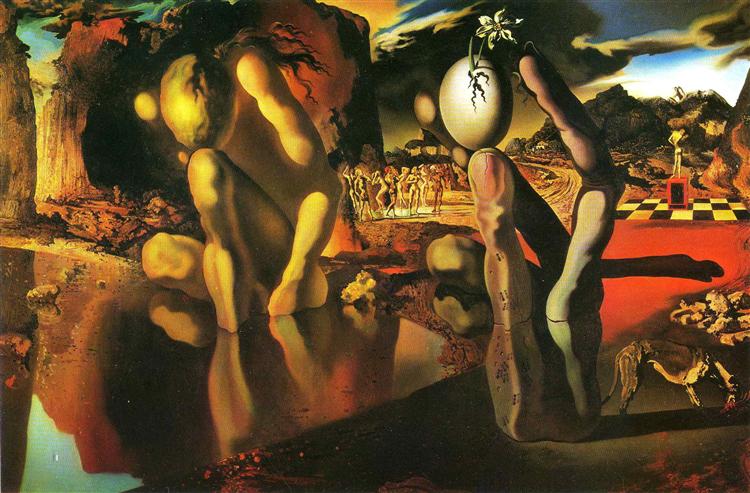
The Metamorphosis of Narcissus, 1937 - Salvador Dali


         The Metamorphosis of Narcissus” (1937)


                   Salvador Dali


                            _____


              This said, the weeping youth again return’d

              To the clear fountain, 


This said, you’ll remember that Narcissus

had pondered suicide, but was afraid that

such an act would also have an impact on

his reflection


                                          where again he burn’d;


burn’d, from the unusual fire that kindled
his breast


                His tears defac’d the surface of the well,

                With circle after circle, as they fell:


disfiguring reverberations in the water

from the tears


               And now the lovely face but half appears,
               O’er-run with wrinkles, and deform’d with tears.
               “Ah whither,” cries Narcissus, “dost thou fly?
               Let me still feed the flame by which I die;


the flame by which I die, the fire which

burns in his chest


              Let me still see, tho’ I’m no further blest.”


Narcissus will not willingly forego the

sight of his reflection though it will

manifestly not at all still his desire,

nor quell his fate


              Then rends his garment off, and beats his breast:
              His naked bosom redden’d with the blow,
              In such a blush as purple clusters show,
              Ere yet the sun’s autumnal heats refine
              Their sprightly juice, and mellow it to wine.


bruises the colour of wine blush in

purple clusters on his chest where

Narcissus has struck himself

repeatedly


              The glowing beauties of his breast he spies,
              And with a new redoubled passion dies.


The glowing beauties, the throbbing

discolorations left by the redoubled

blows


              As wax dissolves, as ice begins to run,
              And trickle into drops before the sun;
              So melts the youth, and languishes away,
              His beauty withers, and his limbs decay;
              And none of those attractive charms remain,
              To which the slighted Echo su’d in vain.


slighted, rebuffed


Echo, the nymph who’d pursued him,

in vain, if you’ll remember


su’d, sued, implored


              She saw him in his present misery,
              Whom, spight of all her wrongs, she griev’d to see.


spight, in spite


              She answer’d sadly to the lover’s moan,
              Sigh’d back his sighs, and groan’d to ev’ry groan:
              “Ah youth! belov’d in vain,” Narcissus cries;


to his reflection


              “Ah youth! belov’d in vain,” the nymph replies.


Echo can only echo


              “Farewel,” says he; the parting sound scarce fell
              From his faint lips, but she reply’d, “farewel.”


Narcissus, interestingly, is reproduced

not only visually in the water by his

own reflection, but audibly as well by

Echo‘s reverberating sounds


see above

              Then on th’ wholsome earth he gasping lyes,
              ‘Till death shuts up those self-admiring eyes.
              To the cold shades his flitting ghost retires,
              And in the Stygian waves it self admires.


Stygian, of the river Styx, which forms

the boundary between Earth and the

Underworld

              For him the Naiads and the Dryads mourn,


Naiads, water nymphs


Dryadstree nymphs


              Whom the sad Echo answers in her turn;


Echo also mourns


              And now the sister-nymphs prepare his urn:
              When, looking for his corps, they only found
              A rising stalk, with yellow blossoms crown’d.


corps, corpse, dead body


rising stalk, with yellow blossoms

crown’d, the narcissus, the flower


R ! chard

“The Carnival of the Animals” – Saint-Saëns/Nash/Disney

in the same spirit of “music as literature” as in
Liszt’s Années de pèlerinage“, or Mussorgsky‘s
Pictures at an Exhibition especially, Camille
Saint-Saëns, composed his Le carnaval des
through an anthropomorphised menagerie 
where the description is impressionistic rather
than narrative, which is to say more painterly
 
he composes in patches of musical textures
instead of melodic and linear paragraphs,
incompatible with the original association
of music as melody, or song, one’s response
would become thereby more intellectual
than emotional, one does not swoon, or
even sway, in other words, as marvel at the
synesthetic imagination, which lets you see
sounds and hear pictures
 
you’ll hear here, or “hear, hear”, the turtles
doing their determined interpretation of the 
can-can, at an improbable crawl, in playful
reference to Offenbach‘s “Galop infernal”,
mad gallop, from his Orpheus in the  
Underworld, other such instances of 
compositional salutations follow, not at
all an unusual practice among composers,
great and small 
 
you’ll be enchanted by the shimmering
ethereality of the aquarium, by the grace
and majesty of the now mythic swan,
among other zoological bedazzlements, 
in 14 movements, in therefore essentially
a symphony, a piece for orchestra with
several movements
 
here they are        
I.      Introduction et marche royale du Lion
               (Introduction and Royal March of the Lion)
II.     Poules et Coqs 
               (Hens and Cocks)
III.    Hémiones (animaux véloces) 
               (Wild Asses)
IV.   Tortues
                (Tortoises)
V.     L’Éléphant 
                (The Elephant)
VI.    Kangourous 
                (Kangaroos)
VII.   Aquarium
VIII.  Personnages à longues oreilles
                (Personages with Long Ears)
IX.    Le coucou au fond des bois 
                (The Cuckoo in the Depths of the Woods)
X.     Volière
                (Aviary)
XI.    Pianistes
                (Pianists)
XII.   Fossiles
                (Fossils)
XIII.  Le Cygne
                (The Swan)
XIV.  Finale
 
 
you’ll want to read the poems that Ogden 
Nash later wrote about them, his very own
Carnival of the Animals“, that now often
accompany the piece, a mistake, I find, for
exposing two entirely idiosyncratic and 
incompatible sensibilities opposite each
other, thereby taking away from each 
 
but Walt Disney has, and you will too have,
a great deal of fun nevertheless with both
of them, though they’re somewhat in his
version abridged, no swan 
 
 
Richard